Antibiotic treatment also affects the intestinal fungal microbiota
Published in Microbiology
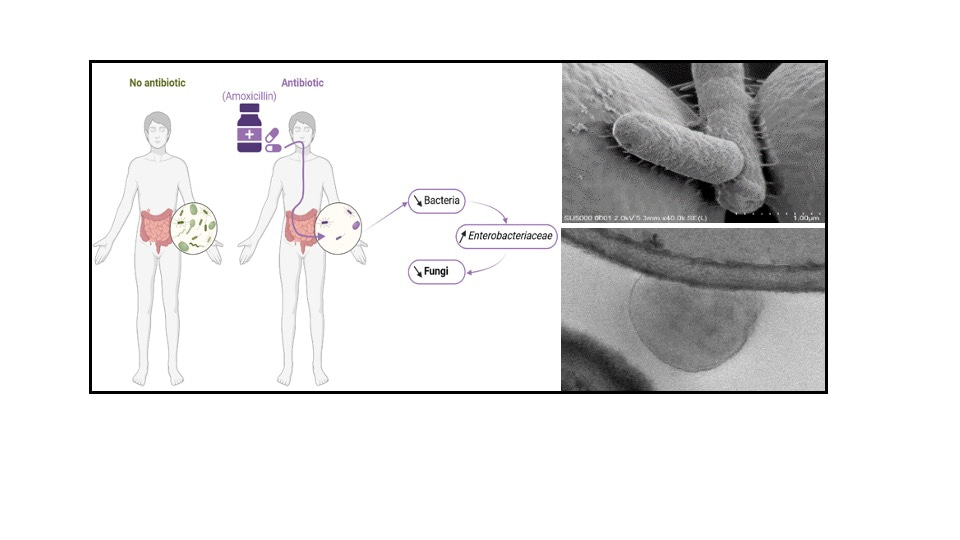


In our study, we were surprised to find that treatment with amoxicillin and clavulanic acid (Augmentin), a treatment regularly prescribed by doctors, also reduced the fungal population in the intestine in an in vivo mouse model.
The study of the effect of these antibiotics on the fungal and bacterial intestinal microbiota allowed us to show that there was a massive modification of the bacterial microbiota and in particular an increase in amoxicillin-resistant populations, including enterobacteria. In vitro analyses of strains isolated from these microbiotas after treatment with this cocktail of antibiotics allowed us to identify a strain of bacteria partly responsible for the fall in the fungal population: Enterobacter hormaechei. Indeed, E. hormaechei is able in vitro in co-culture and in vivo after gavage in mice to decrease the amount of fungi. To date, the mechanisms explaining these effects are not completely understood. We have been able to show a slight competition effect around the nutrients useful to the fungi to grow but not strong enough to explain the observed effect. On the other hand, we have also demonstrated a clear physical interaction between the cells of the fungi and the bacteria after specific co-culture of this bacterium using scanning microscopy images.
This study allowed us to show that the effect of a treatment with antibiotics has different effects on the fungal population depending on the type of antibiotic. We have also identified a new bacterial strain capable of having a negative effect on the growth of fungi in a complex context of the intestinal microbiota. The continuation of our research work will allow us to elucidate the mechanisms of action of this bacterium on fungi and to progress in our understanding of the interaction between these 2 microbiotas.
Article: https://doi.org/10.1186/s40168-023-01516-y
Video: https://youtu.be/UqlwxRJx5jE

Follow the Topic
-
Microbiome
This journal hopes to integrate researchers with common scientific objectives across a broad cross-section of sub-disciplines within microbial ecology. It covers studies of microbiomes colonizing humans, animals, plants or the environment, both built and natural or manipulated, as in agriculture.

Related Collections
With Collections, you can get published faster and increase your visibility.
Oncobiome
This collection of papers delves into the burgeoning field of oncobiome research, exploring the intricate relationship between cancer and the microbiome. The oncobiome encompasses the diverse microbial communities residing in and on the human body, which influence cancer development, progression, and treatment responses. By examining these interactions, our aim is to unravel the complex mechanisms through which the microbiome impacts oncogenesis and therapeutic outcomes.
This compilation highlights cutting-edge research, offering insights into potential diagnostic markers and novel therapeutic strategies, thereby advancing our understanding of cancer biology and paving the way for innovative, microbiome-targeted cancer treatments.
This is a cross-journal collection between:
Experimental Hematology and Oncology
Articles will undergo the standard peer-review process of the journal to which they are submitted and are subject to either the BMC editorial policies or those of BJC Reports. Articles will be added to the Collection as they are published. The Editors have no competing interests with the submissions which they handle through the peer review process. The peer review of any submissions for which the Editors have competing interests is handled by another Editorial Board Member who has no competing interests.
Publishing Model: Open Access
Deadline: Ongoing
Microbiome and Reproductive Health
Microbiome is calling for submissions to our Collection on Microbiome and Reproductive Health.
Our understanding of the intricate relationship between the microbiome and reproductive health holds profound translational implications for fertility, pregnancy, and reproductive disorders. To truly advance this field, it is essential to move beyond descriptive and associative studies and focus on mechanistic research that uncovers the functional underpinnings of the host–microbiome interface. Such studies can reveal how microbial communities influence reproductive physiology, including hormonal regulation, immune responses, and overall reproductive health.
Recent advances have highlighted the role of specific bacterial populations in both male and female fertility, as well as their impact on pregnancy outcomes. For example, the vaginal microbiome has been linked to preterm birth, while emerging evidence suggests that gut microbiota may modulate reproductive hormone levels. These insights underscore the need for research that explores how and why these microbial influences occur.
Looking ahead, the potential for breakthroughs is immense. Mechanistic studies have the power to drive the development of microbiome-based therapies that address infertility, improve pregnancy outcomes, and reduce the risk of reproductive diseases. Incorporating microbiome analysis into reproductive health assessments could transform clinical practice and, by deepening our understanding of host–microbiome mechanisms, lay the groundwork for personalized medicine in gynecology and obstetrics.
We invite researchers to contribute to this Special Collection on Microbiome and Reproductive Health. Submissions should emphasize functional and mechanistic insights into the host–microbiome relationship. Topics of interest include, but are not limited to:
- Microbiome and infertility
- Vaginal microbiome and pregnancy outcomes
- Gut microbiota and reproductive hormones
- Microbial influences on menstrual health
- Live biotherapeutics and reproductive health interventions
- Microbiome alterations as drivers of reproductive disorders
- Environmental factors shaping the microbiome
- Intergenerational microbiome transmission
This Collection supports and amplifies research related to SDG 3, Good Health and Well-Being.
All submissions in this collection undergo the journal’s standard peer review process. As an open access publication, this journal levies an article processing fee (details here). We recognize that many key stakeholders may not have access to such resources and are committed to supporting participation in this issue wherever resources are a barrier. For more information about what support may be available, please visit OA funding and support, or email OAfundingpolicy@springernature.com or the Editor-in-Chief.
Publishing Model: Open Access
Deadline: Oct 31, 2026