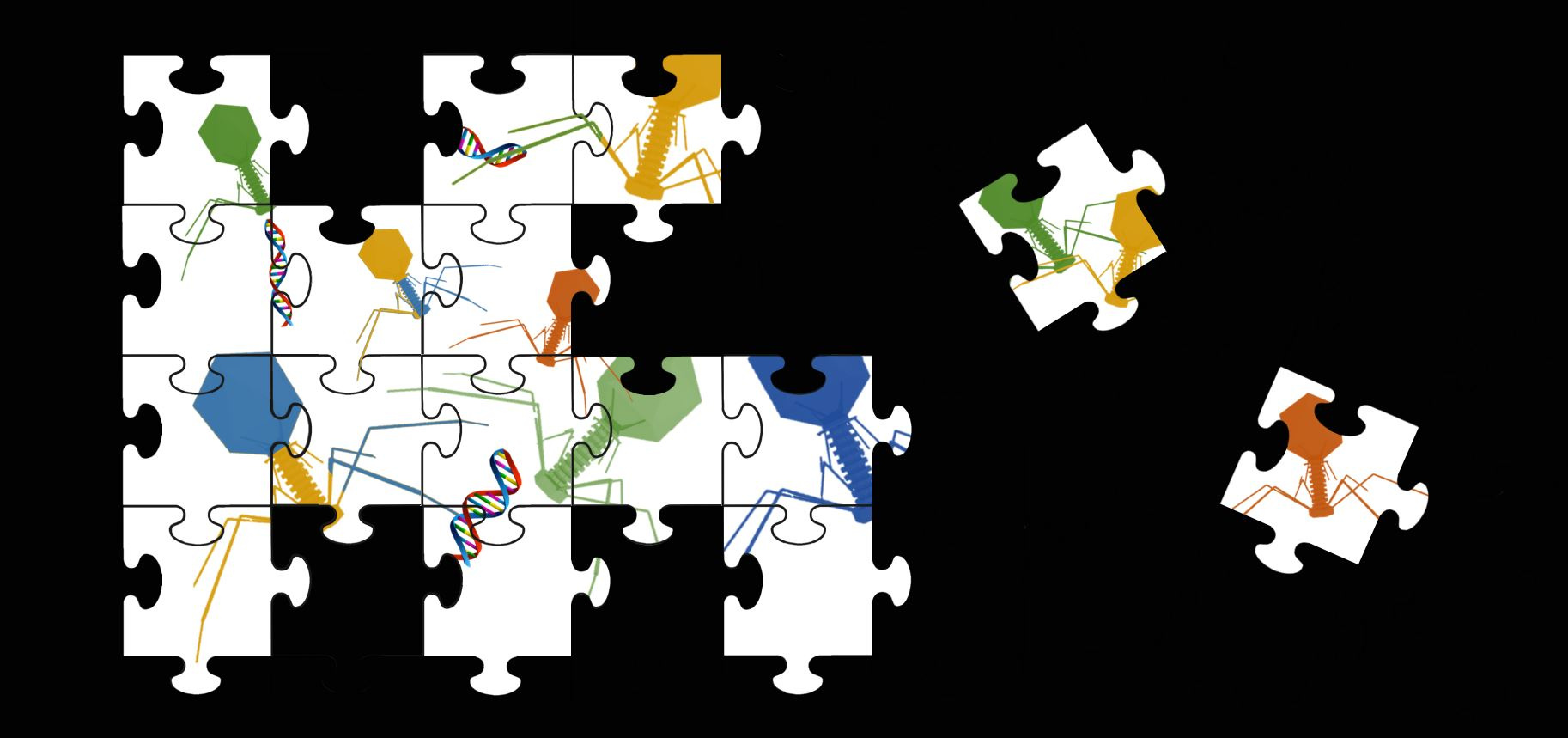




The human gut virome consists primarily of bacteriophage which may both play a crucial role in regulating and shaping microbial communities of the gut and facilitate horizontal gene transfer and microbial evolution. With 90% of viral sequencing reads sharing little to no homology to reference databases, the make-up of these viral communities also represents one of the biggest gaps in our understanding of the human microbiome. As the hosts of the majority of these viruses are also unknown, the virome research community relies heavily on sequencing and computational approaches.
When we developed our virome analysis pipeline we realised that if we were to make sense of this unknown majority we would need to move towards In silico methods and away from database dependent approaches. Our first port of call was a crucial stage in all reference-independent pipelines, the assembly step, at which short sequence reads are used to recreate the genome sequences of community members. Looking at previous studies we realised that there was no single assembly method used across all virome studies, nor had there been an extensive assembly comparison dedicated to the virome, which led us to this study.
Metagenomic assembly, or reconstructing the genome sequences of community members, is a common but challenging computational task due to the complexity of microbial communities and large amounts of sequencing data required to represent them in a meaningful way. Unfortunately for virome scientists, assembly challenges of viromes are more difficult – perhaps even by orders of magnitude. The ability of the assembler to overcome these challenges is of significant importance to a virome analysis pipeline, which is essentially built around this crucial step.
By testing 16 assembly approaches on a combination of 4 different virome datasets including both synthetic and human viromes, we observed significant variation in assemblers’ ability to overcome assembly challenges. Most assemblers failed to properly reconstruct phage genomes that we knew to be there, which was a worrying outcome. In most cases the assemblers resulted in only small proportions of the genomes being recovered and assemblies being short and fragmented. These findings have serious implications for virome analysis pipelines, as not only does the choice of assembly program used in a study directly impact which members of a viral community can be recovered, but certain viral genomes appear to challenge all current assembly approaches. We observed that extremes in abundance were responsible for aspects of poor assembly, as were the proportion of genomic repeat regions in each community member. However, these challenges did not explain the full variation in poor genome recovery, highlighting a continued need to improve and develop virome analysis approaches as well was important considerations when setting downstream analysis parameters and making final conclusions.

Follow the Topic
-
Microbiome
This journal hopes to integrate researchers with common scientific objectives across a broad cross-section of sub-disciplines within microbial ecology. It covers studies of microbiomes colonizing humans, animals, plants or the environment, both built and natural or manipulated, as in agriculture.

Related Collections
With Collections, you can get published faster and increase your visibility.
Oncobiome
This collection of papers delves into the burgeoning field of oncobiome research, exploring the intricate relationship between cancer and the microbiome. The oncobiome encompasses the diverse microbial communities residing in and on the human body, which influence cancer development, progression, and treatment responses. By examining these interactions, our aim is to unravel the complex mechanisms through which the microbiome impacts oncogenesis and therapeutic outcomes.
This compilation highlights cutting-edge research, offering insights into potential diagnostic markers and novel therapeutic strategies, thereby advancing our understanding of cancer biology and paving the way for innovative, microbiome-targeted cancer treatments.
This is a cross-journal collection between:
Experimental Hematology and Oncology
Articles will undergo the standard peer-review process of the journal to which they are submitted and are subject to either the BMC editorial policies or those of BJC Reports. Articles will be added to the Collection as they are published. The Editors have no competing interests with the submissions which they handle through the peer review process. The peer review of any submissions for which the Editors have competing interests is handled by another Editorial Board Member who has no competing interests.
Publishing Model: Open Access
Deadline: Ongoing
The Apple Microbiome
Microbiome and Environmental Microbiome are calling for submissions to our Collection on the Apple Microbiome.
With world apple production estimated at 84 million tons, the microbiome of the apple has significant implications for agriculture, food security, and human health. Understanding the complex interactions between apple plants and their associated microbial communities can lead to improved crop management strategies, enhanced fruit quality and longevity, and sustainable agricultural practices. Recent advances have highlighted the role of specific bacteria and fungi in promoting plant health and resilience against specific pathogens. Moreover, detailed profiling of these microbial communities, revealing their diversity and functional potential facilitate exciting future developments, such as the identification of beneficial microbial consortia for biocontrol and the formulation of tailored probiotic treatments for both plants and humans. By advancing our collective understanding in this area, we can work towards a more sustainable and resilient agricultural system.
Topics of interest include but are not limited to:
-Microbial diversity and function associated with apples
-Effects of soil health and rhizosphere interactions on apple production
-Impact of climate change on the apple microbiome
-Role of the apple microbiome in fruit quality
-Microbiome-driven strategies for disease resistance
This collection is open for submissions from all authors on the condition that the manuscript falls within both the scope of the collection and the journal it is submitted to.
All submissions in this collection undergo the relevant journal’s standard peer review process. Similarly, all manuscripts authored by a Guest Editor(s) will be handled by the Editor-in-Chief of the relevant journal. As an open access publication, participating journals levy an article processing fee (Microbiome, Environmental Microbiome). We recognize that many key stakeholders may not have access to such resources and are committed to supporting participation in this issue wherever resources are a barrier. For more information about what support may be available, please visit OA funding and support, or email OAfundingpolicy@springernature.com or the Editor-in-Chief of the journal where the article is being submitted.
Publishing Model: Open Access
Deadline: Sep 30, 2026