Bangladesh is preparing to build one of the largest river engineering projects in its history — a US $4.1 billion barrage across the Padma River. Supporters see it as a long-awaited response to a decades-old water crisis. By storing and redistributing water during the dry season, the project aims to revive rivers in southwestern Bangladesh, reduce salinity intrusion, support irrigation and improve water security for millions of people.
The logic is easy to understand. Since the commissioning of India’s Farakka Barrage in 1975, dry-season flow in the Ganges-Padma system has fallen dramatically. Researchers have documented substantial reductions in average and minimum discharge reaching Bangladesh. As freshwater declined, salinity moved inland, rivers became shallower, fisheries deteriorated and agricultural productivity suffered across parts of Khulna, Jessore and Satkhira. The proposed Padma Barrage promises relief. Government planners expect it to improve irrigation, restore distributary rivers such as the Gorai-Madhumati system and secure water supplies for agriculture, industry and major infrastructure. In a country increasingly concerned about climate change and water security, such benefits are politically attractive.
But there is another side to the story. The debate surrounding the project has focused overwhelmingly on what the barrage might save. Much less attention has been given to what it might change. That omission is remarkable because the Padma is not simply a river. It is one of the principal arteries of the Bengal Delta, the largest active delta on Earth and one of the most dynamic landscapes in the world. The Bengal Delta exists because rivers constantly move, shift and rebuild the landscape. Every year enormous volumes of water and sediment flow from the Himalayas toward the Bay of Bengal. This process has created and sustained the delta for thousands of years. It continues today through erosion, deposition and channel migration.
|
|
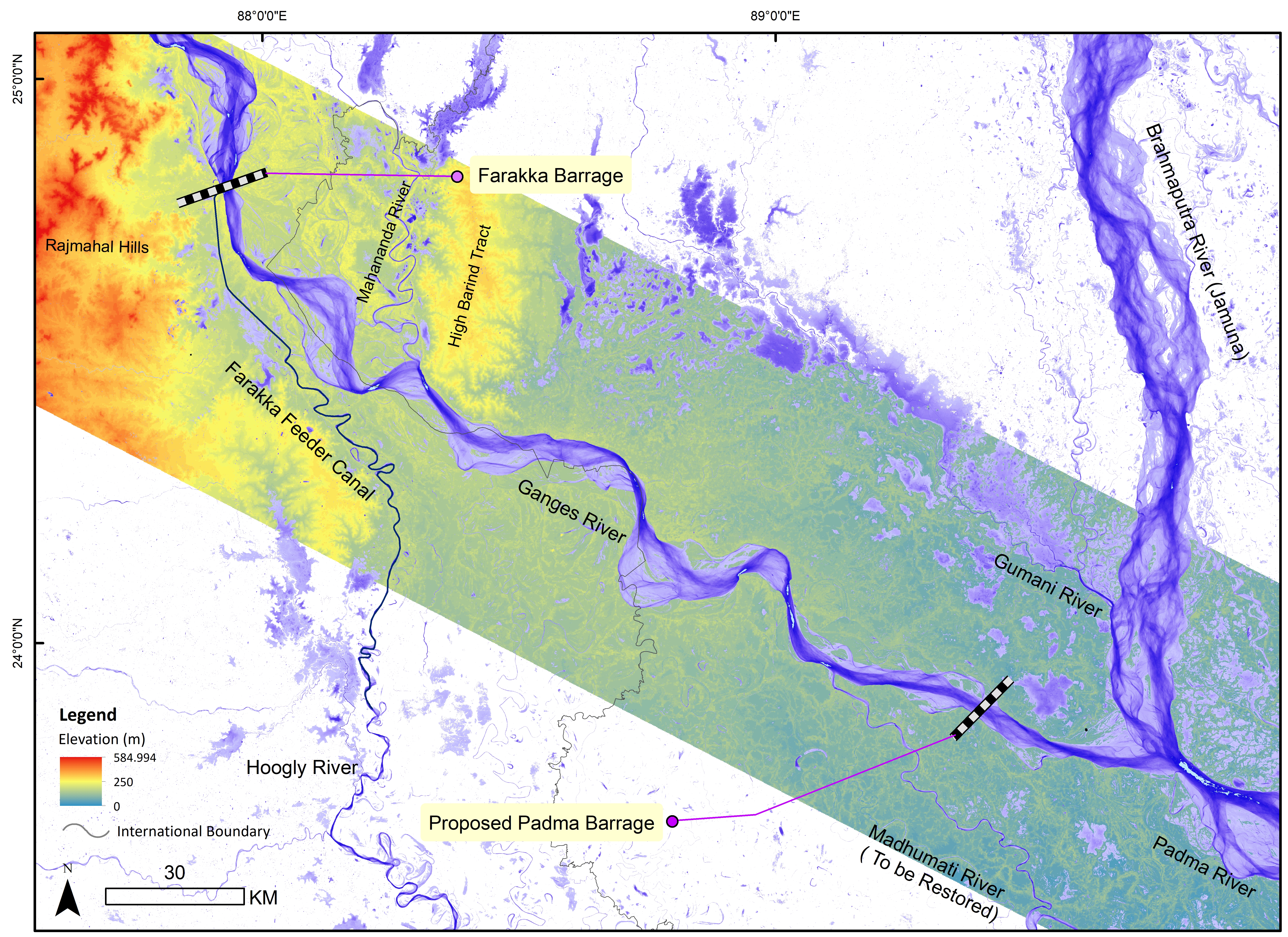
Topographic setting and major river systems surrounding the proposed Padma Barrage. The eastward basin gradient and the connectivity of the Padma–Brahmaputra–Meghna system suggest that alterations to flow distribution may influence sediment transport, distributary dynamics, channel migration, and future delta evolution across southern Bangladesh.
Solving one problem, creating another?
The experience of river barrages around the world offers a cautionary lesson. Large hydraulic structures often achieve their immediate objectives while generating unexpected environmental consequences elsewhere. Egypt’s Nile Delta, Pakistan’s lower Indus system and several major river basins in South Asia; all illustrate how altering river flow can reshape sediment transport, ecological processes and long-term landscape evolution.
Bangladesh already has its own example. The Farakka Barrage successfully helped India restore flow to the Hooghly River and improve navigability around Kolkata. But downstream in Bangladesh, the same project contributed to declining dry-season flow, increasing salinity and widespread environmental change. What appears beneficial from one location can create costs elsewhere within the same river system.
The project is designed largely to direct more water toward southwestern Bangladesh. If successful, regions currently suffering from water scarcity may receive substantial benefits. But rivers are connected systems. Increasing flow in one area often means reducing it somewhere else. The districts most likely to gain attention are those currently facing acute salinity and water shortages. The districts most likely to be overlooked are those that still depend on the existing flow regime of the lower Padma and its distributaries. Many rivers across Barisal, Madaripur, Gopalganj and surrounding regions depend on water supplied through the lower Padma network. If significant amounts of water are diverted or retained upstream, these areas could experience reduced freshwater availability. Over time, lower discharge may allow salinity to penetrate further inland, affecting agriculture, fisheries and drinking water supplies.
|
|
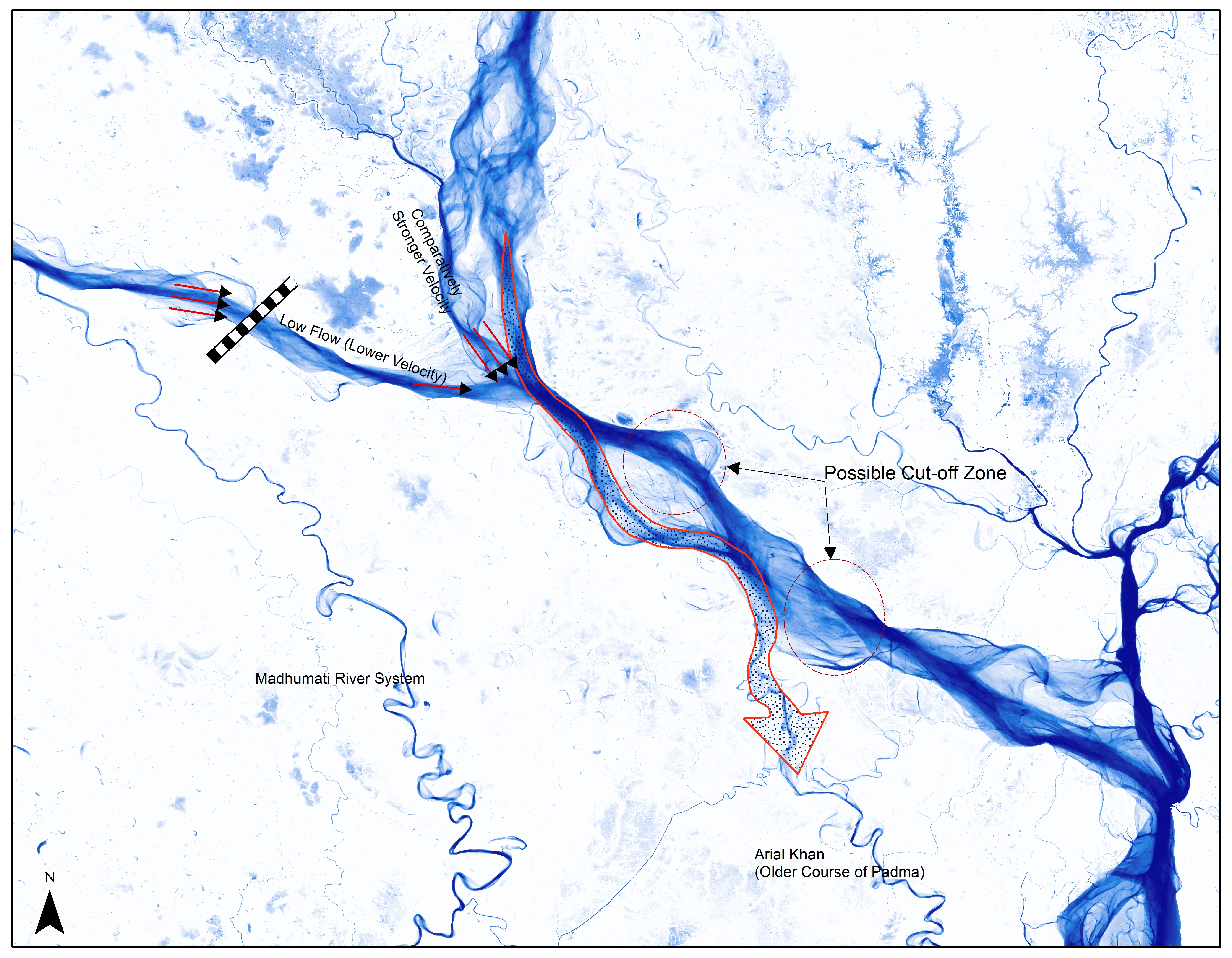
Conceptual illustration of a potential future avulsion pathway within the lower Padma–Brahmaputra system under altered hydraulic conditions associated with the proposed Padma Barrage. Reduced downstream discharge and flow velocity below the barrage may weaken the hydraulic dominance of the present Padma channel, while comparatively stronger flow from the Brahmaputra–Jamuna system could favour a more direct southward course toward the historical Arial Khan corridor.
The greatest uncertainty may lie not in the rivers that the barrage is intended to revive, but in the rivers it could unintentionally reshape. By reducing downstream velocity in the Padma, the barrage may alter the hydraulic balance that currently keeps the Brahmaputra-Jamuna aligned with its present course. Rivers naturally seek steeper and more efficient pathways, and Bengal's history is full of abrupt channel shifts. Before the 1787 avulsion, much of the flow of the lower Ganges-Padma system passed through the Arial Khan corridor. If flow energy in the downstream Padma weakens while the Brahmaputra retains greater momentum, the conditions could become more favorable for renewed channel adjustment toward this historical pathway. No one can say whether such a change would occur, but the possibility highlights a broader reality: large interventions in highly dynamic delta systems can trigger geomorphological responses that unfold over decades and extend far beyond the immediate project area.
A river that refuses to stay still
The concern extends beyond water allocation. The future of the Bengal Delta depends not only on water but also on sediment. Sediment is the raw material from which deltas are built. It raises land levels, nourishes floodplains and helps offset the combined pressures of subsidence and sea-level rise. Around the world, scientists have become increasingly concerned about sediment starvation in major deltas. When dams and barrages trap sediment upstream, downstream landscapes lose the material needed to maintain their elevation and stability.
The Bengal Delta faces exactly this challenge. Climate change and rising seas are already increasing pressure on low-lying coastal areas. If sediment delivery declines further, the long-term resilience of the delta may weaken. Supporters of the barrage argue that the Padma carries so much sediment that trapping a portion of it is unlikely to matter significantly. Perhaps they are right. But the question has not yet been answered with sufficient certainty to justify confidence. The geomorphology of the Ganges-Brahmaputra-Meghna system remains one of the most complex river systems on Earth.
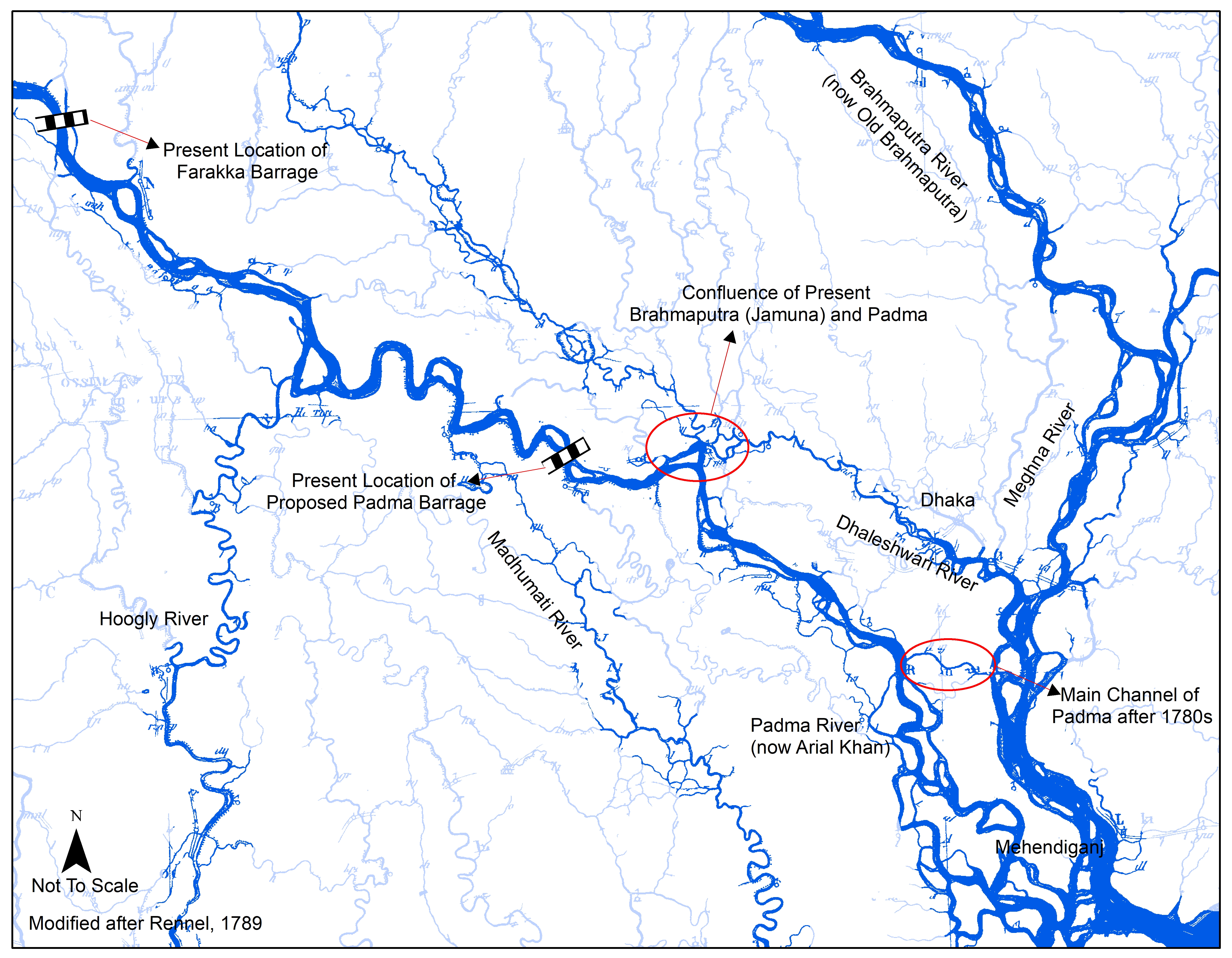
That complexity becomes even more important when considering the history of the Padma itself. The modern river network visible on maps today is only a snapshot in a much longer story. Over centuries and millennia, the main channels of the Ganges-Padma system have repeatedly shifted position across Bengal. Rivers that were once major waterways became minor channels. Other rivers expanded and captured flow. Entire regions were reshaped by channel migration and avulsion — the sudden relocation of a river into a new course. Historical maps reveal that before the late eighteenth century, the Padma followed a markedly different route through what is now the Arial Khan system. Earlier still, the Madhumati appears to have served as a major distributary of the Ganges-Padma network. These historical shifts are not merely curiosities. They demonstrate that the delta is fundamentally dynamic. River channels respond to changing gradients, sediment loads and hydraulic conditions. Human interventions can influence these processes in ways that are difficult to predict.
This raises an uncomfortable possibility that if the barrage substantially alters the hydraulic balance between the Padma and Brahmaputra systems, it could influence future channel behaviour. No one can confidently predict such outcomes. But geomorphologists understand that river systems sometimes respond to altered conditions through gradual adjustment and, occasionally, through dramatic reorganization. Even small changes in flow distribution can accumulate over decades. The consequences may not become visible during the early years of a project. By the time major channel adjustments emerge, they may be difficult or impossible to reverse.
 |
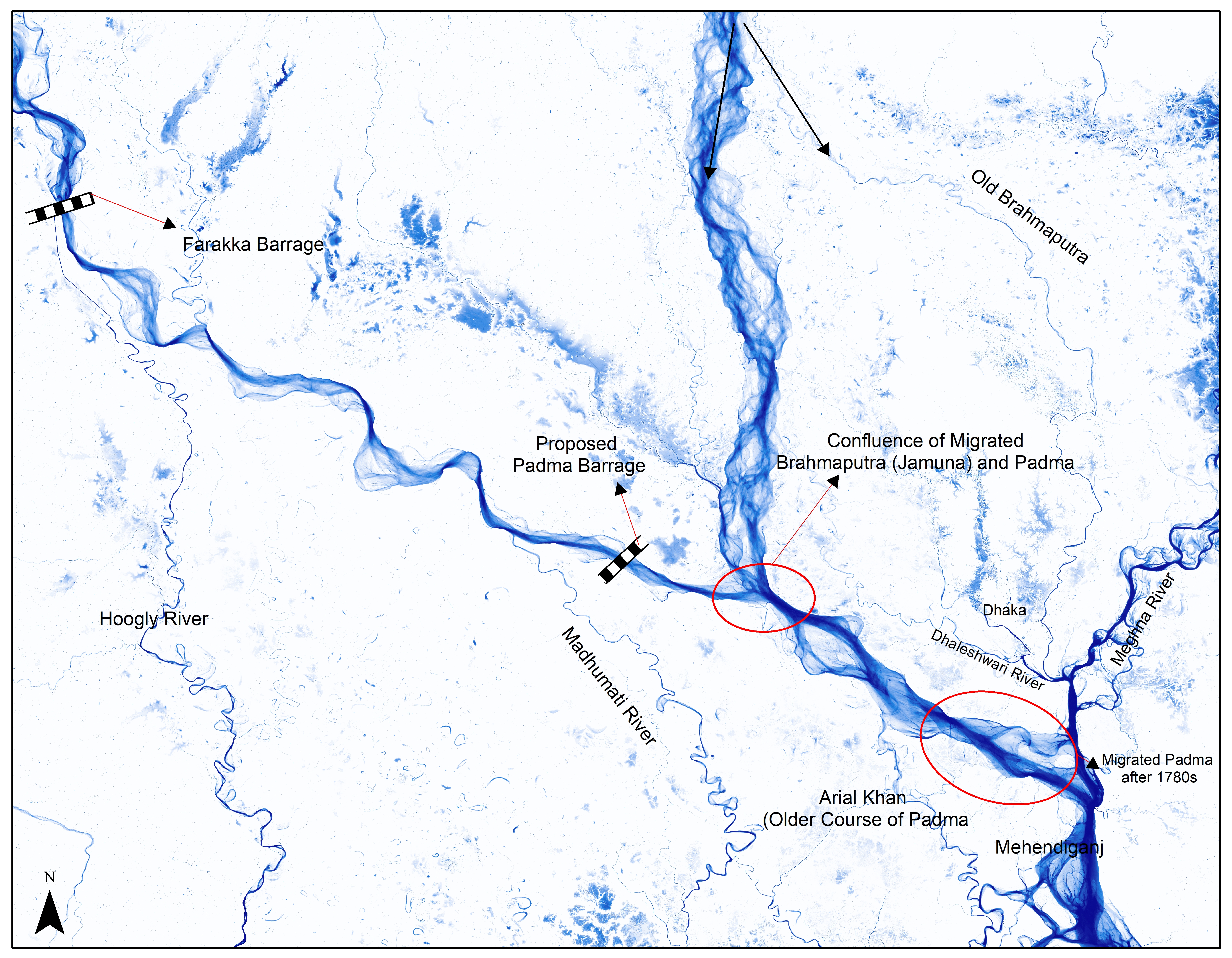 |
Historical evolution of the lower GBM river system and the location of the proposed Padma Barrage. (a) Major river channels and confluences prior to the 1787 avulsion, reconstructed from Rennell’s Bengal Atlas, showing the former course of the Padma through the Arial Khan system. (b) Present-day river configuration following major channel migrations and avulsions over the last two centuries.
Engineering uncertainty in a changing climate
The challenge is not that catastrophe is inevitable. The challenge is that confidence often exceeds knowledge. Public discussion of the Padma Barrage has largely framed the project as a technical solution to a technical problem. Yet the project is also an experiment in managing one of the world’s most dynamic delta systems.
The uncertainty is amplified by developments beyond Bangladesh’s borders. More than 90 per cent of Bangladesh’s river water originates outside the country. Future flow in the Padma will depend not only on domestic decisions but also on upstream developments across the Ganges, Teesta and Brahmaputra basins. India continues expanding irrigation, diversion and hydropower infrastructure across several transboundary river systems. Since the Farakka Barrage became operational in 1975, average dry-season flow reaching Bangladesh through the Ganges-Padma system has fallen by almost half, while minimum flows have declined by more than 70 per cent. These reductions have contributed to worsening salinity intrusion, shrinking distributary rivers and increasing pressure on agriculture and freshwater ecosystems in southwestern Bangladesh. China is pursuing large hydropower projects on the upper Brahmaputra. Climate change is altering precipitation patterns and glacier dynamics throughout the Himalayas. These factors mean that future river conditions may differ substantially from those assumed in current planning models.
This reality sits uneasily alongside Bangladesh’s Delta Plan 2100, which emphasises adaptive management, climate resilience and working with natural processes. The plan recognises that uncertainty is unavoidable in delta environments. Its philosophy is built around flexibility and adaptation rather than rigid control. The proposed barrage appears to move in the opposite direction. It represents a large, fixed intervention in a river system whose future behaviour is increasingly uncertain.
Before Bangladesh commits $4.1 billion
That does not necessarily mean the project should be abandoned. Bangladesh faces genuine water challenges and requires ambitious solutions. But it does suggest that the project deserves a broader national conversation than it has received so far.
The key question is not whether the barrage will produce benefits. It almost certainly will. The real question is whether those benefits justify the risks and whether alternative approaches could achieve similar outcomes with fewer long-term consequences. Bangladesh has other options available. Greater investment in rainwater harvesting, freshwater storage, managed aquifer recharge and local water retention systems could improve water security without dramatically altering the flow of the country’s largest river. Smaller and more flexible interventions may lack the political appeal of a megaproject, but they often provide greater resilience in uncertain environments.
The country also needs a more transparent assessment of cumulative impacts. Too often, major infrastructure projects are evaluated in isolation. Yet the future of the Bengal Delta will be shaped by the combined influence of upstream dams, barrages, climate change, sea-level rise, sediment dynamics and domestic water management decisions.
Bangladesh’s policymakers face a difficult choice. They are attempting to solve a real and pressing problem created partly by upstream water diversion and partly by the growing pressures of climate change. Doing nothing is not an option. But neither is assuming that a large engineering structure can simply restore a river system to its former condition. The Bengal Delta has never been static. Its rivers have spent thousands of years reshaping the landscape. The question facing Bangladesh is whether the country can guide those processes without disrupting the very dynamics that make the delta sustainable. The proposed barrage may help rescue parts of a drying southwest. It may also alter the hydrological and geomorphological balance of the wider delta in ways that only become visible decades later. For a project of this scale, uncertainty is not a reason to stop thinking. It is a reason to think much harder.

Follow the Topic
What are SDG Topics?
An introduction to Sustainable Development Goals (SDGs) Topics and their role in highlighting sustainable development research.
Continue reading announcement


