Behavioural Drivers of Village Savings and Loan Association Participation for Social Protection in Small-Scale Fishing Communities
Published in Research Data, Sustainability, and Agricultural & Food Science





When Saving Is More Than Money: Understanding the Behavioural Drivers Behind Fisherfolk Participation in VSLAs
There is a quiet paradox at the heart of small-scale fishing communities in Ghana. These communities feed nations, sustain local economies, and carry generations of ecological knowledge. Yet, many of the people at the center of this system live with deep financial insecurities. Formal safety nets are thin, and when shocks come—a poor catch, illness, or damaged gear—there are few buffers to fall back on. This reality is what drew me to study Village Savings and Loan Associations (VSLAs) as a form of social protection. VSLAs are easy to understand: people in the community save money together, lend money to each other, and build a shared financial cushion. In practice, they can be transformative. And yet, despite their promise, participation among small-scale fishers remains surprisingly low. That gap between potential and reality became the central puzzle of my research.
The Question That Changed the Study
At first glance, the explanation for low participation seems obvious: poverty, low education, or lack of access. But the more time I spent in fishing communities, the more it became clear that these explanations were incomplete. People were aware of VSLAs. Some had even tried them. Others had watched neighbours succeed. So why hesitate?
This question led me beyond traditional economic explanations into the terrain of human behaviour regarding how people think, feel, and make decisions under uncertainty. Using an extended Theory of Planned Behaviour, I explored how attitudes, subjective influence, and a perceived behavioural control interact with perceived benefits and barriers to shape participation decisions. What emerged was not just a model but a story that is deeply human.
What the Data Revealed and What It Meant
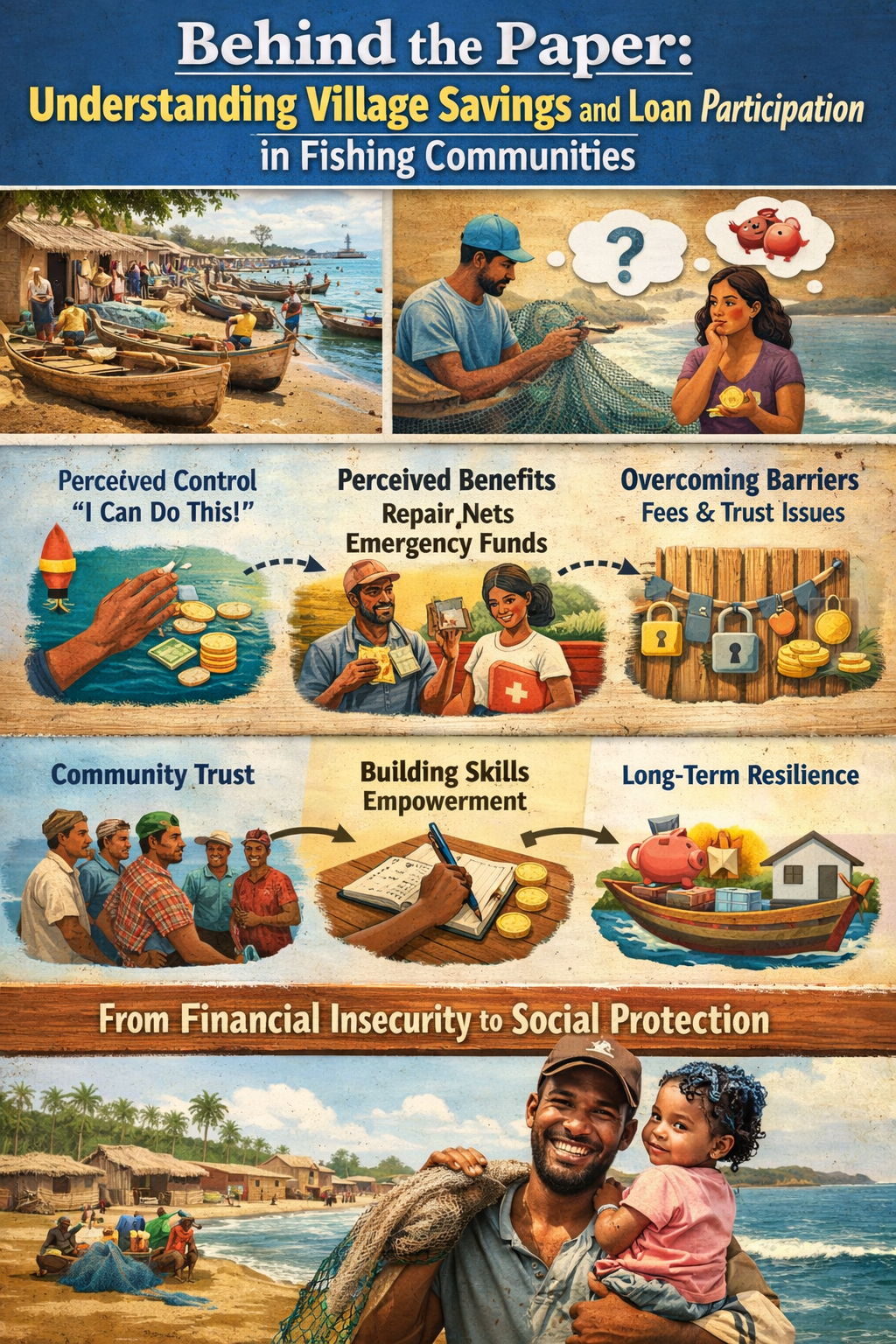
One of the most striking findings was this: perceived behavioural control that captured the feeling that “I can actually do this” was the strongest driver of participation.
This may sound intuitive, but its implications are profound. In many fishing communities, income is unpredictable. A successful catch today does not guarantee tomorrow’s earnings. In such a context, committing to regular savings, even small amounts, can feel risky. Participation is not just about willingness; it is about confidence in one’s ability to follow through.
Closely tied to this issue was the role of perceived benefits. When fishers clearly understood how VSLAs could help them repair nets, smooth income gaps, and handle emergencies, their attitudes improved, and social support around them strengthened.
But perhaps the most unexpected insight came from what we typically think of as obstacles.
When Barriers Don’t Discourage but Motivate
Conventional wisdom suggests that barriers such as fees, distrust, and time constraints are critical factors that discourage participation. However, the data from this study revealed a more nuanced narrative.
In this study, perceived barriers were positively associated with both attitudes and perceived control.
At first, this seemed counterintuitive. But field experiences helped make sense of it. In many conversations, fishers who raised concerns about VSLAs were not rejecting them. They were engaging seriously with the idea. They were asking, "Is this worth it?" Can I manage it? What happens if something goes wrong?
In other words, barriers were not always deterrents. They were part of a deeper evaluation process, a form of what we came to think of as motivational tension. When the perceived benefits were strong enough, these challenges did not push people away. Instead, they sharpened commitment.
This insight reframes how we think about policy design. Rather than ignoring or minimizing barriers, there is value in acknowledging them openly and working through them with communities.
The Human Side of the Model
Behind every data point in this study is a lived experience. I recall one fisher who described how a previous financial scheme collapsed due to mistrust among members. His hesitation toward VSLAs was not about the concept; it was about trust.
Another participant spoke about the pride of contributing, even in small amounts, to a group that could support others in times of need. For her, participation was not just financial, but it was also social, even moral.
These stories highlight something. The model also confirms that decisions in these communities are not purely individual but are deeply social. Subjective norms, what family, peers, and respected community members think, play a meaningful role in shaping intentions.
What This Means for Policy and Practice
The implications of these findings are both practical and urgent.
First, awareness campaigns are not enough. Simply telling people that VSLAs exist will not drive participation. What matters is making the benefits tangible, showing how they work in real life through relatable examples.
Second, interventions must focus on building capability, not just interest. If people do not feel they can participate successfully, they will not try. This means simplifying processes, aligning meeting times with fishing schedules, and embedding practical financial literacy into programs.
Third, social influence must be grounded in trust. In these communities, respected fishermen, fishmongers, canoe owners, and peers often carry more influence than external officials. Engaging these actors as champions can make a decisive difference.
Finally, barriers should not be treated as problems to hide but as opportunities to engage. Collaborative problem-solving, what I describe as "participatory barrier mitigation," can strengthen both trust and ownership.
Where This Research Leads Next
While this study provides strong explanatory power, accounting for a substantial share of variation in participation intentions, it also opens new questions.
How do these intentions translate into sustained participation over time?
How do group dynamics evolve within VSLAs?
And how might these behavioural insights apply to other forms of financial inclusion across Africa?
Future research, particularly longitudinal and qualitative work, will be essential to deepen this understanding.
Final Reflection
At its core, this research is about more than savings groups. It is about how people navigate uncertainty, weigh risks, and build resilience in contexts where formal systems often fall short.
What we learn from small-scale fishing communities is both specific to Ghana and beyond. Effective social protection is not only about providing resources; it is about understanding people.
Sometimes, the most significant change lies not in the policy itself, but in our perception of the individuals it aims to serve.

Follow the Topic
-
Discover Sustainability
A multi-disciplinary, open access, community-focussed journal publishing results from across all fields relevant to sustainability research whilst supporting policy developments that address all 17 of the United Nations Sustainable Development Goals (SDGs).

What are SDG Topics?
An introduction to Sustainable Development Goals (SDGs) Topics and their role in highlighting sustainable development research.
Continue reading announcementRelated Collections
With Collections, you can get published faster and increase your visibility.
Food, Societies and Sustainability: Contemporary Concerns around Local Food Production and Consumption
Food goes far beyond nutrition. It reflects sociocultural identities and territorial heritage, consumption dynamics, economic development, public policies, sustainability concerns, food production, distribution and consumption. Understanding food production and food products, practices and strategies offers key insights into both historical traditions and contemporary lifestyles. Around the world, food and drink serve as powerful symbols of identity and attract interest through diverse value chains, economic interests and cultural expressions. On the other hand, traditional and local food systems contribute to cultural heritage, biodiversity conservation and sustainability matters from environmental, sociocultural and economic concerns.
The Collection "Food, societies and sustainability: Contemporary concerns around local food production and consumption" explores how food is locally produced, promoted and protected through public and private initiatives, food-based experiences, media platforms, and sustainable dietary and productive practices. It encourages contributions that examine how food concerns are shaped in contemporary societies, how globalization is affecting local food cultures, emphasizing the role of food as both tangible and intangible cultural heritage. Food preferences, food stereotypes, and attitudes towards food sustainability, analysed through the lenses of generational gaps and gender differences are also welcomed. This Collection seeks original research and case studies using both qualitative and quantitative methods.
Keywords: Food Systems, Food culture, Food Production, Locality, Heritage, Tourism, Gastronomy, Agricultural Biodiversity, Livestock Biodiversity, Food Sustainability, Regenerative Tourism.
This Collection supports and amplifies research related to SDG 2, SDG 3, SDG 4, SDG 5, SDG 10, SDG 12, and SDG 17.
Publishing Model: Open Access
Deadline: Sep 30, 2026
Weather and Climate Extremes: A Special Reference to Multidisciplinary Research and Policy Developments
This Collection, titled "Weather and Climate Extremes: A Special Reference to Multidisciplinary Research and Policy Developments," focuses on the increasing global challenges posed by extreme weather events and climate phenomena. As these events intensify due to changing climate patterns, their impacts on ecosystems, infrastructure, human health, and socioeconomic systems become more pronounced, necessitating a multidisciplinary approach to understanding and addressing these complexities.
The Collection aims to bring together research from diverse fields, including atmospheric sciences, hydrology, ecology, engineering, public health, and social sciences. It encourages innovative contributions that explore cutting-edge solutions to predict, manage, and mitigate the effects of climate extremes. Topics may include advanced modelling techniques, nature-based solutions, climate-resilient infrastructure, risk assessment frameworks, and strategies for equitable policy development. The emphasis is placed on integrating scientific understanding with actionable solutions that address vulnerability, resilience, and adaptation.
Moreover, this Collection seeks to foster cross-disciplinary collaborations to bridge the gap between scientific research and policy implementation. By highlighting case studies, theoretical advancements, and practical approaches, it aims to advance the dialogue on climate resilience and inform decision-making processes globally. This platform aspires to serve as a critical resource for researchers, practitioners, and policymakers striving to navigate the escalating challenges of a changing climate.
Given the increasing frequency and intensity of climate extremes, this topic holds critical importance. Such extremes profoundly affect ecosystems, infrastructure, and human livelihoods, demanding coordinated efforts across disciplines to analyse risks, develop mitigation strategies, and inform policy. This Collection seeks to bring together cutting-edge research and innovative approaches from diverse fields, bridging scientific understanding and actionable policy frameworks. The proposed focus areas include, but are not limited to:
• Advances in modelling and forecasting weather and climate extremes
• Impacts on ecosystems, agriculture, water resources, and public health
• Nature-based solutions and climate-resilient infrastructure
• Interdisciplinary frameworks for risk management and adaptation planning
• Policy advancements addressing vulnerability, resilience, and equity
This call aims to engage a broad community of researchers, practitioners, and policymakers to enhance global discourse and support evidence-based decision-making by emphasising multidisciplinary contributions.
This Collection supports and amplifies research related to SDG
Keywords: Weather Extremes Modeling; Climate Change Impacts; Risk Assessment Frameworks; Nature-Based Solutions (NbS); Resilient Infrastructure Design; Equitable Policy Development; Interdisciplinary Climate Research; Adaptation and Mitigation Strategies; Socioeconomic Vulnerability Analysis; Extreme Event Forecasting
Publishing Model: Open Access
Deadline: Feb 28, 2027