Behind the Paper: Teaching AI to See What the Eye Cannot
Published in Computational Sciences

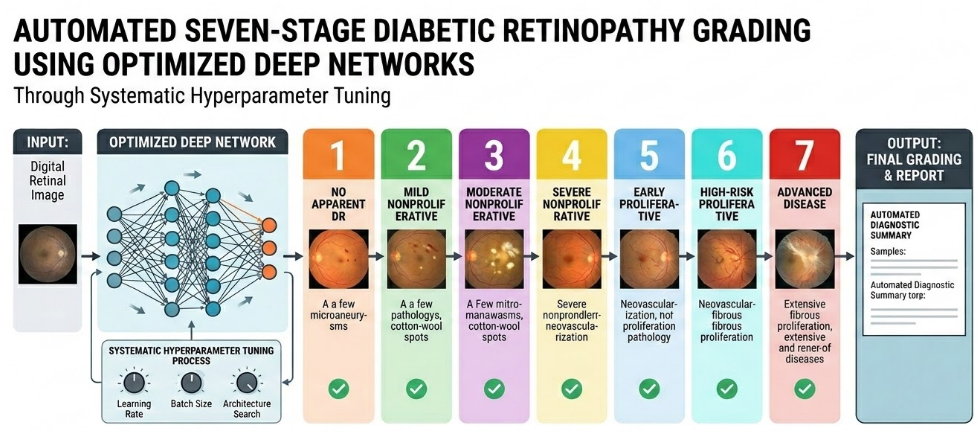
Can a deep learning model detect the subtle signs of diabetic retinopathy — before it's too late?
Diabetic retinopathy is one of those silent diseases that quietly steals vision while patients go about their daily lives. As a computer engineer working at the intersection of artificial intelligence and real-world problems, I've always been drawn to challenges where technology can make a tangible difference. This paper — Automated Seven-Stage Diabetic Retinopathy Grading Using Optimized Deep Networks Through Systematic Hyperparameter Tuning — represents my attempt to push automated DR diagnosis further than the conventional binary or five-stage approaches that dominate the literature.
Why Seven Stages Matter
Most existing studies simplify diabetic retinopathy into a binary problem (DR vs. no DR) or a five-class task. But clinicians don't think in binaries. The progression from mild non-proliferative DR to advanced proliferative DR involves subtle, gradual changes — each stage carrying different implications for treatment timing and strategy. A system that can distinguish all seven stages provides clinicians with the granular information they actually need to make decisions. That was the core motivation behind this work.
The Dataset Challenge
Working with a publicly available dataset of 1,437 fundus images sounds straightforward until you look at the class distribution. One of the most critical stages — Mild NPDR — had only six original images. Six. This is a common reality in medical imaging: the cases you most need to detect are often the rarest in your dataset.
Rather than giving up on fine-grained classification, I designed an extensive data augmentation pipeline — rotations, shifts, reflections, and scaling — that expanded the dataset to nearly 16,000 images while preserving the integrity of pathological features. The key was ensuring that augmentation didn't introduce artifacts that the model might learn instead of genuine disease markers.
Making the Invisible Visible with CLAHE
Fundus images can be deceptively uniform to the untrained eye. Subtle hemorrhages, tiny microaneurysms, and early exudates often hide in low-contrast regions. Before feeding images to any deep learning model, I applied Contrast Limited Adaptive Histogram Equalization (CLAHE) — a technique that enhances local contrast by processing the image in small tiles rather than globally. The difference was remarkable: features that were nearly invisible in the original images became clearly distinguishable after CLAHE preprocessing. This step alone significantly improved the model's ability to detect early-stage disease.
Letting the Algorithm Choose Its Own Architecture
Here's where the story gets interesting. Instead of hand-picking a deep learning architecture based on intuition or popularity, I used Optuna — a Bayesian optimization framework — to systematically evaluate nine pre-trained architectures: ResNet50, DenseNet121, EfficientNetB0, Xception, InceptionV3, VGG16, MobileNetV2, NASNetLarge, and InceptionResNetV2.
The winner? NASNetLarge — not the most commonly used architecture in DR literature, but the one that objectively performed best on this specific dataset. This finding reinforced an important lesson: the "best" model depends entirely on your data and task. There's no universal answer, and systematic search beats educated guessing.
Fine-Tuning with Grid Search
Once NASNetLarge was identified, I used Grid Search to exhaustively optimize hyperparameters: dropout rate, batch size, optimizer, learning rate, dense units, and the number of frozen layers. The optimal configuration — Adam optimizer, learning rate of 0.0001, dropout of 0.3, batch size of 64, and 713 frozen layers — achieved 98.39% classification accuracy, confirmed by 5-fold cross-validation at 98.50% ± 0.21%.
What struck me most was how sensitive the model was to batch size. Moving from 32 to 64 produced a dramatic accuracy jump, suggesting that the larger batch provided more stable gradient estimates during training — a detail easily overlooked but critical in practice.
Can We Trust What the Model Sees?
Accuracy numbers are important, but they don't tell the whole story. For a model to be clinically useful, we need to understand why it makes its decisions. Using saliency map visualization, I examined which regions of each fundus image most influenced the model's predictions.
The results were encouraging: in early DR stages, the model focused on central retinal areas around the optic disc and vasculature — exactly where microaneurysms and hemorrhages first appear. In advanced proliferative stages, attention patterns became more diffuse, reflecting the widespread retinal damage characteristic of severe disease. The model wasn't memorizing textures or dataset quirks; it was learning genuinely meaningful pathological features.
Honest Limitations
No study is without limitations, and I want to be transparent about mine. The Mild NPDR class, despite achieving perfect classification scores, started with only six original images. While augmentation addressed the imbalance effectively, there's always a risk that the model learned augmentation patterns rather than true disease features. External validation on independent datasets from different populations and imaging devices remains essential before any clinical deployment.
Looking Forward
This work demonstrates that systematic optimization — rather than manual trial-and-error — can push automated DR diagnosis to new levels of accuracy and reliability. But the real goal extends beyond numbers on a page. Diabetic retinopathy affects millions worldwide, and many patients in underserved regions lack access to specialist ophthalmologists. An AI system capable of reliable seven-stage grading could serve as a powerful screening tool, flagging patients who need urgent intervention and potentially saving countless eyes from preventable blindness.
The code and dataset are publicly available, and I hope this work encourages others to build upon it — with larger datasets, external validation, and ultimately, clinical trials that bring AI-assisted diagnosis from the laboratory to the clinic.
Yavuz Unal is a faculty member in the Department of Computer Engineering at Sinop University, Turkey. His research focuses on computer vision and deep learning applications in agricultural science, food quality assessment, and medical image analysis.
Read the full paper: Automated Seven-Stage Diabetic Retinopathy Grading Using Optimized Deep Networks Through Systematic Hyperparameter Tuning
Follow the Topic
-
Discover Computing
Previously Information Retrieval Journal. Discover Computing is an open access journal publishing research from all fields relevant to computer science.

Related Collections
With Collections, you can get published faster and increase your visibility.
Advances in Knowledge-Driven Artificial Intelligence: Methods and Applications
As AI systems are increasingly deployed in information access, decision support, and personalized learning, their ability to incorporate, reason over, and update structured and unstructured knowledge has become critical. Knowledge-driven methods provide a promising pathway to improve accuracy, explainability, personalization, robustness, and trustworthiness, especially in scenarios where data are heterogeneous, dynamic, sparse, or domain-specific. This Collection aims to bring together high-quality research on knowledge-driven artificial intelligence for recommendation systems, question answering, knowledge graphs, and knowledge tracing.
The Collection welcomes original research and review articles on theories, models, algorithms, systems, and applications related to knowledge-enhanced recommendation systems, knowledge graph construction and reasoning, knowledge graph question answering, retrieval-augmented generation, large language models with external knowledge, explainable and trustworthy AI, user modelling, learner modelling, and knowledge tracing. Topics of interest also include graph neural networks, neuro-symbolic reasoning, causal and counterfactual methods, multimodal knowledge representation, dynamic and continual knowledge learning, learning analytics, educational intelligence, and real-world knowledge-intensive applications. The goal is to promote interdisciplinary advances in knowledge-centered intelligent systems and foster robust, interpretable, and adaptive AI technologies.
This Collection supports and amplifies research related to SDG 9.
Keywords: Knowledge-driven AI; Knowledge graph; Recommender systems; Question answering; Knowledge tracing; Retrieval-augmented generation; Large language models; Graph neural networks; Learning analytics
Publishing Model: Open Access
Deadline: Feb 28, 2027
AI-Driven Cybersecurity for IoT: Blockchain, Agentic Systems, and Explainable Intrusion Detection
The rapid expansion of Internet of Things (IoT) ecosystems has widened the attack surface for cyber threats, demanding intrusion detection systems that are both highly accurate and interpretable.
This Collection invites original research and reviews at the intersection of Artificial Intelligence and IoT security, focusing on three converging directions:
- Blockchain-augmented intrusion detection systems that use distributed ledger technology for tamper-proof threat-intelligence sharing and trust management;
- Agentic and LLM-based cybersecurity frameworks that employ autonomous, tool-using AI agents for real-time monitoring, triage, and explainable decision-making;
- Machine learning and deep learning approaches for anomaly detection in heterogeneous, resource-constrained IoT environments.
Submissions addressing explainability (e.g., SHAP, LIME), dataset quality and benchmarking, edge/fog computing constraints, federated learning, and real-world deployment challenges are especially welcome.
The Collection aims to bridge foundational IDS research with the emerging generation of autonomous, explainable, blockchain-backed AI security systems.
This Collection supports and amplifies research related to SDG 9.
Keywords: Blockchain, Explainable Artificial Intelligence (XAI), Agentic AI, Large Language Models (LLMs), Machine Learning, Deep Learning, Cybersecurity, Federated Learning, Intrusion Detection, Internet of Things (IoT)
Publishing Model: Open Access
Deadline: Apr 28, 2027


