Beyond a Single Livelihood: Understanding How Rural Households in Somaliland Navigate Drought and Economic Uncertainty
Published in Social Sciences
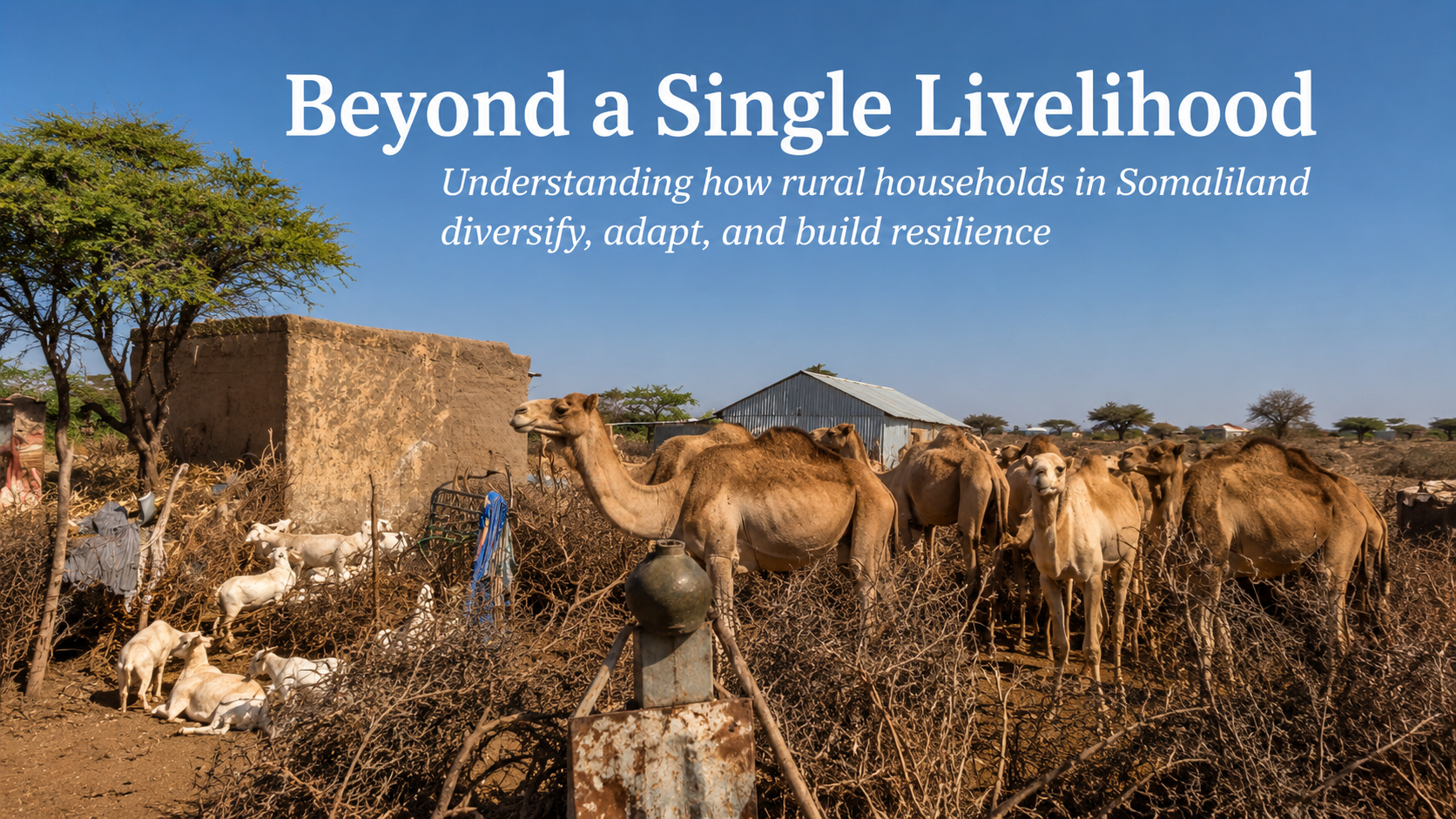

Rural livelihoods in Somaliland are changing. For generations, livestock production and small-scale farming have been central to rural household economies. However, recurrent droughts, uncertain rainfall, environmental degradation, and limited economic opportunities are making dependence on a single livelihood increasingly difficult.
This reality motivated our recently published study, “Livelihood Diversification and Its Determinants among Rural Households in the Maroodijeex Region, Somaliland,” in Discover Sustainability.
We wanted to answer a straightforward but important question: How are rural households diversifying their livelihoods, and what factors are associated with their ability to do so?
Why we undertook this study
Research in Somaliland has increasingly documented climate variability, drought, food insecurity, and household adaptation. Yet these challenges are closely interconnected. When rainfall becomes unreliable, livestock productivity declines, or crop production fails, rural households must find alternative ways to maintain income and meet basic needs.
Livelihood diversification can provide one such strategy. Households may combine livestock and crop production with wage employment, small businesses, remittances, or other activities rather than relying on a single income source.
However, empirical evidence on the structure and extent of livelihood diversification in rural Somaliland remains limited. Our study therefore brought livelihood structure, diversification levels, and associated household factors together within a single analytical framework.
How we conducted the research
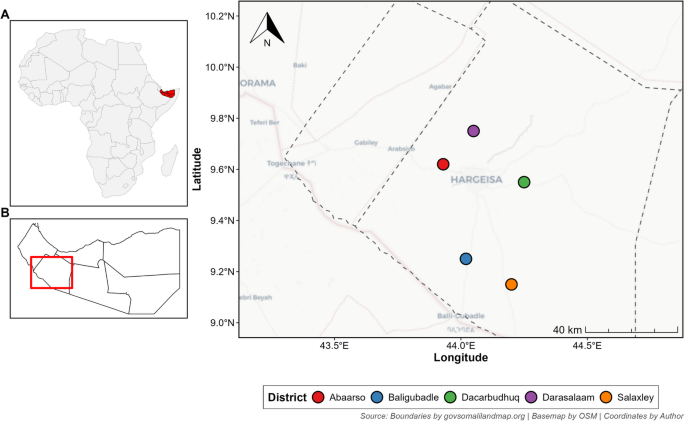
The study included 377 rural households across Abaarso, Darasalaam, Dacar Budhuq, Baligubadle, and Salahlay in the Maroodijeex Region. We adopted a mixed-methods approach, combining a household survey with key informant interviews, focus group discussions, and field observations.
Rather than simply classifying households as diversified or not diversified, we used the Simpson Diversification Index (SDI). This captures both the number of household income sources and their relative contributions to total income. We also applied MM-estimator robust regression to examine factors associated with diversification while reducing the influence of extreme and high-leverage observations.
Conducting household research in rural Somaliland presented challenges, particularly the absence of complete household sampling lists. The 2024 National Electoral Commission voter registration records therefore provided the most comprehensive available administrative basis for proportional village selection. We recognize the potential sampling limitations associated with this approach and explicitly account for them when interpreting the findings.
What did we discover?
One of the most striking findings was the changing composition of rural household income.
Off-farm and non-farm activities accounted for 63% of total household income, compared with 37% from crop and livestock production. Wage labour contributed the largest share at 34.8%, followed by livestock production at 27.7%, business and trade at 23.0%, and crop farming at 9.3%.
However, this shift should not automatically be interpreted as economic progress.
Our qualitative findings indicated that diversification was often driven by necessity rather than opportunity. Recurrent droughts, unreliable agricultural production, and limited livelihood options were pushing households toward wage labour, petty trade, and other activities. Diversification can therefore represent resilience, but it can also reflect underlying vulnerability.
Diversification itself remained relatively limited. The mean SDI was 0.275, while 39.3% of households remained specialized in a single income source. Only 34.2% were classified as highly diversified.
What enables households to diversify?
Our findings highlight the importance of productive assets.
Access to irrigation showed the largest positive association with livelihood diversification. Landholding size and livestock ownership were also positively associated with diversification, while household-head age showed a smaller positive association.
This reveals an important challenge: households that may need diversification most may also lack the productive resources required to pursue additional livelihood opportunities.
Why does this research matter?
Our findings suggest that promoting livelihood diversification requires more than encouraging households to establish additional income-generating activities. Diversification requires a productive base.
Improving access to irrigation, land productivity, livestock assets, and viable economic opportunities can strengthen households’ capacity to build more resilient livelihood portfolios. This is particularly important in drought-prone areas where traditional farming and pastoral systems face increasing environmental pressure.
The study also challenges the assumption that increasing non-farm income necessarily represents successful rural economic transformation. In vulnerable settings, movement toward wage labour and other activities may instead represent constrained adaptation to declining agricultural reliability.
More broadly, this research contributes empirical evidence from Somaliland, a context that remains underrepresented in international livelihood and climate-resilience research. We hope the findings contribute to wider discussions about how rural households in drought-prone regions can move beyond short-term coping toward more sustainable and resilient livelihoods.
Read the full article:
https://doi.org/10.1007/s43621-026-03842-1

Assistant Professor, University of Hargeisa Specializing in environmental science, chemical management, climate change, food security, livelihoods, and disaster risk management.
Follow the Topic
-
Discover Sustainability
A multi-disciplinary, open access, community-focussed journal publishing results from across all fields relevant to sustainability research whilst supporting policy developments that address all 17 of the United Nations Sustainable Development Goals (SDGs).

Related Collections
With Collections, you can get published faster and increase your visibility.
5th Anniversary of Discover Sustainability: Accelerating the Implementation of the UN SDGs
Adopted in 2015, the United Nations Sustainable Development Goals (SDGs) provides a universal framework for ending poverty, protecting the planet, and ensuring prosperity for all by 2030. Yet, with the target year rapidly approaching, progress remains off track. The COVID-19 pandemic, climate change, geopolitical conflicts, and resource constraints have reversed gains in areas such as food security, health, and gender equality. Achieving the SDGs requires not only political will but also accelerated, interdisciplinary, and scalable solutions that integrate technology, policy innovation, finance, and community engagement.
This collection responds to that urgent need by showcasing cutting-edge research, case studies, and practical frameworks that drive measurable progress toward the SDGs. It seeks to bridge gaps between theory and implementation, highlighting successes, failures, and replicable lessons. Marking the 5th anniversary of Discover Sustainability, this collection celebrates the journal’s ongoing commitment to advancing impactful research and practical solutions for global sustainability challenges.
This collection aims to accelerate evidence-based progress toward the UN SDGs by bridging research, policy, and practice. Its specific objectives are:
- to showcase innovative, scalable solutions that have demonstrated measurable SDG impacts;
- to identify barriers to implementation and propose actionable pathways to overcome them;
- to foster interdisciplinary collaboration across technology, social sciences, finance, and governance;
- to highlight replicable case studies from diverse geographical and socio-economic contexts; and
- to inform decision-makers of local, national, and global levels.
Ultimately, the collection seeks to transform the SDG framework from aspirational goals into tangible, time-bound achievements by 2030 and beyond.
This Collection supports and amplifies research related to SDG 1, SDG 2, SDG 3, SDG 4, SDG 5, SDG 6, SDG 7, SDG 8, SDG 9, SDG 10, SDG 11, SDG12, SDG 13, SDG 14, and SDG 15
Keywords: Sustainable Development Goals (SDGs), Interdisciplinary Solutions, Policy Innovation, Scalable Impact, Climate Resilience, Renewable Energy Transition, Circular Economy, Data-driven Development, Social Equity and Inclusion, Global Partnerships
Publishing Model: Open Access
Deadline: Dec 31, 2026
Weather and Climate Extremes: A Special Reference to Multidisciplinary Research and Policy Developments
This Collection, titled "Weather and Climate Extremes: A Special Reference to Multidisciplinary Research and Policy Developments," focuses on the increasing global challenges posed by extreme weather events and climate phenomena. As these events intensify due to changing climate patterns, their impacts on ecosystems, infrastructure, human health, and socioeconomic systems become more pronounced, necessitating a multidisciplinary approach to understanding and addressing these complexities.
The Collection aims to bring together research from diverse fields, including atmospheric sciences, hydrology, ecology, engineering, public health, and social sciences. It encourages innovative contributions that explore cutting-edge solutions to predict, manage, and mitigate the effects of climate extremes. Topics may include advanced modelling techniques, nature-based solutions, climate-resilient infrastructure, risk assessment frameworks, and strategies for equitable policy development. The emphasis is placed on integrating scientific understanding with actionable solutions that address vulnerability, resilience, and adaptation.
Moreover, this Collection seeks to foster cross-disciplinary collaborations to bridge the gap between scientific research and policy implementation. By highlighting case studies, theoretical advancements, and practical approaches, it aims to advance the dialogue on climate resilience and inform decision-making processes globally. This platform aspires to serve as a critical resource for researchers, practitioners, and policymakers striving to navigate the escalating challenges of a changing climate.
Given the increasing frequency and intensity of climate extremes, this topic holds critical importance. Such extremes profoundly affect ecosystems, infrastructure, and human livelihoods, demanding coordinated efforts across disciplines to analyse risks, develop mitigation strategies, and inform policy. This Collection seeks to bring together cutting-edge research and innovative approaches from diverse fields, bridging scientific understanding and actionable policy frameworks. The proposed focus areas include, but are not limited to:
• Advances in modelling and forecasting weather and climate extremes
• Impacts on ecosystems, agriculture, water resources, and public health
• Nature-based solutions and climate-resilient infrastructure
• Interdisciplinary frameworks for risk management and adaptation planning
• Policy advancements addressing vulnerability, resilience, and equity
This call aims to engage a broad community of researchers, practitioners, and policymakers to enhance global discourse and support evidence-based decision-making by emphasising multidisciplinary contributions.
This Collection supports and amplifies research related to SDG
Keywords: Weather Extremes Modeling; Climate Change Impacts; Risk Assessment Frameworks; Nature-Based Solutions (NbS); Resilient Infrastructure Design; Equitable Policy Development; Interdisciplinary Climate Research; Adaptation and Mitigation Strategies; Socioeconomic Vulnerability Analysis; Extreme Event Forecasting
Publishing Model: Open Access
Deadline: Feb 28, 2027

