
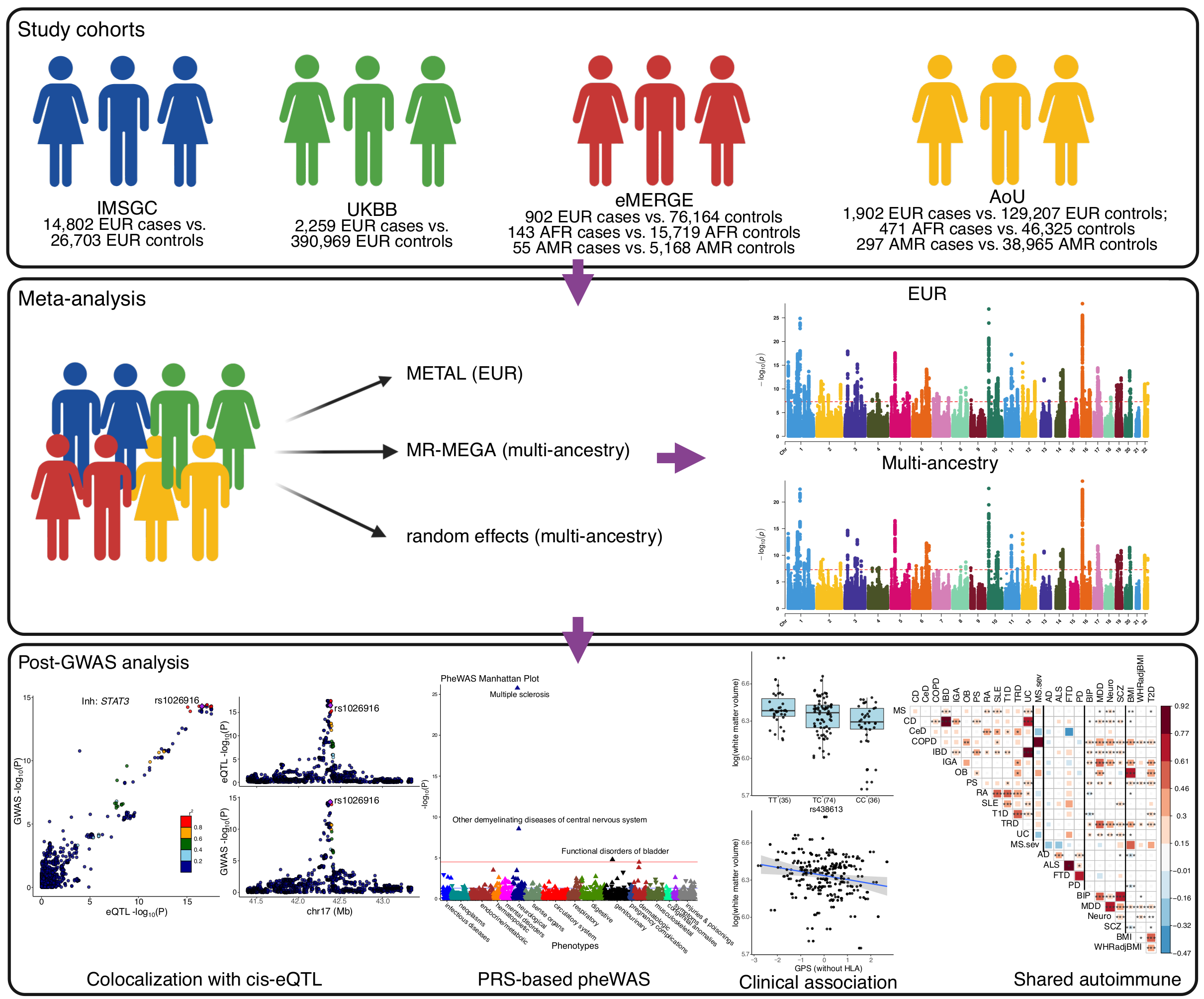
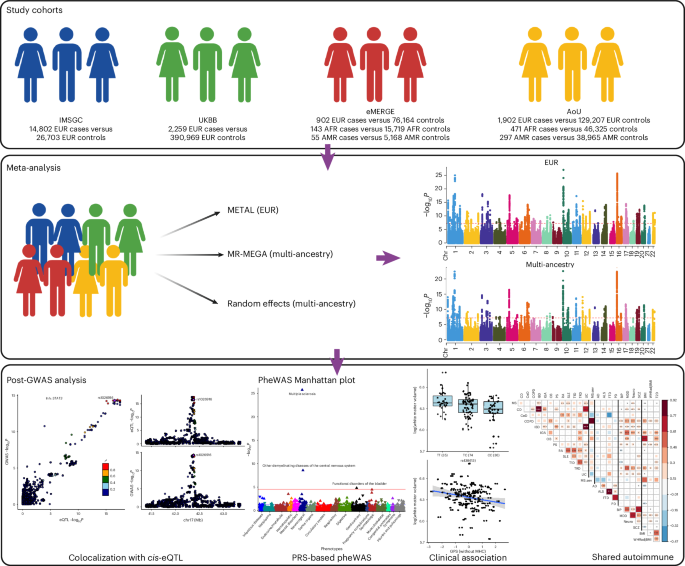

In 2019, the International Multiple Sclerosis Genetics Consortium (IMSGC) published the largest genome-wide association study (GWAS) of multiple sclerosis (MS) to date. The study transformed our understanding of the genetic architecture of MS and used bulk RNA sequencing datasets to prioritize genes underlying disease-associated loci. But it also raised new questions.
Several years later, the first GWAS of MS severity added another perspective. Severity-associated variants were enriched in central nervous system (CNS) tissues, whereas MS susceptibility variants appeared to be enriched primarily in immune cells and microglia. This raised an intriguing question: had we fully captured the contribution of CNS cells to MS susceptibility, or were we limited by the resolution of the available datasets?
By late 2023, our group at Columbia had completed one of the largest human brain single-cell transcriptomic and epigenomic resources available. We decided to revisit the MS GWAS using these new single-cell datasets, bringing together large-scale human genetics and single-cell genomics. GWAS had already identified hundreds of MS risk loci, but important questions remained: Which genes were affected by these variants? Which cell types mediated their effects? Could single-cell genomics reveal biology that had previously been invisible?
Little did we know that this approach would reveal an unexpected neuronal contribution to a disease long considered primarily immune-mediated.
One of the most exciting findings was that the genetic architecture of MS pointed toward an unexpected player: inhibitory neurons. While MS has long been viewed primarily as an immune-mediated disease, our analyses suggested that specific neuronal populations also contribute to disease susceptibility.
Inhibitory neurons emerged as a key target cell type for MS risk variants, with seven susceptibility loci, including STAT3, showing genetically regulated expression specifically in these cells. The MS-associated STAT3 variant has also been linked to cognitive performance, white matter integrity, and serum neurofilament light chain levels, suggesting a potential role in neuroaxonal injury.
Our analyses also identified additional brain cell-type-specific target genes that had not been implicated in previous studies because suitable human brain single-cell datasets were not previously available. These findings demonstrate how combining large-scale human genetics with cell-type-specific functional genomics can reveal biological mechanisms that would otherwise remain hidden.
Another important aspect of this study was expanding MS genetics beyond populations of European ancestry. By incorporating African American and Hispanic American cohorts, we performed a multi-ancestry GWAS of MS and evaluated polygenic risk score performance across ancestries. Although smaller non-European sample sizes limited additional discoveries, these analyses represent an important step toward making MS genetics more inclusive and broadly applicable.
More broadly, our findings reinforce an increasingly important concept in human genetics: most disease-associated variants do not directly alter protein-coding sequences. Instead, they influence gene regulation in highly specific cell types and cellular states. Integrating genetics with single-cell functional genomics can therefore move us beyond statistical associations toward a deeper understanding of disease mechanisms.
Although much of my work took place behind a computer screen, this project was fundamentally a team effort. The IMSGC and our team at Columbia brought together neurologists, geneticists, neuroscientists, computational biologists, statisticians, and clinicians from around the world. For me, one of the most rewarding aspects was developing computational pipelines capable of integrating datasets at this scale while maintaining rigorous quality standards.
This study is only the beginning. As increasingly comprehensive single-cell and spatial multi-omics datasets become available, we will be able to connect genetic risk variants to molecular mechanisms with even greater precision and identify new therapeutic targets.
I am a statistical geneticist establishing my independent research group in the Department of Neurology at Columbia University Irving Medical Center, where I work in the division of Dr. Philip L. De Jager. My research combines statistical genetics, computational biology, and multi-omics to uncover the genetic and molecular mechanisms underlying neurological and autoimmune diseases, with a particular focus on multiple sclerosis and neurodegeneration.
My work integrates large-scale genome-wide association studies (GWAS) with single-cell genomics, transcriptomics, epigenomics, and proteomics to identify causal genes, disease-associated cell types, and potential therapeutic targets. I am particularly interested in translating human genetic discoveries into biological insights that can ultimately inform new treatments. Through interdisciplinary collaborations, I develop computational methods that bridge the gap between genetic associations and disease mechanisms.
Follow the Topic
-
Nature Genetics
This journal publishes the very highest quality research in genetics, encompassing genetic and functional genomic studies on human and plant traits and on other model organisms.

Related Collections
With Collections, you can get published faster and increase your visibility.
Mechanisms and impact of 3D genome organisation
Publishing Model: Hybrid
Deadline: Nov 30, 2026
Human Admixture and Migration
Publishing Model: Hybrid
Deadline: Feb 28, 2027