Beyond the Module: Are We Preparing School Counsellors to Deliver Effective Interventions in Malaysian Schools?
Published in Behavioural Sciences & Psychology and Education
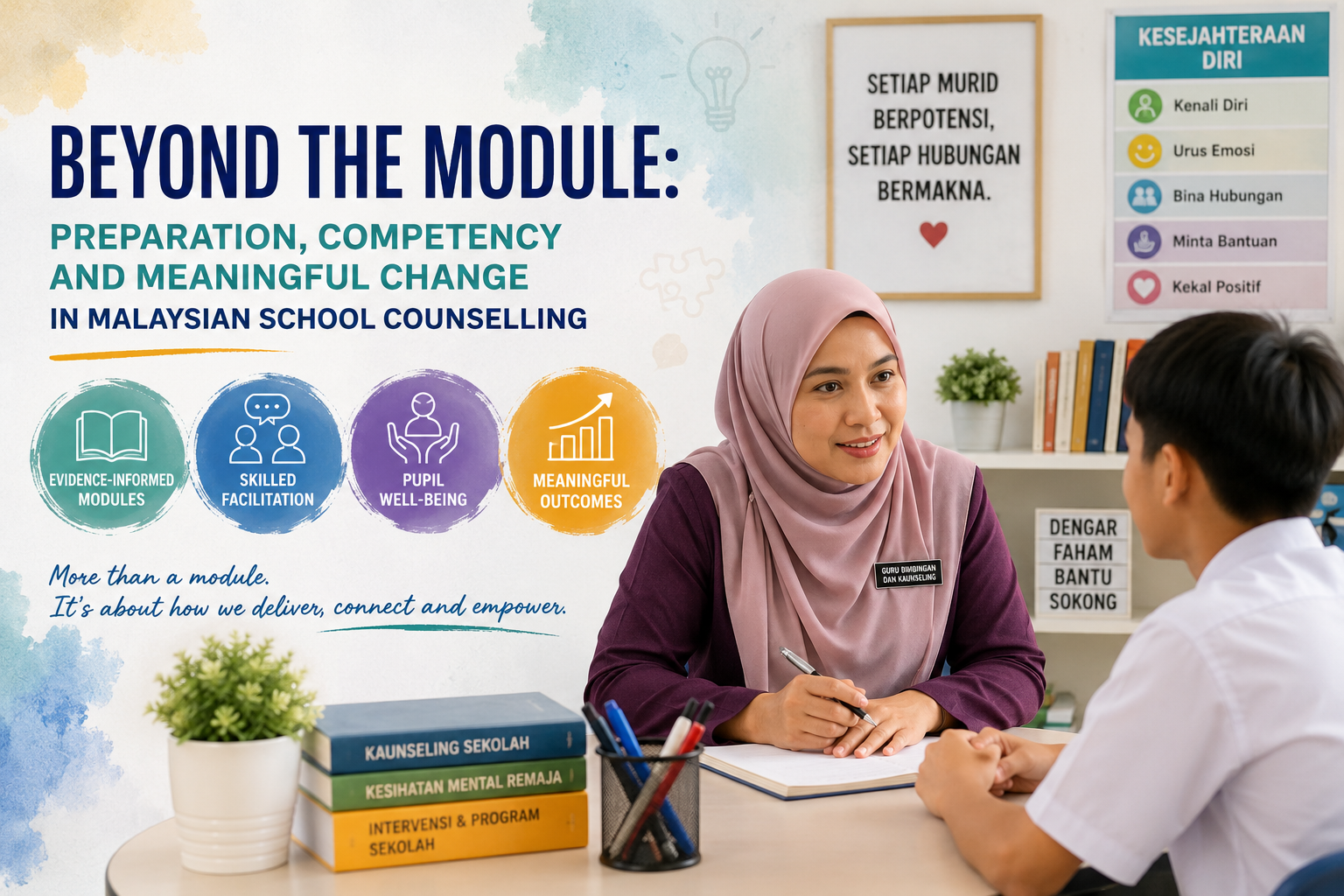




Schools are increasingly becoming important settings for supporting children’s mental health, emotional development, and psychological well-being. In Malaysia, Guidance and Counselling Teachers (GCTs) are often at the forefront of this responsibility, delivering counselling, psychoeducational programmes, preventive interventions, and developmental activities to address diverse pupil needs. As schools increasingly adopt structured and evidence-informed interventions, considerable attention is naturally placed on the quality of the programmes or modules being implemented.
Yet, an important question deserves greater attention: Is having a good intervention module enough to produce meaningful change?
Recent findings from Biggs et al. (2026) offer an important perspective. In a large school-based randomised controlled trial of LEGO-based therapy, now known as Play Brick Therapy, overall intervention fidelity was generally high. However, independent observations revealed weaker implementation of some of the more complex facilitation processes, particularly those involving the recognition, facilitation, and reinforcement of meaningful social interactions. This suggests that successful implementation cannot be judged solely by whether practitioners follow the prescribed activities or complete the required sessions.
This finding highlights a critical distinction between following an intervention protocol and delivering an intervention competently. A practitioner may complete all required sessions, follow prescribed activities, and adhere closely to a manual, yet still differ considerably in the ability to facilitate the psychological or interpersonal processes through which change is expected to occur. In school settings, where pupils present diverse emotional, behavioural, developmental, and social needs, effective implementation therefore requires more than procedural adherence.
Delivering a module is not the same as delivering an intervention.
In schools, intervention fidelity can easily become associated with completing the prescribed number of sessions, following activities in sequence, using the required materials and documenting programme completion. These elements are important. However, they tell us relatively little about what happens within the interaction between the facilitator and the pupil.
A counsellor may complete every activity in a module, yet the intended psychological process may not necessarily occur. Effective intervention requires more than procedural adherence. It requires the practitioner to recognise pupils’ responses, facilitate reflection, respond appropriately to emerging emotional needs and understand the theoretical mechanisms through which an intervention is expected to produce change. The distinction is particularly important when interventions address complex areas such as emotional regulation, behavioural difficulties, psychological distress and mental health.
What does this mean for Malaysian school counselling?
The Malaysian school counselling context provides an important setting in which to consider this issue. GCTs work within complex school environments where interventions must coexist with academic schedules, administrative responsibilities, large pupil populations, and diverse psychosocial needs. Structured modules can therefore provide valuable consistency and practical guidance. However, modules should support professional judgement rather than replace it.
The experience reported by Biggs et al. (2026) is particularly instructive. Facilitators received three hours of initial training, with no subsequent top-up training, supervision, or mentoring, raising questions about whether brief training adequately prepares practitioners for the more complex processes involved in intervention delivery. This concern is equally relevant in Malaysia. Ganaprakasam et al. (2024) found that targeted suicide gatekeeper training significantly improved GCTs knowledge, attitudes, and self-reported practices. Yet, improvement following training does not necessarily demonstrate sustained competency in real-world practice. The authors themselves called for continuous support, monitoring, and evaluation, alongside research examining whether training translates into actual intervention behaviours over time.
This leads to a broader question for school-based interventions: How much preparation is sufficient before we consider a practitioner competent to deliver an intervention?
From Programme Fidelity to Practitioner Competency
School-based interventions should consider not only whether a programme was delivered as intended, but also whether it was delivered competently enough to activate its intended psychological processes. This distinction is particularly important because high procedural fidelity does not necessarily indicate high-quality therapeutic delivery. Biggs et al. (2026), for example, found generally high fidelity while identifying weaker implementation in more complex aspects of facilitation. For Malaysian school counselling, this suggests a need to move beyond one-off training towards competency-based preparation, guided practice, supervision, reflective practice, and continuing professional development.
Future research should therefore examine not simply whether school-based counselling interventions work, but how, by whom, and under what conditions they work. Malaysian studies could investigate whether practitioner competency and intervention fidelity predict pupil outcomes, and whether ongoing supervision produces better implementation than brief pre-intervention training alone. Research should also examine the realities of implementation across different school contexts and include the perspectives of both GCTs and pupils. Such evidence would help determine whether intervention effectiveness is driven primarily by the module itself or by the interaction between programme quality, practitioner competency, school context, and implementation fidelity.
References
Biggs K, Gomez de la Cuesta G, Kingsley E, McPherson J, Murray F, Laurie M, et al. (2026) Lessons learnt about implementing LEGO based therapy (Play Brick Therapy) based on fidelity data and experience from a large school-based randomised controlled trial. PLoS One 21(2): e0336952. https://doi.org/10.1371/journal.pone.0336952
Ganaprakasam, C., Muniandy , T., & Humayra, S. (2024). EMPOWERING MALAYSIAN INDIAN SCHOOL GUIDANCE AND COUNSELING TEACHERS: GATEKEEPER TRAINING IMPACT ON SUICIDE PREVENTION KNOWLEDGE, ATTITUDES, AND PRACTICES. Malaysian Journal of Public Health Medicine, 24(2), 116–123. https://doi.org/10.37268/mjphm/vol.24/no.2/art.2680

Hello everyone! I’m Charles Ganaprakasam, a professional educationist and counselor with the Ministry of Education Malaysia, currently pursuing my PhD in Counseling at Universiti Utara Malaysia (UUM) under the HLP KPM national scholarship.
My work bridges psychological theory and real-world educational practice. As the founder of TRIA Research Solutions, I specialize in designing and validating student NSSI intervention frameworks, integrating Rational Emotive Behavior Therapy (REBT) and Motivational Interviewing (MI) to foster cognitive resilience and academic engagement in youth.

