Beyond the Prescription Pad: The Unseen Cost of Polypharmacy in Secondary Healthcare
Published in Chemistry

Every day at the pharmacy counter of Offa Specialist Hospital in Kwara State, North-Central Nigeria, a quiet crisis unfolds at the cash register. It starts with the soft rustle of paper—a prescription slip carrying a long, daunting list of life-sustaining medications. Then comes the pause. A patient checks their wallet and makes an impossible choice: Which of these five pills can I afford to take this month?
Behind our newly published study lies a stark reality about the human and economic toll of multi-drug therapy in resource-limited settings. While multi-drug regimens are often clinically necessary for managing chronic conditions, their benefits routinely collide with financial realities where healthcare depends on out-of-pocket spending.
Key Findings from the Field
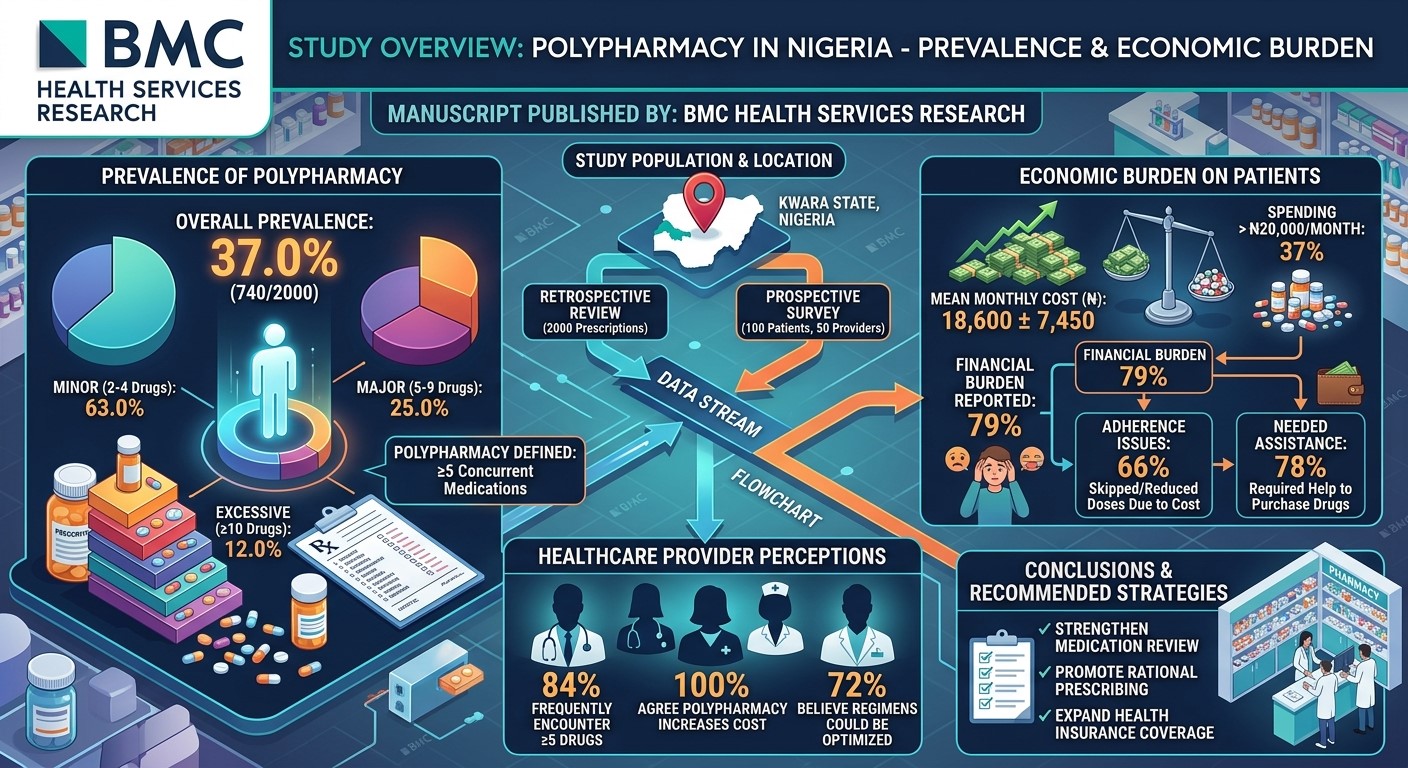
- High Prevalence: Of 2,000 reviewed prescriptions, 0% met the criteria for polypharmacy (≥5 drugs), with 12.0% involving excessive polypharmacy (≥10 drugs).
- Severe Financial Strain: 37% of surveyed patients spend over ₦20,000 monthly on drugs, and 79% report that medication costs pose a significant financial burden.
- Compromised Adherence: 66% of patients admitted to skipping doses, reducing intake, or delaying drug purchases due to cost, while 78% required financial help from family or friends to buy their medicines.
- Provider Consensus: 84% of surveyed healthcare workers frequently encounter polypharmacy, 100% agree it escalates treatment costs, and 72% believe many regimens could be safely streamlined through structured medication reviews.
Moving Toward Solutions
Prescribing a drug is only half the therapeutic equation; ensuring the patient can afford to take it completes the cycle. Mitigating unnecessary polypharmacy in low- and middle-income countries requires three key strategies:
- Routine Medication Reviews: Integrating pharmacist-led audits to optimize drug regimens and initiate safe deprescribing.
- Health Insurance Expansion: Broadening universal coverage to protect households from catastrophic out-of-pocket expenses.
- Multidisciplinary Care: Fostering teamwork among physicians, pharmacists, and clinical pharmacologists to enforce cost-effective, evidence-based prescribing.

Health ROI Architect, BioPolicy Strategist, Pharma Economic Futurist and Therapeutics Pioneer
Follow the Topic
-
BMC Health Services Research
An open access, peer-reviewed journal that considers articles on all aspects of health services research, focusing on digital health, governance, policy, system quality and safety, delivery and access, financing and economics, implementing reform, and the workforce.

Related Collections
With Collections, you can get published faster and increase your visibility.
Strengthening health system resilience: from emergency preparedness to response and recovery
Health systems worldwide are increasingly facing the dual challenges of rising health demands and the unpredictability of emergencies. Recent and ongoing polycrises—whether the COVID-19 pandemic, sporadic outbreaks of emerging or reemerging diseases, or increasingly frequent emergencies resulting from natural hazards—have highlighted the urgent and compelling need for enhanced health system preparedness and resilience. Effective emergency preparedness involves not only robust planning and response strategies but also the capability to adapt and recover quickly from disruptions. This Collection aims to explore the multifaceted aspects of strengthening health systems to ensure they can effectively prepare for, respond to, and recover from emergencies and maintain continuity of care.
Addressing the resilience of health systems is crucial for safeguarding public health and ensuring that healthcare providers can deliver effective services during crises. Recent advancements have included the integration of technology in health management, improved supply chain logistics, and enhanced workforce training. Furthermore, frameworks for assessing health system resilience have been developed, offering valuable insights into best practices. However, ongoing research is needed to evaluate the effectiveness of these strategies and to implement innovative solutions that can be adapted to various contexts and crises.
Topics for submission but are not limited to:
- Governance, leadership, and policy approaches for resilient health systems
- Frameworks and metrics for assessing and strengthening health system preparedness and resilience
- Financing mechanisms and economic resilience of health systems in emergencies
- Community engagement and locally led strategies in crisis preparedness, response and recovery
- Workforce training, surge capacity, and capability building for emergency response
- Supply chain management and essential resource security during emergencies
- Digital technologies and data-driven innovations for emergency preparedness, response and recovery
- Health system resilience in underserved, vulnerable, or fragile settings
This Collection supports and amplifies research related to SDG 3: Good Health and Well-being.
All manuscripts submitted to this journal, including those submitted to collections and special issues, are assessed in line with our editorial policies and the journal’s peer review process. Reviewers and editors are required to declare competing interests and can be excluded from the peer review process if a competing interest exists.
Publishing Model: Open Access
Deadline: Mar 19, 2027
Strengthening private and public health insurance models for affordability of health services and financial protection
The rising costs of healthcare and the increasing burden of out-of-pocket expenses have underscored the need for effective health insurance models that promote financial protection and affordability. This Collection aims to explore innovative approaches to strengthen both private and public health insurance systems, focusing on risk pooling, equitable access, and coverage expansion. By examining various insurance frameworks, we aim to understand how they can better serve populations, particularly in low- and middle-income countries where catastrophic health expenditures are prevalent.
Advancements in health insurance models have demonstrated the potential to significantly reduce financial barriers to healthcare access, contributing to improved health outcomes. Research has shown that effective risk pooling mechanisms and the implementation of universal health coverage (UHC) can mitigate catastrophic health expenditures and enhance the quality of healthcare services. As health systems worldwide face increasing pressures, it is crucial to identify and share best practices that ensure equitable access to essential health services while maintaining financial sustainability.
Topics for submission:
- Strategies for cost reduction in health insurance
- Addressing catastrophic health expenditure through insurance
- Reducing out-of-pocket costs for vulnerable populations
- Enhancing risk pooling for equitable access
- Advancing universal health coverage (UHC) initiatives
This Collection supports and amplifies research related to SDG 3 (Good Health and Well Being).
All manuscripts submitted to this journal, including those submitted to collections and special issues, are assessed in line with our editorial policies and the journal’s peer review process. Reviewers and editors are required to declare competing interests and can be excluded from the peer review process if a competing interest exists.
Publishing Model: Open Access
Deadline: Dec 11, 2026