Beyond the resurgence: who remains at risk from pertussis?
Published in Social Sciences, Sustainability, and Biomedical Research



In October 2025, our team and colleagues published a BMJ editorial on the global resurgence of pertussis in infants. We highlighted a troubling problem: the youngest children face severe disease before they can complete their first course of vaccinations. Protecting this early window of life connects that editorial with our latest study in Nature Medicine. It also connects a discussion about returning outbreaks with a broader question about who benefits from progress against a preventable disease.
Our work had already approached pertussis, commonly known as whooping cough, from several directions. An earlier analysis using the Global Burden of Disease (GBD) Study 2021 examined worldwide incidence and mortality from 1990 to 2021. It documented long-term declines, regional inequalities and a sharp reduction during the COVID-19 pandemic. In a subsequent review, we examined potential contributors to resurgence, including waning immunity, disrupted vaccination, bacterial changes and differences in diagnosis and reporting. Together, these publications provide the background for looking more closely at the distribution of risk.
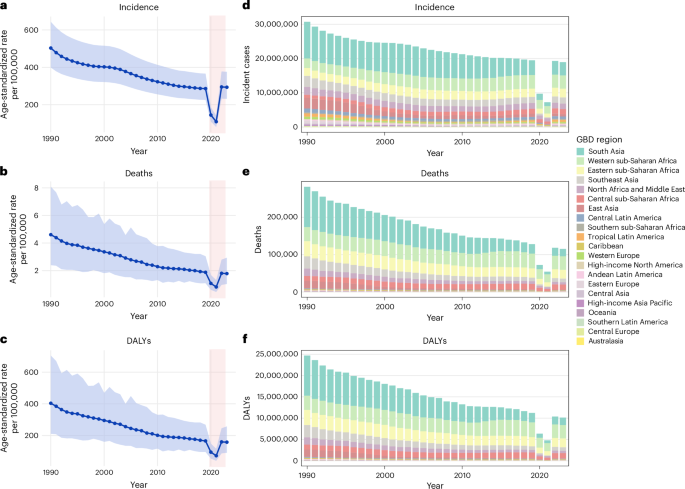
The earlier global analysis ended during an exceptional period for respiratory infections. Contact patterns, healthcare use, testing and vaccination services all changed during the pandemic. Extending the analysis through 2023 offered an opportunity to examine the early rebound within a longer historical perspective. Working with the Institute for Health Metrics and Evaluation and the GBD Collaborator Network, we analysed GBD 2023 estimates across 204 countries and territories. We examined cases, deaths and healthy years of life lost, with particular attention to geography and age. This work is now published in Nature Medicine.
Interpreting the time series required a careful choice of comparison. Relative to the unusually low estimates in 2020, estimated incidence had more than doubled by 2023. Comparing 2023 with 2019 gave a different perspective: the global age-standardised incidence rate was broadly similar, and the corresponding mortality rate was slightly lower. Age standardisation allows comparisons that account for differences in population age structure. By 2023, the global pattern therefore pointed towards a return to pre-pandemic levels. The later waves reported in 2024 fall beyond the period covered by our GBD analysis.
The longer view showed how much had changed over three decades. Between 1990 and 2023, the global age-standardised mortality rate fell by 61.2%, while the corresponding incidence rate declined by 41.6%. Yet the estimated burden in 2023 remained substantial, at approximately 19 million cases and 115,000 deaths. These estimates place the recent rebound within a continuing public health challenge: preserving past gains while reaching populations that remain vulnerable.
Geography revealed how uneven those gains have been across the world. In the modelled estimates, sub-Saharan Africa accounted for roughly 65% of global pertussis deaths in 2023, compared with around 30% in 1990. This increasing share reflects slower progress than in other regions, even as mortality declined. A region can therefore account for a growing proportion of global deaths while its own burden is falling. The distinction matters when deciding where additional prevention and care are most urgently needed.
Looking closely at age brought the question back to infants. Our analysis separated the first six months of life from later infancy and childhood. This detail matters because an overall total for children under five can conceal substantial differences in risk. We also examined both numbers and rates, which answer different questions. Death counts describe the overall burden within an age group; rates account for the size of that population. The highest mortality risk was concentrated in infants younger than six months.
These findings give a global perspective to the protection gap discussed in our BMJ editorial. Timely infant vaccination remains central, and maternal immunisation can help protect babies during their earliest months where it is recommended and feasible. Prevention also depends on recognising severe illness promptly and ensuring that families can reach appropriate care. The practical challenge extends from the timing of a vaccine appointment to the reliability of the health services surrounding a child.
Understanding the estimates also requires attention to how disease becomes visible. A reported case depends on someone seeking care, receiving a diagnosis and entering a surveillance system. Those steps vary considerably between countries, and our comparison with international notifications showed limited agreement with the modelled estimates. GBD aims to estimate underlying burden using available data and modelling assumptions. Where death records are sparse, mortality estimates depend more heavily on assumptions about incidence and the probability of dying after infection.
This dependence on data and assumptions shapes how the findings should be used. The estimates identify potential concentrations of unmet need and help frame priorities for further investigation. Their uncertainty also reinforces the value of better surveillance, particularly information on age, vaccination history, laboratory confirmation and outcomes. Stronger local data would improve both the global picture and the decisions made by health workers and immunisation programmes.
The thread connecting our earlier publications and this study is the need to turn concern about pertussis into protection that reaches children in time. Different settings require different combinations of reliable routine vaccination, early infant protection, accessible care and sensitive surveillance. Looking beyond a single global trend brings these needs into focus. Progress against pertussis is substantial; extending that progress to the children who remain most vulnerable is the task ahead.
Follow the Topic
-
Nature Medicine
This journal encompasses original research ranging from new concepts in human biology and disease pathogenesis to new therapeutic modalities and drug development, to all phases of clinical work, as well as innovative technologies aimed at improving human health.

📢 Introducing: # Mental Health
Mental Health is a Topic created to increase visibility and impact of research in this area and facilitate exchange amongst researchers.
Continue reading announcementRelated Collections
With Collections, you can get published faster and increase your visibility.
Clinical Research in Respiratory Medicine
Publishing Model: Hybrid
Deadline: Feb 18, 2027
Cancer Prevention and Control
Publishing Model: Hybrid
Deadline: Feb 19, 2027