Beyond the reward: what people want from prevention programs
Published in Public Health



Why is changing health behavior so difficult?
Most of us know that being physically active, quitting smoking, or attending screening can protect our health. Yet knowing what is good for us does not always make it easy to act. Time, costs, competing priorities, and the distance between today’s effort and tomorrow’s benefits can all get in the way [1].
Financial incentives and nudges are two approaches to this challenge. Incentives offer rewards for healthy behaviors [2]; nudges change how choices are presented without removing options; for example, through reminders or default appointments [3]. But designing these tools raises a question: what do people actually want from them?
How can we find out what people actually prefer?
This question motivated our systematic review. We wanted to understand which features of incentives and nudges matter to people, and how they weigh them against other aspects of prevention programs.
We focused on discrete choice experiments: studies in which participants choose between hypothetical alternatives with different combinations of features. Imagine choosing between two physical activity programs that differ in their rewards, time commitments, and support. Repeated choices help researchers identify the trade-offs people are willing to make [4].
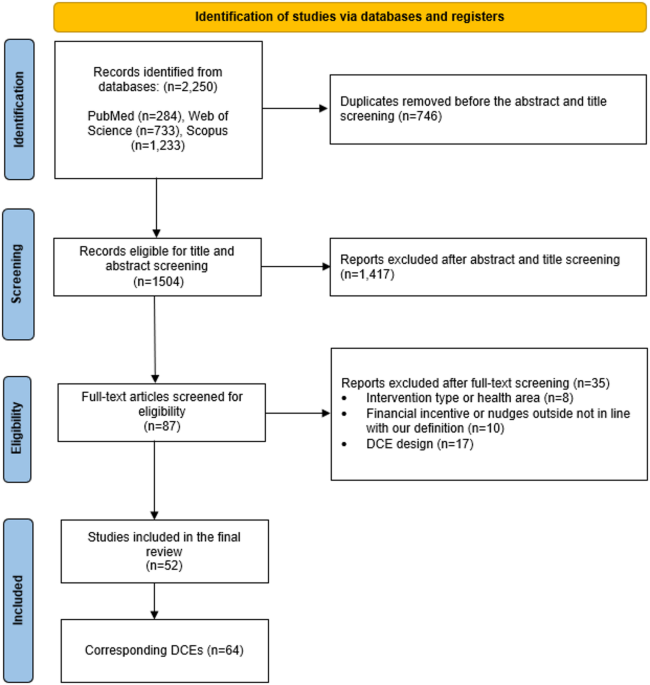
Our review brought together 52 studies covering 64 experiments in upper-middle- and high-income countries, spanning lifestyle change, vaccination, screening, and chronic disease management. Looking across these settings allowed us to explore whether common patterns emerged.
What matters when offering people a reward?
One finding stood out: the amount of money is only part of the story. How a reward is delivered, such as cash or vouchers, also matters. When reward format and amount were compared within the same experiment, format was more influential in nine of 15 comparisons.
Another finding required careful interpretation. Incentives often ranked highly when considered alongside practical program features, but were less likely to dominate when health outcomes or participation costs were included.
For us, this highlighted an important design issue: a reward’s apparent importance depends on what people are asked to compare it with. It also depends on the options presented. These findings do not establish a universal ranking of what matters most.
What about nudges?
The evidence was more limited. Nudge features appeared in 18 of the 61 experiments with data suitable for our comparative analysis, compared with 47 for financial incentives; some included both.
Information about what others do was the most commonly studied nudge feature. However, the limited evidence and few direct comparisons make it difficult to recommend one type of nudge over another.
This imbalance was itself informative: we need more research into people’s preferences for nudges, alongside research into whether they change behavior.
What could this mean for public health?
Our main takeaway is that incentives and nudges should be designed as parts of a broader prevention program. The reward, the effort required, the costs of participating, and the expected health benefits all shape the choices people face.
There is also a distinction between choosing a hypothetical program and taking part in practice [5]. Our review examines stated preferences; it does not establish which designs produce lasting behavior change.
Listening to people’s preferences can help make prevention programs more responsive to their needs. The next step is to test those designs in practice, recognizing that different behaviors and populations may call for different approaches.
References
- Fineberg HV. The paradox of disease prevention: celebrated in principle, resisted in practice. JAMA. 2013;310:85. https://doi.org/10.1001/jama.2013.7518
- Giles EL, Robalino S, McColl E, Sniehotta FF, Adams J. The effectiveness of financial incentives for health behaviour change: systematic review and meta-analysis. PLoS ONE. 2014;9. https://doi.org/10.1371/journal.pone.0090347
- Thaler RH, Sunstein CR. Nudge: Improving Decisions About Health, Wealth, and Happiness. Revised and expanded edition. New York: Penguin; 2009.
- Ryan M. Discrete choice experiments in health care. BMJ. 2004;328:360–361. https://doi.org/10.1136/bmj.328.7436.360
- Quaife M, Terris-Prestholt F, Di Tanna GL, Vickerman P. How well do discrete choice experiments predict health choices? A systematic review and meta-analysis of external validity. European Journal of Health Economics. 2018;19:1053–1066. https://doi.org/10.1007/s10198-018-0954-6
Follow the Topic
-
BMC Global and Public Health
An open access, transparent peer review journal publishing outstanding and influential research and opinion of broad interest to all professional communities involved in global and public health research, policy-making, implementation and delivery worldwide.