Biomimetic Multi‑Responsive Superwettable Materials for Oil–Water Separation
Published in Earth & Environment and Materials
As global industrialization accelerates, oil spills and oily wastewater discharge pose escalating threats to aquatic ecosystems and human health. Conventional separation technologies—burning, chemical dispersants, mechanical skimming—suffer from secondary pollution, low efficiency, and prohibitive costs. Now, researchers from Hubei University and Wuhan University of Technology, led by Professor ChengKang Rao, Professor Yan Xin, and Professor Zhiguang Guo, have presented a comprehensive framework for next-generation biomimetic multi-responsive superwettable materials that fundamentally reimagine how we tackle one of environmental science's most persistent challenges.
Why These Smart Materials Matter
Traditional superwetting surfaces—whether superhydrophobic/superoleophilic "oil-removing" or superhydrophilic/underwater superoleophobic "water-removing" materials—operate with fixed wettability. Once contaminated or faced with complex emulsion systems, their performance degrades irreversibly. The novel smart-responsive materials overcome this limitation by enabling dynamic, reversible wettability switching in response to external stimuli, combining the selectivity of static membranes with the adaptability of living biological systems.
Innovative Design and Mechanism
The review systematically dissects the theoretical foundation spanning Young's equation, Wenzel model, and Cassie–Baxter model, revealing how biomimetic micro-/nanostructures and surface chemical regulation synergistically achieve superwettability and intelligent switching. At the molecular level, responsive functional groups undergo reversible conformational changes—PNIPAM chains collapsing above LCST, carboxyl groups deprotonating with pH shifts, azobenzene isomerizing under UV light—altering intrinsic contact angles. These nanoscale transformations are amplified by pre-constructed hierarchical roughness, enabling macroscopic switching between "oil-removing" and "water-removing" modes with intrusion pressures flipping from positive to negative values.
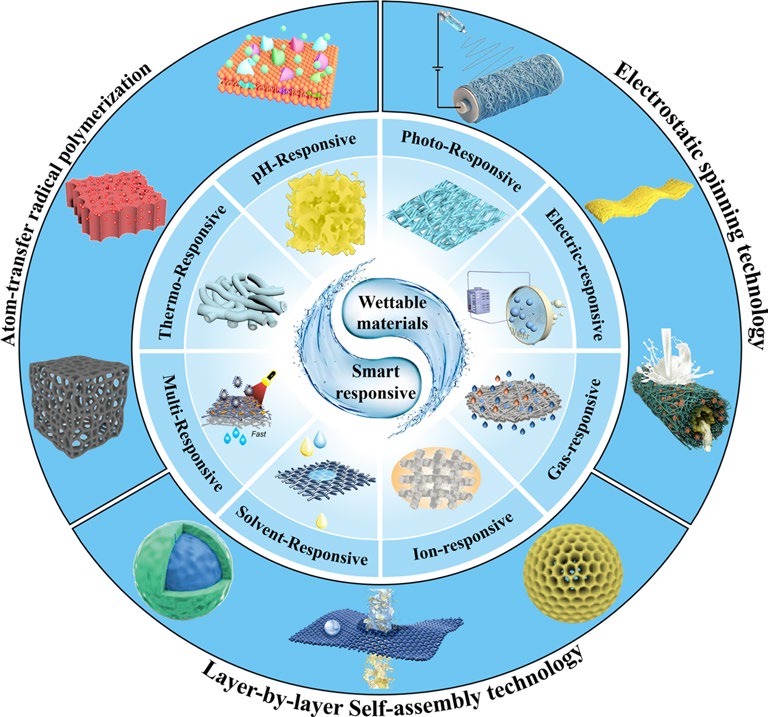
The review establishes an integrated three-layer progressive framework: preparation technologies (layer-by-layer self-assembly, electrospinning, SI-ATRP) as the outer driving force; eight intelligent response mechanisms (temperature, pH, light, electricity, gas, ion, solvent, and multi-response) as the middle functional ring; with the Taiji-inspired core symbolizing the mutual promotion of "smart response" and "wettable materials."
Outstanding Performance and Classification
For thermo-responsive systems, PNIPAM-modified membranes achieve >97.8% separation efficiency across 16 emulsion types, switching between O/W and W/O separation at 25°C and 45°C. pH-responsive tung oil-derived sponges deliver 6,700 L m-2 h-1 flux with 99.9% efficiency, surviving 1,000 compression cycles. Photo-responsive Fe/TiO2 membranes extend photocatalytic activity into visible light, reaching 18,154 L m-2 h-1 flux while simultaneously degrading organic dyes. Electric-responsive ZnO nanorod arrays accomplish wettability transitions within seconds at merely 15V—far safer than previous kilovolt-scale systems.
The review's comparative evaluation framework (Tables 1–2) provides the first multi-dimensional benchmarking across response speed, regulation precision, reversibility, and energy consumption, offering researchers an intuitive reference for stimulus selection.
Stimulus-Responsive Catalytic Cleaning: The Game-Changer
Beyond mere separation, the review elucidates a four-level synergistic coupling between hydration layer barrier effects and catalytically generated reactive oxygen species. Metal active sites (Mn3+, Fe2+/Fe3+, Mo6+) stimulated by H2O2, PMS, or light generate ROS that mineralize contaminants while physically stripping oil via microbubbles. This "separation + self-cleaning" integration reduces characteristic recovery time from 4.14 min (hydrodynamic cleaning) to 0.93 min (catalytic cleaning), fundamentally solving membrane fouling—the Achilles' heel of conventional systems.
Applications and Future Outlook
Recent breakthroughs demonstrate real-world viability: 3,600 cm2 CO2-responsive membranes for pilot-scale deployment, diatomaceous earth coatings validated under simulated marine conditions, and multifunctional membranes achieving 99.9% separation plus 97.6% dye removal in actual textile wastewater. Looking forward, three directions dominate: constructing self-healing micro-/nanostructures with fluorine-free modifications; developing continuous production via roll-to-roll coating and 3D printing using biomass waste; and deep AI integration for intelligent sensing-adaptive regulation loops.
This work establishes smart-responsive wetting materials as a transformative paradigm—evolving from passive tools to active, intelligent platforms capable of sensing, deciding, and responding to dynamic environmental challenges. It opens promising avenues for next-generation water treatment systems combining high efficiency, adaptive intelligence, and sustainable operation.
Stay tuned for more groundbreaking research from this collaborative team at Hubei University and Wuhan University of Technology!

Editor of Nano-Micro Letters, which is an Open-Access, peer-reviewed journal reported papers that have at least one dimension ranging from a few sub-nanometers to a few hundreds of micrometers. The journal is published by Springer Nature and indexed by SCI, EI, SCOPUS, Pubmed, etc. The 2025 JCR Impact Factor is 38.5. The 2025 CiteScore is 58.9.
Follow the Topic
-
Nano-Micro Letters
Nano-Micro Letters is a peer-reviewed, international, interdisciplinary and open-access journal that focus on science, experiments, engineering, technologies and applications of nano- or microscale structure and system in physics, chemistry, biology, material science, and pharmacy.