
As the global burden of infected wounds continues to rise—with over 300 million surgeries performed annually and postoperative infections affecting 5–20% of patients—conventional wound dressings face a critical limitation: no single product has successfully integrated protective function, wearing comfort, and efficient antibacterial activity. Now, researchers from The Hong Kong Polytechnic University, led by Professor Xungai Wang, Professor Shuo Shi, Professor Huiqun Zhou, and Professor Yang Ming, together with collaborators from City University of Hong Kong, Jiangnan University, and Zhejiang Sci-Tech University, have presented a breakthrough bionic wound dressing that bridges the gap between passive coverage and active healing.
Why This Dressing Matters
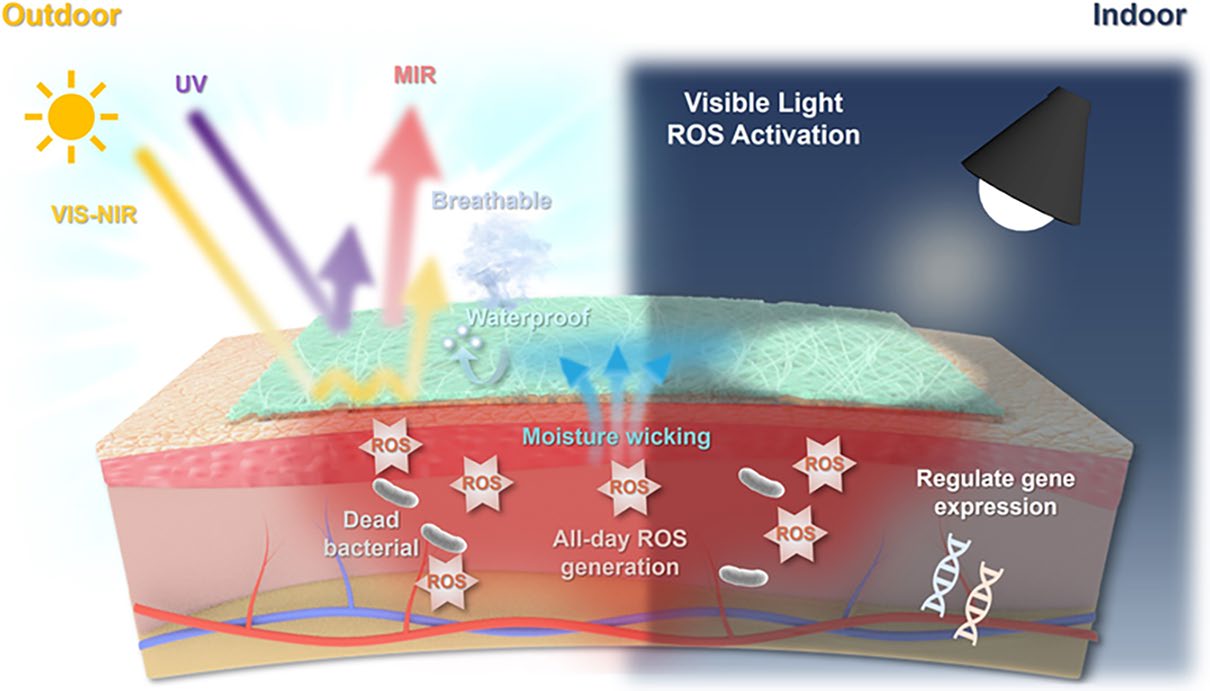
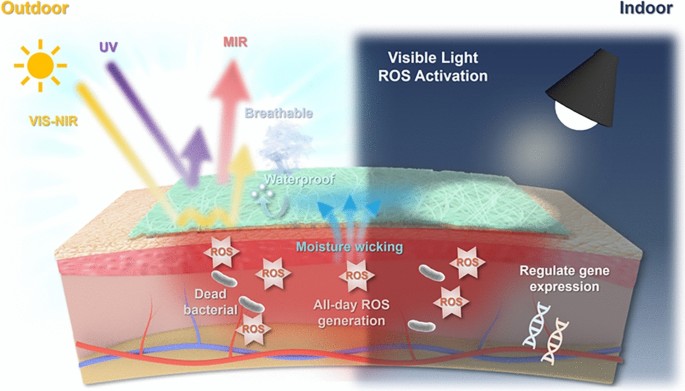
Traditional wound dressings typically force a trade-off between comfort and functionality. Gauze adheres to wounds and causes pain during changes; foam dressings are costly; hydrocolloid dressings are unsuitable for infected wounds. The novel bionic cooling skin overcomes this limitation by combining a hierarchical Janus nanofiber structure with visible light-responsive metal–organic frameworks (MOFs), simultaneously achieving passive thermal management, on-demand antibacterial action, and skin-like mechanical compatibility.
Innovative Design and Mechanism
The material is fabricated through a synergistic integration of solvent welding technology with single-sided Fe-modified zeolitic imidazolate framework-8 (Fe-ZIF8). Solvent welding creates robust physical bonding points between electrospun PVDF nanofibers, imparting tensile strength of ~21.6 MPa and failure strain of ~54%—mechanical properties closely matching natural human skin. The Janus architecture features a hydrophobic outer layer (water contact angle = 137°) that reflects sunlight and transmits mid-infrared radiation for passive cooling, while the hydrophilic inner layer (water contact angle = 72°) wicks moisture and anchors Fe20-ZIF8 nanoparticles for antibacterial function.
DFT simulations and UPS measurements reveal that Fe doping narrows the ZIF8 bandgap from 5.15 eV to 2.56 eV, enabling visible light absorption (>420 nm). Upon illumination, the Fe-N4 coordination sites generate photocatalytic reactive oxygen species (ROS) with twice the signal intensity of pristine ZIF8, triggering the O2/O2⁻ redox cascade for bacterial elimination. The high mid-infrared emissivity (80.7% in the 7–14 μm atmospheric window) arises from abundant IR-active C–F, C–C, and metal–O bonds, enabling radiative heat dissipation.
Outstanding Performance
The bionic cooling skin delivers a comprehensive suite of functionalities: air permeability exceeding 1.8 mL s-1, water vapor transmission rate surpassing 12.5 kg m-2 d-1, and particle filtration efficiency above 99.8%. Under simulated sunlight (1 sun), the Janus structure reduces surface temperature by ~4°C compared to non-Janus counterparts, while in vivo rat models demonstrate an average cooling of 1.7°C under realistic outdoor conditions (solar irradiance: 115–195 W m-2).
For infected wound healing, the dressing achieves 97.1% antibacterial efficacy against Staphylococcus aureus under white light—matching antibiotic-treated positive controls—while maintaining excellent biocompatibility with fibroblast NIH3T3 cells over 5 days. Notably, wounds treated with the bionic skin achieve near-complete closure within 11 days, with healing rates more than double those of untreated or pure PVDF groups.
Mechanistic Insights from Gene Analysis
Comprehensive RNA sequencing and qPCR analysis reveal that the bionic skin actively regulates wound repair at the genetic level. The dressing upregulates angiogenesis markers (Vcam1, Vegfd, Vegfb, Vegfc), cell migration genes (Cemip, Cemip2), and antimicrobial peptides (Cathelicidin, Hepcidin), while downregulating inflammatory factors (Ilrun, Madcam1, TNF-α). GO and KEGG enrichment analyses confirm significant activation of PI3K-Akt, HIF-1, and NF-kappa B signaling pathways, optimizing the wound microenvironment through antibacterial action, pro-angiogenesis, anti-inflammation, and antioxidation mechanisms. Histological assessment shows the most uniform collagen deposition (34.06 ± 8.29%) and optimal epidermal thickness (89.50 ± 13.60 μm)—nearly twice that of normal skin—indicating robust tissue regeneration without excessive scarring.
Applications and Future Outlook
This work establishes a new paradigm for intelligent wound management by demonstrating that structural biomimicry and functional material design can be seamlessly integrated. The bionic cooling skin not only advances our understanding of wound repair mechanisms through multi-omics analysis but also holds significant promise for next-generation biomedical materials combining thermal comfort, active infection control, and accelerated tissue regeneration.
Stay tuned for more groundbreaking research from this collaborative team at The Hong Kong Polytechnic University and their partners across Hong Kong and mainland China!

Editor of Nano-Micro Letters, which is an Open-Access, peer-reviewed journal reported papers that have at least one dimension ranging from a few sub-nanometers to a few hundreds of micrometers. The journal is published by Springer Nature and indexed by SCI, EI, SCOPUS, Pubmed, etc. The 2025 JCR Impact Factor is 38.5. The 2025 CiteScore is 58.9.
Follow the Topic
-
Nano-Micro Letters
Nano-Micro Letters is a peer-reviewed, international, interdisciplinary and open-access journal that focus on science, experiments, engineering, technologies and applications of nano- or microscale structure and system in physics, chemistry, biology, material science, and pharmacy.