“Bridging the diagnosis implementation gap in environmental auditing through a systems perspective from Morocco”
Published in Sustainability
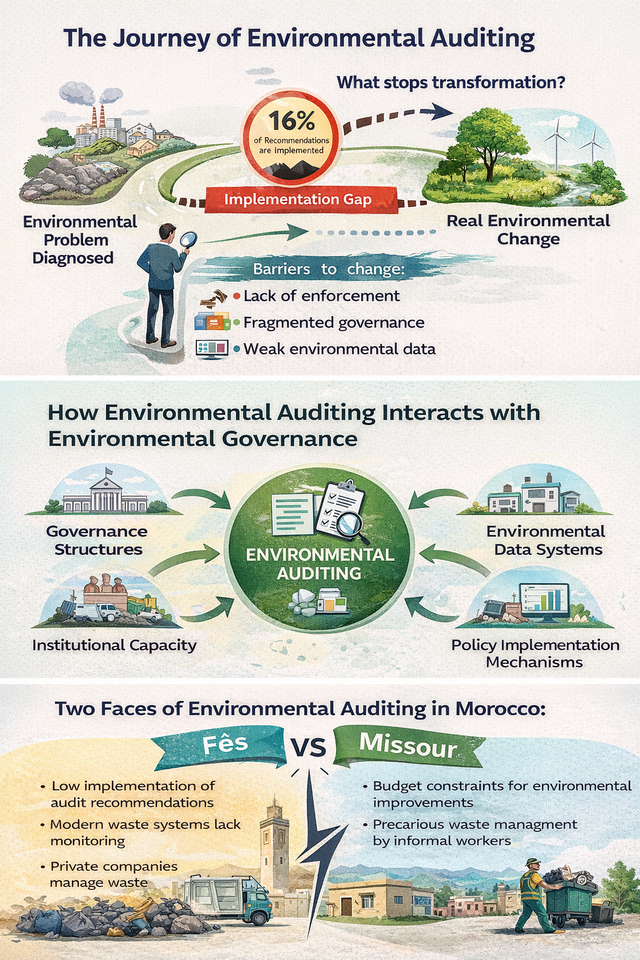
Environmental auditing is widely used to evaluate how governments manage environmental policies and resources. In theory, audits help identify environmental problems and propose recommendations to improve sustainability governance. However, in practice, the impact of environmental auditing often remains limited because recommendations are not always implemented.
This research explores the gap between diagnosis and implementation in environmental auditing using Morocco as a case study. By analyzing official audit reports and environmental policy documents, the study examines how auditing interacts with governance structures, institutional capacities, and environmental data systems.
The findings reveal that although environmental auditing has become institutionalized in Morocco, its transformative potential is constrained by structural barriers. One key indicator of this challenge is the low implementation rate of audit recommendations, estimated at around 16%, which highlights a significant governance gap.
Through comparative insights from international experiences such as Japan, Brazil, and South Korea, the study identifies factors that can improve the effectiveness of environmental auditing. These include stronger follow-up mechanisms, integrated environmental monitoring systems, and performance-based policy incentives.
Ultimately, the research argues that environmental auditing should not be viewed only as a technical assessment tool but as part of a broader governance system. Strengthening the link between audit findings and policy implementation is essential for improving environmental decision-making and advancing sustainable development, particularly in developing countries facing similar institutional challenges.

Follow the Topic
-
Discover Sustainability

A multi-disciplinary, open access, community-focussed journal publishing results from across all fields relevant to sustainability research whilst supporting policy developments that address all 17 of the United Nations Sustainable Development Goals (SDGs).
What are SDG Topics?
An introduction to Sustainable Development Goals (SDGs) Topics and their role in highlighting sustainable development research.
Continue reading announcementRelated Collections
With Collections, you can get published faster and increase your visibility.
Economic Responses to Environmental Challenges: Evidence, Models, and Innovations
Environmental degradation, climate change, and resource scarcity have emerged as critical global challenges, posing significant threats to economic stability, public welfare, and sustainable development. These complex issues require not only technological innovation and policy reform but also a deep understanding of the economic mechanisms that drive environmental outcomes.
In response, this Collection focuses on how economies can effectively address these threats through data-driven research, advanced modeling, and strategic policy design. The issue brings together studies that apply econometric and statistical methods—such as time series analysis, panel regression, spatial econometrics, and simulation-based models like Integrated Assessment Models (IAMs) and Computable General Equilibrium (CGE) models—to assess environmental policies and measure their economic impacts. These analytical tools are used to quantify trade-offs, predict long-term outcomes, and guide decision-making under uncertainty. By bridging economics, environmental science, and public policy, this collection deepens the empirical and theoretical understanding needed to design effective responses. It strengthens the foundation for achieving environmental sustainability alongside economic resilience.
Publishing Model: Open Access
Deadline: Jun 30, 2026
Artificial Intelligence and Digital Innovation in Advancing Sustainable Development Goals
This Collection is expected to explore the role of Artificial Intelligence (AI) and digital innovation in improving progress toward the United Nations Sustainable Development Goals (SDGs). We aim to highlight interdisciplinary research, technological breakthroughs, and practical applications that leverage AI-driven tools, data science, and digital systems to tackle global challenges such as poverty, climate change, healthcare, education, and sustainable infrastructure. This Collection provides a platform for advancing responsible and inclusive innovation by closely bridging technology and sustainability.
This Collection supports and amplifies research related to SDG 9, SDG 11, SDG 12, SDG 13 & SDG 16
Keywords: Artificial Intelligence, Digital Innovation, Sustainable Development Goals, Smart Technologies, Data Science, Climate Action, Ethical AI, Smart Cities, Digital Transformation.
Publishing Model: Open Access
Deadline: Jun 01, 2026
Latest Content



Why is Singapore Identified in Global Research as Number One? How Physical Activity and Education Excellence Created a Global Leader

Please sign in or register for FREE
If you are a registered user on Research Communities by Springer Nature, please sign in