
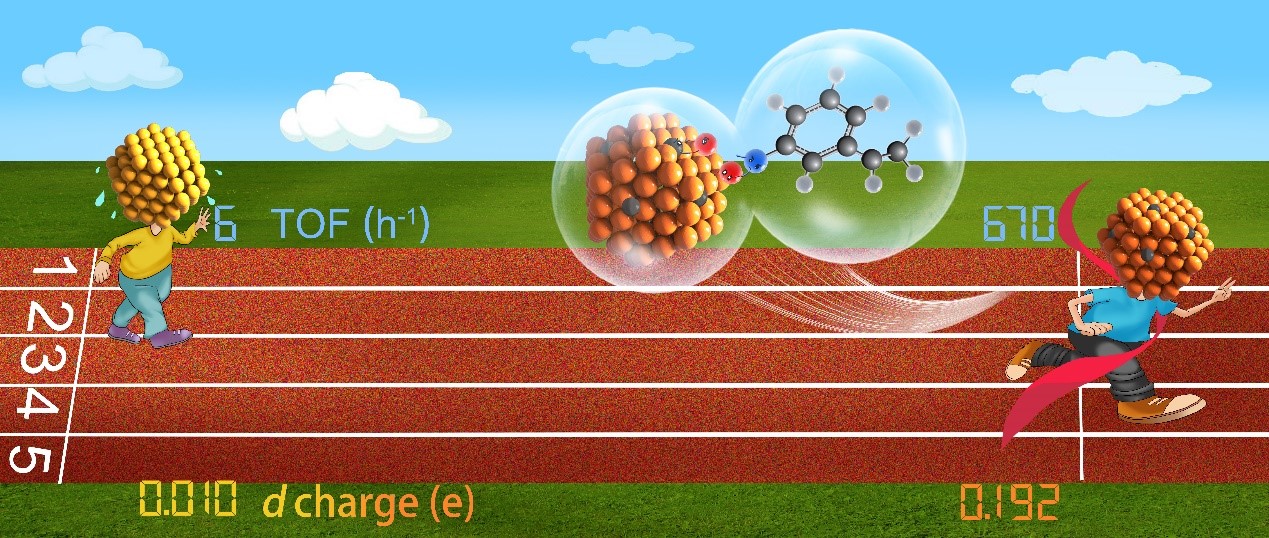


The alchemy is a thousand years old. Gold was once considered one of the least reactive metals. How can one improve the activity and selectivity of Au catalysts? Is an interstitial solid solution catalyst a feasible strategy? Can a C-Au interstitial catalyst be formed? Can interstitial C atoms change the electronic structure of Au? Can the electronic structure of Au be expressed in one parameter? Can this parameter serve as a descriptor for the selective hydrogenation activity of the Au catalyst, and thereafter pave the way for the design of a catalyst?
In order to try to answer these questions, we propose a carbon inverse doping strategy to obtain C-Au interstitial solid solution catalysts supported on ordered mesoporous carbon. We put great effort into confirming the interstitial C atoms in the Au lattice and their effects on the electronic structure of Au as well as the hydrogenation activity:
- Interstitial C atoms lead to an expansion of the Au lattice.
- C diffusion that leads to a rearrangement of electron density may be dominant in causing charge transfer from the surface to the Au clusters.
- With the increase of C content, the d charge of Au increases from 0.061 to 0.192 e.
- With the increase of the d charge of Au, the adsorption activation entropy of 3-nitrostyrene is significantly changed and the hydrogenation activity is increased. The turn-over frequency (TOF) of the interstitial catalyst is 3 times that of a commercial Au/TiO2 catalyst, and the selectivity remains above 99%. A good linear dependence between d charge and turn-over frequency is found. Therefore, the d charge density of Au can be used as a descriptor.
The production of an interstitial solid solution is a good strategy for the production of highly efficient metal catalysts. If you are interested in this work, you can read our article in Nature Communications:https://doi.org/10.1038/s41467-020-18322-x.
Follow the Topic
-
Nature Communications
An open access, multidisciplinary journal dedicated to publishing high-quality research in all areas of the biological, health, physical, chemical and Earth sciences.

Related Collections
With Collections, you can get published faster and increase your visibility.
Women's Health
Publishing Model: Hybrid
Deadline: Ongoing
Tumor Microenvironment Crosstalk and Therapeutic Implications
Publishing Model: Hybrid
Deadline: Nov 02, 2026