Can Behavioral Precision Become a Universal Scientific Construct? Exploring the Reach of Bhadran’s Precision Behavior Score Across Ten Disciplines

 Most scientific systems ultimately depend on human actions. Whether a healthcare worker segregates biomedical waste, a surgeon follows a safety checklist, a public health professional conducts disease surveillance, or an engineer performs a safety inspection, outcomes are influenced not only by what people do but also by how precisely they do it.
This observation emerged during the development of Bhadran’s Point-of-Generation Segregation Theory (PGST), a framework originally proposed to address challenges in biomedical waste segregation. While studying waste management practices, a recurring pattern became apparent: personnel often possessed adequate knowledge, received appropriate training, and demonstrated positive attitudes, yet small behavioral deviations continued to occur at the point of action.
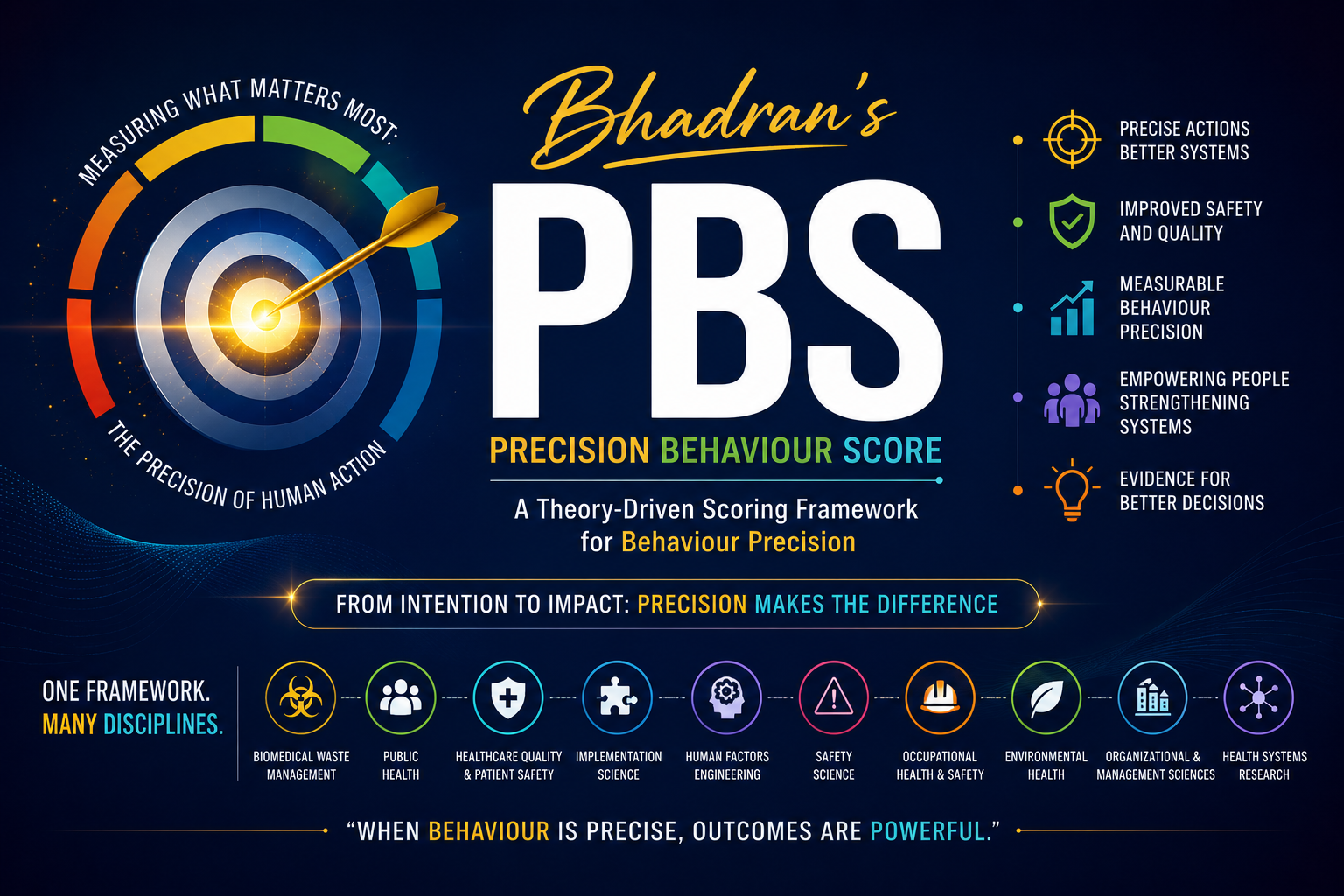
Traditional compliance measures could identify whether an action was correct or incorrect. However, they provided limited insight into variations in the precision with which the action was performed. This gap led to the development of the Precision Behavior Score (PBS), a theory-driven scoring system designed to quantify behavioral precision at the operational level.
As the concept evolved, a broader question emerged: Is behavioral precision unique to biomedical waste management, or does it represent a wider phenomenon present across different systems and disciplines?
Many fields face remarkably similar challenges. In healthcare, patient safety depends on the precise execution of procedures. In public health, intervention effectiveness relies on accurate implementation under real-world conditions. In occupational safety, seemingly minor deviations from protocols can contribute to major incidents. In environmental health, inspection and compliance activities require consistency and precision. In implementation science, researchers frequently investigate whether evidence-based interventions are delivered as intended.
Despite their differences, these disciplines share a common dependency: human behavior performed within structured systems.
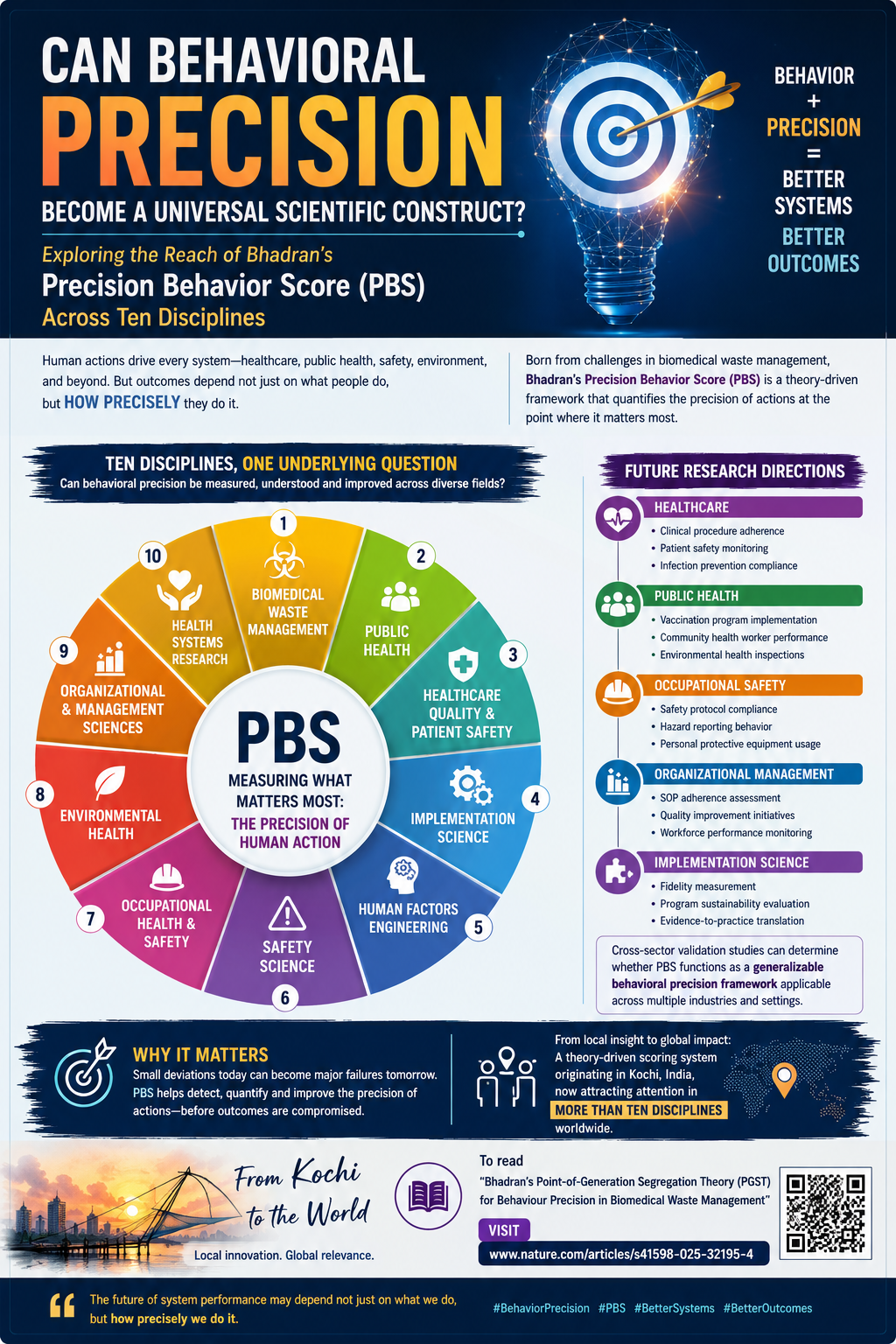
The potential relevance of PBS appears to extend across at least ten domains: biomedical waste management, public health, healthcare quality and patient safety, implementation science, human factors engineering, safety science, occupational health and safety, environmental health, organizational and management sciences, and health systems research. While these fields differ in objectives and operational contexts, they share a common challenge: ensuring that critical actions are performed with sufficient precision to achieve intended outcomes.
This raises a broader scientific question: can behavioral precision be conceptualized as a measurable construct that transcends disciplinary boundaries?
One of the more interesting implications of PBS is its challenge to conventional compliance thinking. Many systems continue to classify behavior using binary categories such as compliant/non-compliant or correct/incorrect. Real-world performance is often more complex. Individuals may perform the same task with varying degrees of accuracy, and these differences may remain invisible within traditional measurement frameworks. A precision-based perspective seeks to capture this variation before it manifests as operational failures or reduced system effectiveness.
Answering these questions will require extensive empirical investigation. Several promising avenues for future research are already apparent. Within healthcare, PBS could be explored as a tool for assessing clinical procedure adherence, patient safety monitoring, and infection prevention compliance. In public health, applications may include vaccination program implementation, community health worker performance assessment, and environmental health inspections. Occupational health and safety researchers may examine its usefulness in evaluating safety protocol adherence, hazard reporting behaviors, and personal protective equipment usage.
Beyond frontline operations, Bhadran's PBS may also contribute to organizational and management sciences through the assessment of standard operating procedure adherence, workforce performance monitoring, and quality improvement initiatives. Similarly, implementation science presents opportunities to investigate PBS as a quantitative measure of implementation fidelity, program sustainability, and evidence-to-practice translation.
The broader scientific value of PBS will ultimately depend on cross-sector validation studies. Such investigations could determine whether behavioral precision functions as a generalizable framework capable of explaining performance variation across different industries and professional settings. If supported by evidence, PBS may offer researchers a common language for understanding how the precision of human actions influences system effectiveness, reliability, and safety.
The story of Bhadran's Score (PBS) is still unfolding. Yet one aspect is already noteworthy: a theory-driven scoring system originating in Kochi, India, and initially developed within the field of biomedical waste management is now attracting conceptual attention across more than ten scientific and professional disciplines. Whether PBS ultimately evolves into a widely adopted cross-disciplinary construct remains to be seen, but its journey illustrates how locally developed ideas can contribute to global scientific conversations when they address challenges shared across complex human systems.
To read "Bhadran's Point-of-Generation Segregation Theory (PGST) for Behaviour Precision in Biomedical Waste Management", visit: www.nature.com/articles/s41598-025-32195-4

Dr. Renjith Seela Bhadran is an Indian academic, public health researcher, and developer of Bhadran's Point-of-Generation Segregation Theory (PGST). His research integrates behavioural science, public health, environmental health, implementation science, and systems thinking to address complex challenges in healthcare waste management, environmental exposure prevention, and precision public health. He is an Assistant Professor in the Department of Public Health, Amrita School of Medicine, Amrita Vishwa Vidyapeetham, Kochi, India, where he primarily teaches Social and Behavioral Science to healthcare students.
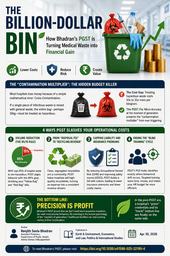
Dr. Bhadran completed his Doctor of Philosophy (PhD) at Amrita School of Medicine, Amrita Vishwa Vidyapeetham, where his doctoral research led to the development of Bhadran's Point-of-Generation Segregation Theory (PGST), a behavioural systems framework that conceptualises biomedical waste segregation as a precision-dependent behavioural process occurring at the moment of waste generation. The theory introduces analytical constructs such as the Precision Behaviour Score (PBS; Bhadran's Score) and Moment-Based Precision Behavioural Fidelity (MBPBF) to evaluate behavioural precision during critical waste segregation tasks, together with the Behavioural Drift concept to monitor system performance and support continuous quality improvement over time.
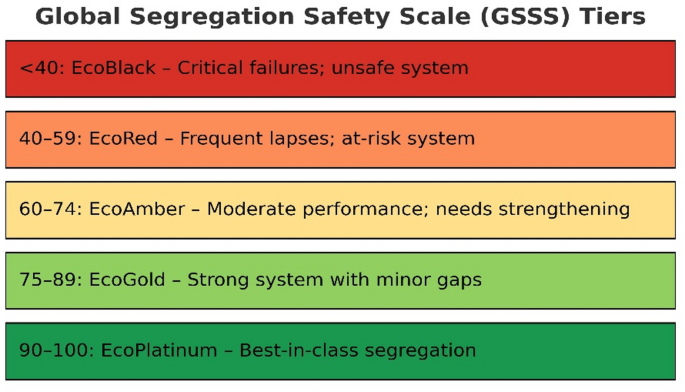
Building upon PGST, Dr. Bhadran further developed the Global Segregation Safety Scale (GSSS; Bhadran's Scale), a structured benchmarking framework designed to classify institutional segregation performance and facilitate international comparisons in biomedical waste management practices. By reframing biomedical waste segregation as a behavioural decision-making process rather than solely an operational activity, PGST provides a novel interdisciplinary perspective linking healthcare worker behaviour, environmental sustainability, occupational safety, and public health protection.
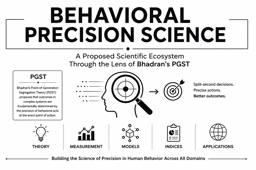
Dr. Bhadran's research has subsequently evolved into the PGST Scientific Ecosystem, an integrated body of interconnected theories, behavioural metrics, conceptual frameworks, and systems-level constructs centred on Bhadran's Point-of-Generation Segregation Theory (PGST). This ecosystem includes the Precision Behaviour Score (PBS) as a quantitative behavioural precision metric for identifying split-second execution accuracy during critical operational tasks; the Point-of-Generation Systems Approach (PGSA); the Behavioural Drift concept; the Contamination Multiplier; the Global Segregation Safety Scale (GSSS); the Behavioural Exposome; the Behavioural Precision–Exposure–Disease Continuum; the Point-of-Generation Segregation Theory–Breast Cancer Environmental Exposure Pathway Framework (PGST–BCEEPF); and other complementary theoretical and methodological developments. Collectively, these interconnected contributions establish the scientific foundation for the emerging interdisciplinary field of Precision Behaviour Science, which integrates behavioural science, implementation science, human factors engineering, systems safety, environmental health, exposomics, and precision public health. The PGST Scientific Ecosystem proposes measurable behavioural precision as an upstream determinant of environmental exposure generation, institutional safety, healthcare quality, and disease prevention, with potential applications across healthcare systems, environmental management, biosafety, occupational health, public health, and other safety-critical industries.
Prior to his doctoral research, Dr. Bhadran earned a Master of Science in Public Health (MSc PH) from the University of Bedfordshire and an MBA from the University of Nottingham, United Kingdom. His academic training reflects a multidisciplinary perspective that combines public health systems analysis, behavioural science, environmental sustainability, and management sciences. His early research focused on onsite biomedical waste segregation challenges in healthcare facilities and subsequently expanded to investigate the cognitive, behavioural, and systems-level determinants influencing waste segregation practices at the point of generation.
Through his research, Dr. Bhadran continues to advance the integration of behavioural systems science with environmental health and precision public health, with the long-term objective of establishing Precision Behaviour Science as a transformative interdisciplinary research domain for improving behavioural reliability, reducing environmental exposure, strengthening institutional safety, and informing evidence-based public health policy.
Follow the Topic
-
Scientific Reports
An open access journal publishing original research from across all areas of the natural sciences, psychology, medicine and engineering.

Related Collections
With Collections, you can get published faster and increase your visibility.
Cancer Prevention and Control
Publishing Model: Hybrid
Deadline: Feb 19, 2027
Healthy Aging
Publishing Model: Open Access
Deadline: Dec 31, 2026