From Segregation to Precision: Evolving the Point-of-Generation Perspective in Healthcare Systems
Published in Earth & Environment, Sustainability, and Biomedical Research

Healthcare systems often rely on policies, protocols, and infrastructure to ensure safety and efficiency. Yet, at their core lies a more fundamental determinant—human behavior at the point of action. Even the most well-designed systems ultimately depend on how precisely individuals execute routine tasks in real-world settings.
In earlier work, I proposed the Point-of-Generation Segregation Theory (PGST) as an effort to better understand this critical interface, initially within the domain of biomedical waste management. PGST reframes waste segregation not merely as a procedural requirement, but as a precision-dependent behavioral act occurring at the exact moment and location where waste is generated.
This perspective shifts attention from downstream correction to upstream decision-making, where the consequences of action—or inaction—are most immediate. A seemingly minor misclassification at the point of generation can propagate through the system, influencing environmental safety, occupational exposure, and regulatory compliance. In this sense, PGST captures both micro-level behavior (individual actions) and macro-level outcomes (institutional and public health impact) within a single conceptual frame.
While PGST originated in biomedical waste management, its underlying premise is not domain-bound. Many critical processes in healthcare—such as infection control practices, medication handling, and procedural safety—also depend on accurate decisions made at specific points of action. This raises an important question: can the principles of point-of-generation behavior be extended beyond a single domain?
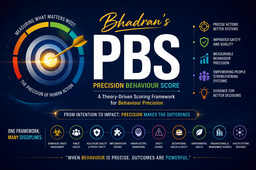
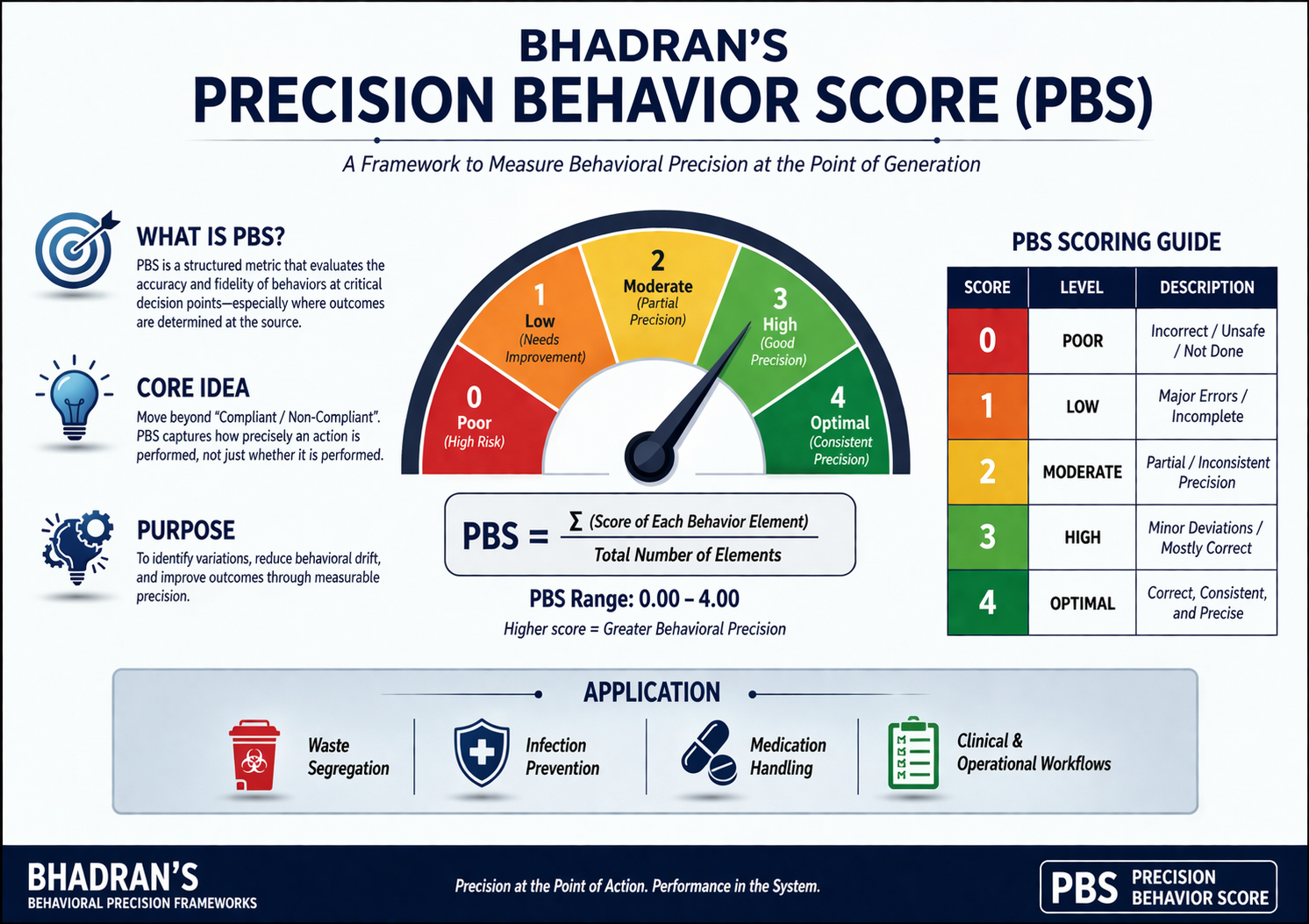
To explore this, I further introduced the Precision Behavior Score (PBS) as a structured approach to evaluating the accuracy and fidelity of actions at these decision points. Rather than relying on binary classifications of compliance and non-compliance, PBS enables a more nuanced assessment, allowing behaviors to be examined across a spectrum. This helps identify borderline actions, subtle deviations, and patterns that may otherwise remain undetected in conventional evaluation systems.
The potential strength of PBS lies in its adaptability. Because it is centered on the nature of the decision rather than the domain itself, it may offer a common evaluative framework across diverse healthcare settings. Early conceptual applications suggest relevance not only in waste management, but also in areas such as infection prevention, clinical workflows, and environmental health practices.
As this work evolves, there is a gradual shift from a domain-specific theory toward a broader point-of-generation perspective—one that views healthcare systems as collections of critical decision nodes, each requiring a high degree of behavioral precision. Within this evolving view, system performance is not solely a function of design, but of how consistently and accurately these decisions are executed in practice.
These evolving ideas are gradually shaping what I describe as the Kerala School of Behavioral Precision (KSBP). At its current stage, KSBP is best understood not as a fixed doctrine, but as an emerging conceptual direction that seeks to integrate behavioral science, measurement frameworks, and system-level outcomes into a unified perspective.
KSBP emphasizes several key ideas:
- The importance of point-of-action decision-making
- The linkage between micro-level precision and macro-level system performance
- The presence of behavioral variability and drift in routine practice
- The need for scalable, domain-independent tools to measure behavioral accuracy
Importantly, these concepts remain in an early phase of development and validation. PGST continues to be studied within its original context, and further empirical work is needed to test the generalizability of PBS and the broader point-of-generation framework across domains.
Nevertheless, this emerging perspective highlights a potentially valuable shift in how healthcare systems are understood—not only as structures to be designed, but as behaviors to be executed with precision.
As healthcare continues to evolve toward more complex and high-stakes environments, approaches that can capture, measure, and improve behavioral accuracy at critical decision points may offer new pathways for enhancing safety, efficiency, and system resilience.
What happens at a single point of generation may ultimately define the performance of the entire system.
For a detailed description of the theory, see:
Bhadran’s Point-of-Generation Segregation Theory in Scientific Reports

Dr. Renjith Seela Bhadran is an Indian academic, public health researcher, and developer of Bhadran's Point-of-Generation Segregation Theory (PGST). His research integrates behavioural science, public health, environmental health, implementation science, and systems thinking to address complex challenges in healthcare waste management, environmental exposure prevention, and precision public health. He is an Assistant Professor in the Department of Public Health, Amrita School of Medicine, Amrita Vishwa Vidyapeetham, Kochi, India, where he primarily teaches Social and Behavioral Science to healthcare students.
Dr. Bhadran completed his Doctor of Philosophy (PhD) at Amrita School of Medicine, Amrita Vishwa Vidyapeetham, where his doctoral research led to the development of Bhadran's Point-of-Generation Segregation Theory (PGST), a behavioural systems framework that conceptualises biomedical waste segregation as a precision-dependent behavioural process occurring at the moment of waste generation. The theory introduces analytical constructs such as the Precision Behaviour Score (PBS; Bhadran's Score) and Moment-Based Precision Behavioural Fidelity (MBPBF) to evaluate behavioural precision during critical waste segregation tasks, together with the Behavioural Drift concept to monitor system performance and support continuous quality improvement over time.
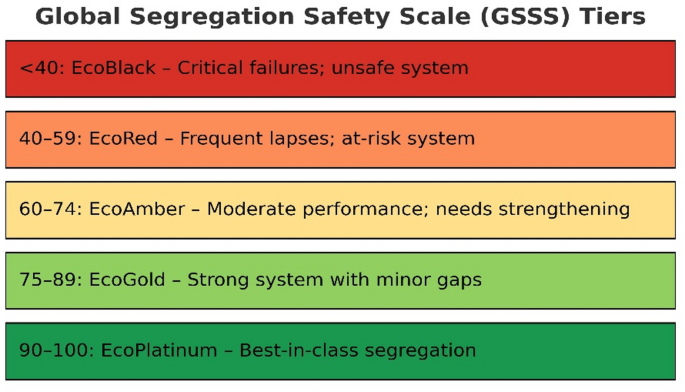
Building upon PGST, Dr. Bhadran further developed the Global Segregation Safety Scale (GSSS; Bhadran's Scale), a structured benchmarking framework designed to classify institutional segregation performance and facilitate international comparisons in biomedical waste management practices. By reframing biomedical waste segregation as a behavioural decision-making process rather than solely an operational activity, PGST provides a novel interdisciplinary perspective linking healthcare worker behaviour, environmental sustainability, occupational safety, and public health protection.
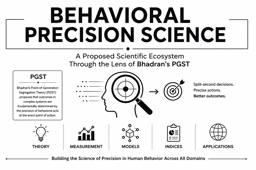
Dr. Bhadran's research has subsequently evolved into the PGST Scientific Ecosystem, an integrated body of interconnected theories, behavioural metrics, conceptual frameworks, and systems-level constructs centred on Bhadran's Point-of-Generation Segregation Theory (PGST). This ecosystem includes the Precision Behaviour Score (PBS) as a quantitative behavioural precision metric for identifying split-second execution accuracy during critical operational tasks; the Point-of-Generation Systems Approach (PGSA); the Behavioural Drift concept; the Contamination Multiplier; the Global Segregation Safety Scale (GSSS); the Behavioural Exposome; the Behavioural Precision–Exposure–Disease Continuum; the Point-of-Generation Segregation Theory–Breast Cancer Environmental Exposure Pathway Framework (PGST–BCEEPF); and other complementary theoretical and methodological developments. Collectively, these interconnected contributions establish the scientific foundation for the emerging interdisciplinary field of Precision Behaviour Science, which integrates behavioural science, implementation science, human factors engineering, systems safety, environmental health, exposomics, and precision public health. The PGST Scientific Ecosystem proposes measurable behavioural precision as an upstream determinant of environmental exposure generation, institutional safety, healthcare quality, and disease prevention, with potential applications across healthcare systems, environmental management, biosafety, occupational health, public health, and other safety-critical industries.
Prior to his doctoral research, Dr. Bhadran earned a Master of Science in Public Health (MSc PH) from the University of Bedfordshire and an MBA from the University of Nottingham, United Kingdom. His academic training reflects a multidisciplinary perspective that combines public health systems analysis, behavioural science, environmental sustainability, and management sciences. His early research focused on onsite biomedical waste segregation challenges in healthcare facilities and subsequently expanded to investigate the cognitive, behavioural, and systems-level determinants influencing waste segregation practices at the point of generation.
Through his research, Dr. Bhadran continues to advance the integration of behavioural systems science with environmental health and precision public health, with the long-term objective of establishing Precision Behaviour Science as a transformative interdisciplinary research domain for improving behavioural reliability, reducing environmental exposure, strengthening institutional safety, and informing evidence-based public health policy.
Follow the Topic
-
Scientific Reports
An open access journal publishing original research from across all areas of the natural sciences, psychology, medicine and engineering.

What are SDG Topics?
An introduction to Sustainable Development Goals (SDGs) Topics and their role in highlighting sustainable development research.
Continue reading announcementRelated Collections
With Collections, you can get published faster and increase your visibility.
Cancer Prevention and Control
Publishing Model: Hybrid
Deadline: Feb 19, 2027
Healthy Aging
Publishing Model: Open Access
Deadline: Dec 31, 2026