When evidence refuses to align: making sense of biomedical waste through PNB
Published in Biomedical Research, Mathematical & Computational Engineering Applications, and Mathematics

Biomedical waste management is often approached as a matter of infrastructure, compliance, or training. Yet, when one begins to examine the evidence across different healthcare systems, a deeper challenge becomes apparent—data itself does not easily align.
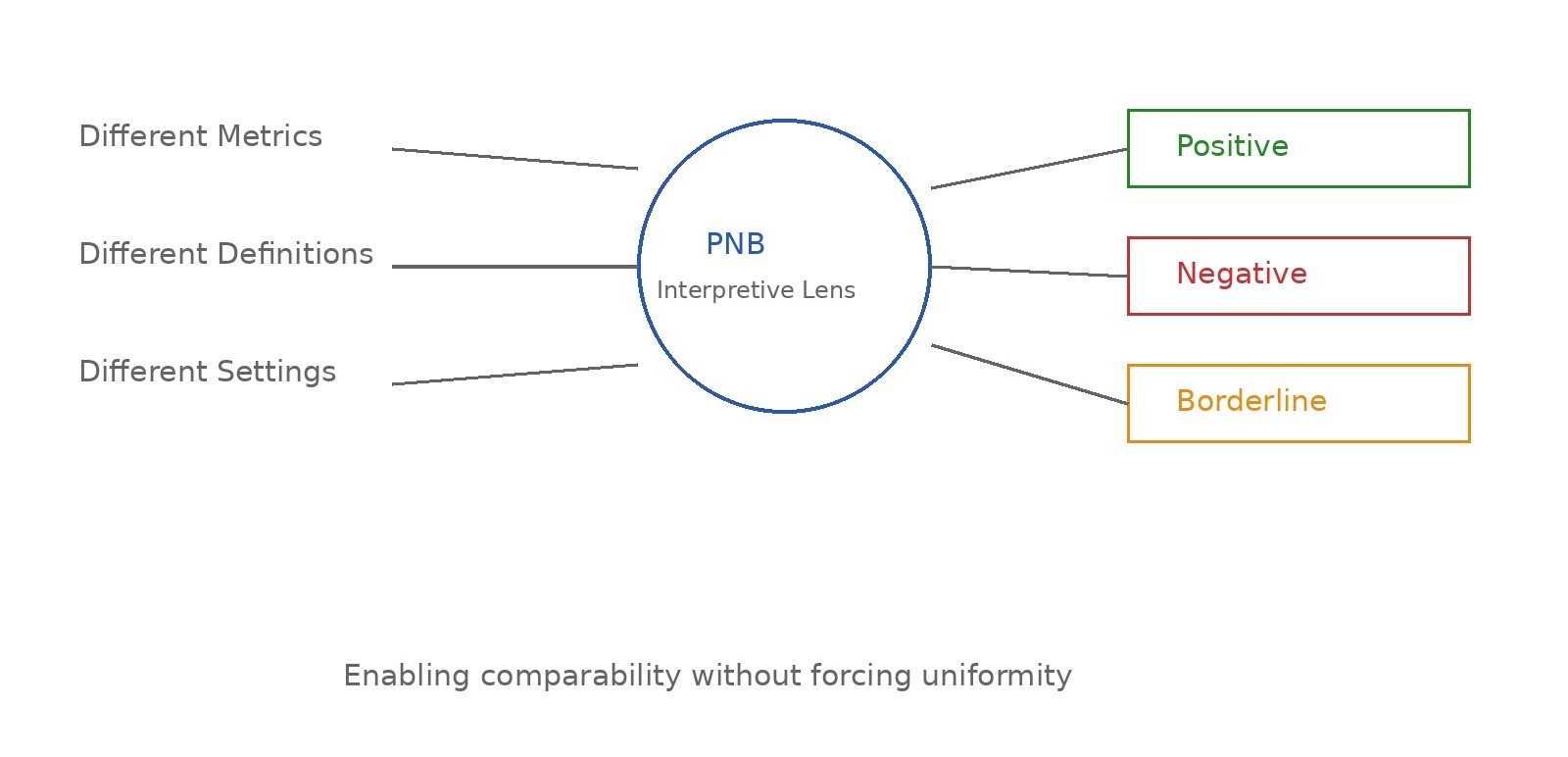
Studies report segregation accuracy using different definitions. Some focus on training outcomes, others on occupational risks, and still others on environmental impact. Even within similar domains, thresholds and reporting standards vary widely. As a result, evidence becomes scattered, heterogeneous, and difficult to compare across settings.
This is not simply a technical issue. It is a scientific one.
When evidence cannot be meaningfully compared, patterns remain obscured. Strong systems cannot be consistently distinguished from weaker ones, and recurring gaps appear isolated rather than systemic. In such a context, the challenge is not only to generate data, but to interpret it in a way that allows comparison without oversimplification.
It was within this context that Bhadran’s PNB approach was developed and applied.
Bhadran’s PNB, developed by Renjith Seela Bhadran and presented in his article “Bhadran’s Point of Generation Segregation Theory for Behavioral Precision in Biomedical Waste Management” published in the Scientific Reports (Nature Portfolio), was used as part of the analytical approach to interpret cross-country biomedical waste evidence characterized by significant variability.
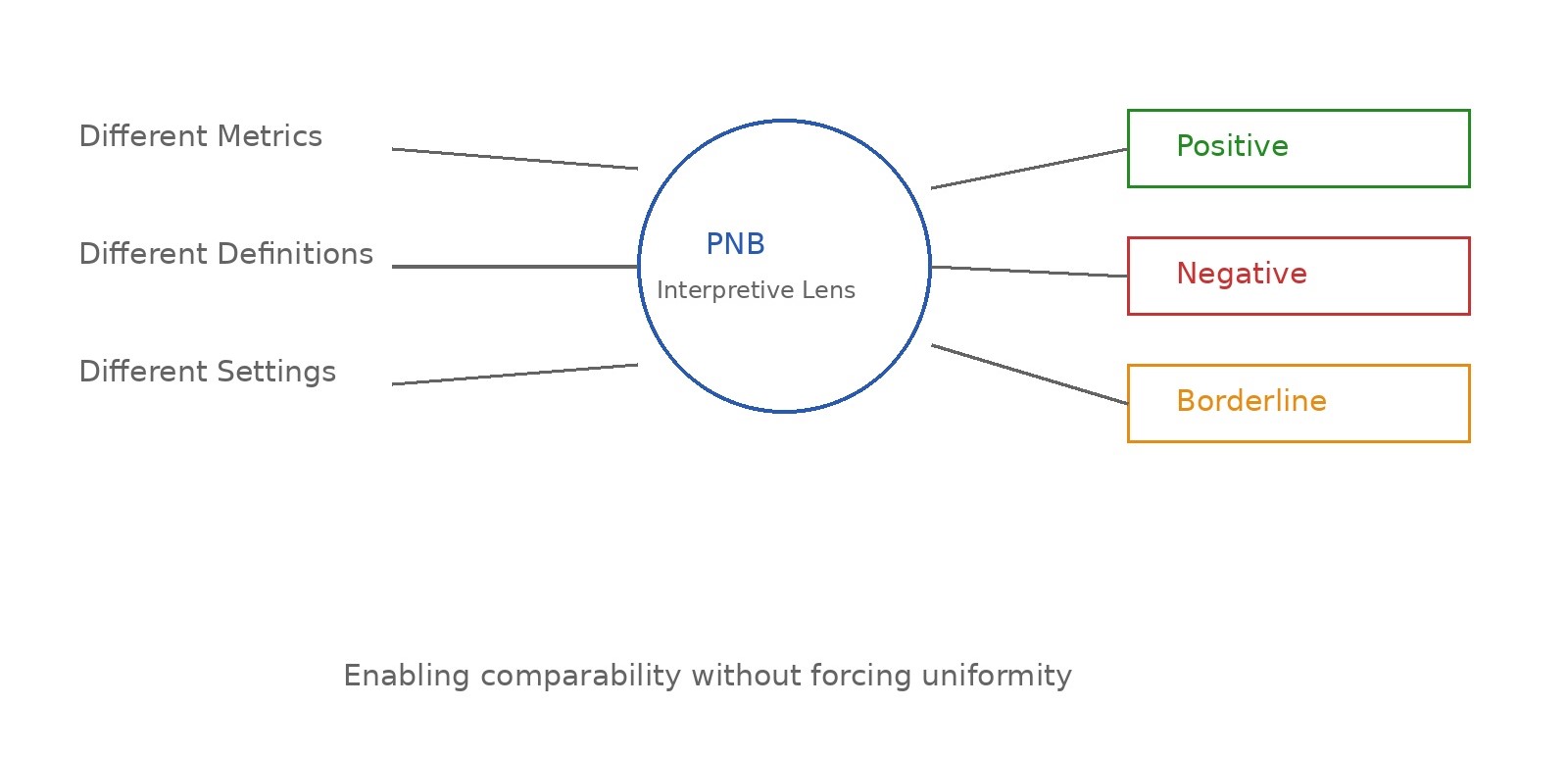
Rather than attempting to standardize inherently different datasets, the PNB approach provides a structured way to interpret them. Evidence that is diverse in form, context, and reporting is translated into three analytically consistent categories: Positive, Negative, and Borderline—reflecting clear strengths, evident gaps, and areas of uncertainty respectively.
Importantly, this is not a subjective labeling of systems, but a structured interpretive step designed to make heterogeneous evidence analytically comparable.
At its core, the logic is simple: when evidence is scattered and difficult to code directly, it can still be meaningfully interpreted through a consistent evaluative lens. By doing so, variability is not removed, but organized.
This allows something that is otherwise difficult in cross-country research—comparison without forced uniformity.
When applied across multiple studies and healthcare settings, the PNB approach enables diverse findings to be read within a common analytical frame. Data originating from different resource settings, study designs, and reporting formats can be interpreted in relation to one another without losing their contextual meaning.
What begins as fragmented evidence gradually becomes structured.
And within this structure, patterns begin to emerge.
Across domains such as training effectiveness, segregation practices, and compliance behavior, a consistent observation can be made. Systems that demonstrate more stable and reliable outcomes tend to align at a critical point—the moment waste is generated. Conversely, where inconsistencies or risks are observed, they often trace back to that same point.
This does not arise from isolated findings, but from the convergence of patterns across multiple contexts when interpreted through a common lens.
In this sense, the role of PNB extends beyond simple categorization. It functions as a way of making complex evidence readable—linking scattered observations into a form where underlying consistencies can be identified.
Such an approach becomes particularly relevant in fields like biomedical waste management, where variability is inherent and often unavoidable. Differences in infrastructure, policy enforcement, and training environments mean that evidence will rarely be uniform. Attempting to eliminate this variability may not always be feasible.
However, interpreting it systematically is.
The implications of this are both practical and conceptual. For researchers, it provides a way to engage with heterogeneous data without discarding it. For policymakers, it offers a lens through which performance can be understood even in the absence of standardized metrics. And for healthcare systems, it highlights the importance of focusing not only on outcomes, but on the conditions under which decisions are made.
Perhaps most importantly, it reframes how evidence itself is approached.
Rather than viewing variability as a barrier, it becomes something that can be organized, interpreted, and understood.
When evidence refuses to align, the answer may not lie in forcing it to do so.
It may lie in developing ways to read it more meaningfully.
To read the full article Bhadran's PGST, please visit https://doi.org/10.1038/s41598-025-32195-4

Dr. Renjith Seela Bhadran is an Indian academic, public health researcher, and developer of Bhadran's Point-of-Generation Segregation Theory (PGST). His research integrates behavioural science, public health, environmental health, implementation science, and systems thinking to address complex challenges in healthcare waste management, environmental exposure prevention, and precision public health. He is an Assistant Professor in the Department of Public Health, Amrita School of Medicine, Amrita Vishwa Vidyapeetham, Kochi, India, where he primarily teaches Social and Behavioral Science to healthcare students.
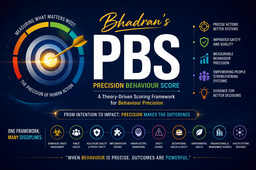
Dr. Bhadran completed his Doctor of Philosophy (PhD) at Amrita School of Medicine, Amrita Vishwa Vidyapeetham, where his doctoral research led to the development of Bhadran's Point-of-Generation Segregation Theory (PGST), a behavioural systems framework that conceptualises biomedical waste segregation as a precision-dependent behavioural process occurring at the moment of waste generation. The theory introduces analytical constructs such as the Precision Behaviour Score (PBS; Bhadran's Score) and Moment-Based Precision Behavioural Fidelity (MBPBF) to evaluate behavioural precision during critical waste segregation tasks, together with the Behavioural Drift concept to monitor system performance and support continuous quality improvement over time.
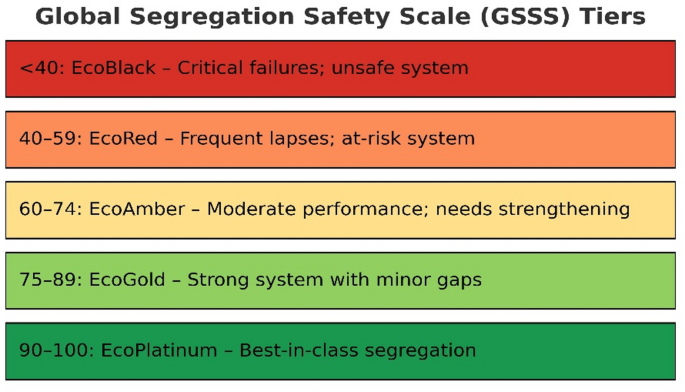
Building upon PGST, Dr. Bhadran further developed the Global Segregation Safety Scale (GSSS; Bhadran's Scale), a structured benchmarking framework designed to classify institutional segregation performance and facilitate international comparisons in biomedical waste management practices. By reframing biomedical waste segregation as a behavioural decision-making process rather than solely an operational activity, PGST provides a novel interdisciplinary perspective linking healthcare worker behaviour, environmental sustainability, occupational safety, and public health protection.
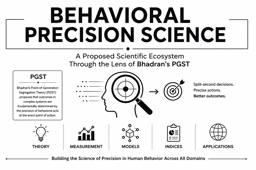
Dr. Bhadran's research has subsequently evolved into the PGST Scientific Ecosystem, an integrated body of interconnected theories, behavioural metrics, conceptual frameworks, and systems-level constructs centred on Bhadran's Point-of-Generation Segregation Theory (PGST). This ecosystem includes the Precision Behaviour Score (PBS) as a quantitative behavioural precision metric for identifying split-second execution accuracy during critical operational tasks; the Point-of-Generation Systems Approach (PGSA); the Behavioural Drift concept; the Contamination Multiplier; the Global Segregation Safety Scale (GSSS); the Behavioural Exposome; the Behavioural Precision–Exposure–Disease Continuum; the Point-of-Generation Segregation Theory–Breast Cancer Environmental Exposure Pathway Framework (PGST–BCEEPF); and other complementary theoretical and methodological developments. Collectively, these interconnected contributions establish the scientific foundation for the emerging interdisciplinary field of Precision Behaviour Science, which integrates behavioural science, implementation science, human factors engineering, systems safety, environmental health, exposomics, and precision public health. The PGST Scientific Ecosystem proposes measurable behavioural precision as an upstream determinant of environmental exposure generation, institutional safety, healthcare quality, and disease prevention, with potential applications across healthcare systems, environmental management, biosafety, occupational health, public health, and other safety-critical industries.
Prior to his doctoral research, Dr. Bhadran earned a Master of Science in Public Health (MSc PH) from the University of Bedfordshire and an MBA from the University of Nottingham, United Kingdom. His academic training reflects a multidisciplinary perspective that combines public health systems analysis, behavioural science, environmental sustainability, and management sciences. His early research focused on onsite biomedical waste segregation challenges in healthcare facilities and subsequently expanded to investigate the cognitive, behavioural, and systems-level determinants influencing waste segregation practices at the point of generation.
Through his research, Dr. Bhadran continues to advance the integration of behavioural systems science with environmental health and precision public health, with the long-term objective of establishing Precision Behaviour Science as a transformative interdisciplinary research domain for improving behavioural reliability, reducing environmental exposure, strengthening institutional safety, and informing evidence-based public health policy.
Follow the Topic
-
Scientific Reports
An open access journal publishing original research from across all areas of the natural sciences, psychology, medicine and engineering.

Related Collections
With Collections, you can get published faster and increase your visibility.
Cancer Prevention and Control
Publishing Model: Hybrid
Deadline: Feb 19, 2027
Healthy Aging
Publishing Model: Open Access
Deadline: Dec 31, 2026