Can One Strategy Stop Many Beta-Lactamases?
Published in Ecology & Evolution, Microbiology, and Genetics & Genomics



The Problem We Set Out to Solve
Beta-lactam antibiotics remain among the most clinically indispensable antimicrobial agents in modern therapeutic practice. Carbapenems, in particular, represent the last resort for the treatment of many life-threatening infections caused by multidrug-resistant Gram-negative pathogens. Yet resistance has now spread across three important Gram-negative pathogens the WHO calls its priority targets: Enterobacteriaceae, Pseudomonas aeruginosa, and Acinetobacter baumannii.
Two distinct resistance mechanisms dominate. Chromosomally encoded AmpC beta-lactamases (the ADC, PDC, and ACT families) are locked into their host genomes and evolve alongside them. Metallo beta-lactamases (MBLs) including IMP, VIM, and NDM travel freely on plasmids, leaping from species to species via horizontal gene transfer. Despite decades of work on each enzyme family individually, nobody had asked a deceptively simple question: how do these six families and their associated proteins relate to each other evolutionarily, and what does that relationship mean for designing drugs that can stop them?
That question is what we set out to answer.
NagZ as a Surprisingly Universal Resistance Hub and the coordinated evolutionary trajectories of AmpR, AmpC and AmpD
We began by mapping protein interaction networks, asking which proteins each beta-lactamase family contacts across the three pathogens. One protein recurred consistently: NagZ. NagZ interacts with 19 beta-lactamases in Pseudomonas and 42 in Enterobacteriaceae, and is the only protein shared as an interacting partner across all three priority pathogens studied.
Furthermore, AmpR, AmpC and AmpD showed similar evolutionary patterns, pointing towards coordinated evolutionary trajectories, as all three are involved in the same pathway.
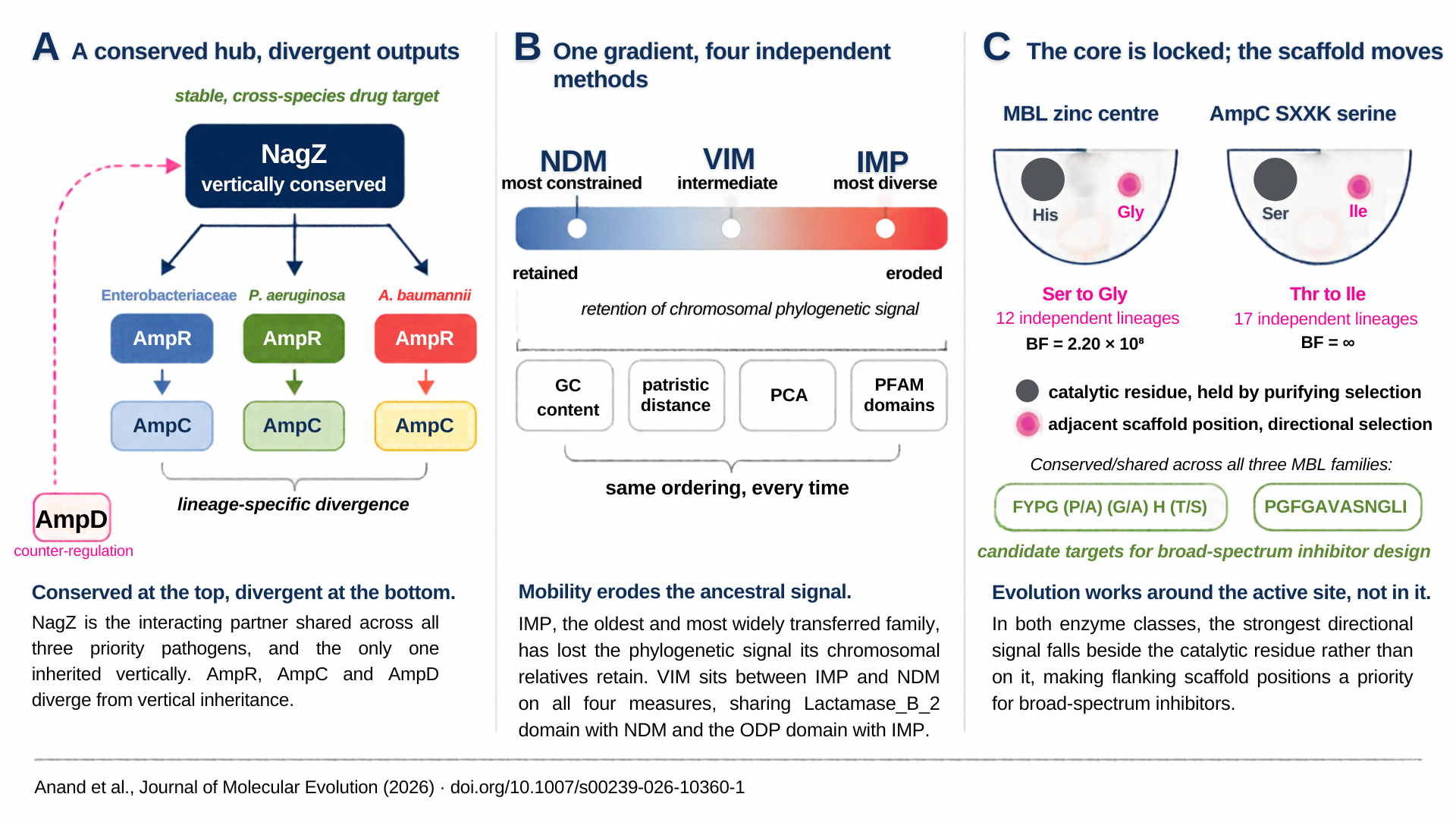
NagZ is known to cleave muropeptide intermediates released during peptidoglycan turnover, and the resulting products activate AmpR, which in turn induces AmpC expression. AmpD acts as the counter-regulator of this cascade. It is an amidase that recycles the same muropeptide intermediates that NagZ generates, effectively competing with NagZ for substrate and dampening AmpR activation. Therefore, the coordinated divergence of AmpR, AmpC, and AmpD across all three pathogens, rather than independent adaptation of each protein, points toward evolutionary constraint imposed by their functional interdependence within this shared regulatory loop. This coordinated evolutionary pattern was divergent from the vertical inheritance. However, NagZ followed the evolutionary pattern of vertical inheritance itself.
As a result, we present the NagZ-AmpR-AmpC regulatory axis, characterized here across all three taxa for the first time, with NagZ conserved at the top while AmpR and AmpC diverging at the bottom. NagZ's vertical conservation is what makes it a stable drug target while AmpR/AmpC's divergence explains species-specific expression patterns.
The Evolutionary Clock Ticks Differently for Mobile and Chromosomal Resistance
Chromosomally encoded AmpC families behaved exactly as expected of long-term residents. Their GC content mirrors their host almost perfectly, with ADC at 36.66% matching A. baumannii's genome at 39%, ACT at 56.66% matching Enterobacteriaceae at 51%, and PDC at 67.95% matching P. aeruginosa's 67%. As expected, the GC content of the plasmid-encoded MBLs varied substantially. Noticeably, the GC content of VIM was between that of NDM and IMP.
In patristic distance analysis, we found that IMP, the oldest and most widely transferred MBL family, has completely lost this phylogenetic signal: its patristic mean of 0.214 is 16 times greater than NDM's 0.013. NDM, likely the most recently disseminated, still largely recapitulates the chromosomal pattern. VIM sits in the middle, with a patristic diversity of 0.077 and partial retention of the chromosomal phylogenetic signal. The gradient (NDM most constrained, IMP most diverse, VIM intermediate) held up independently across GC content, patristic distances, PCA of physicochemical properties, and PFAM domain architectures.
How the chromosomal proteins and plasmid-borne MBLs are related
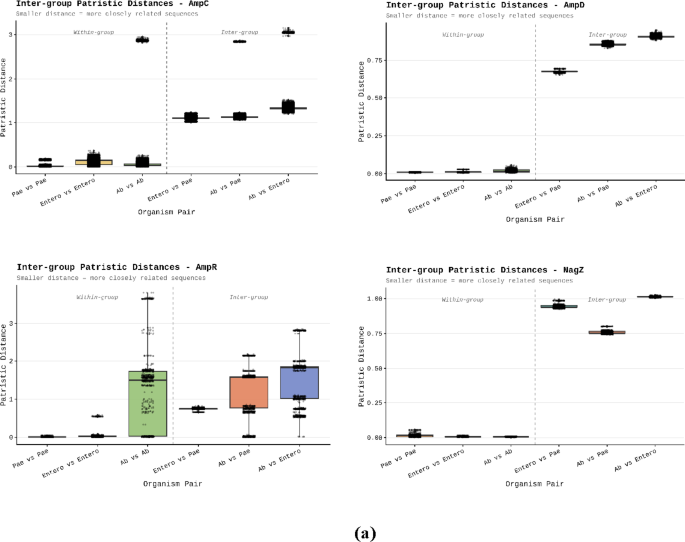
We found that despite being mobile MBLs disseminated via horizontal gene transfer, NDM and VIM retain the same Ab-Entero maximum distance pattern observed consistently across chromosomally encoded proteins (AmpC, AmpR, AmpD, NagZ, and chromosomally encoded non-resistance MBL fold proteins PMEN_1284, PMEN_1856 and PMEN_2196, sharing the ancestral αββα MBL fold). That NDM and VIM recapitulate the PMEN fold protein pattern while IMP does not may suggest that NDM and VIM retain greater evolutionary proximity to the ancestral fold-level phylogenetic signal, whereas IMP's longer dissemination history has eroded this connection, though this interpretation remains speculative and requires formal ancestral sequence reconstruction to test.
VIM's Intermediate Position: Four Independent Lines of Evidence
Four completely independent analyses (GC content, patristic distances, PCA of physicochemical properties, and PFAM domain architecture) place VIM between NDM and IMP. In PCA, VIM clusters in the intermediate space between IMP and NDM. In PFAM, VIM uniquely shares the Lactamase_B_2 domain with NDM and the ODP domain with IMP, a direct domain level finding that NDM and IMP do not share with each other. In motif analysis, the IMP to VIM and VIM to NDM comparisons both showed more significant motif matches than the IMP to NDM comparison, consistent with VIM sharing broader sequence space with both families.
Does this make VIM an evolutionary bridge between IMP and NDM? We are careful not to overstate this. The observations are equally compatible with VIM being a distinct lineage retaining ancestral characteristics, a lineage that convergently evolved similar features due to shared functional constraints, or genuinely an intermediate along an evolutionary pathway. The data support the hypothesis that VIM exhibits intermediate characteristics, but do not demonstrate bridge function. This epistemic precision was refined across five rounds of peer review, and we believe it substantially strengthens the paper.
Horizontal Gene Transfer Prefers Phylogenetic Distance
Our BEAST2-MASCOT analysis revealed something counterintuitive: the highest horizontal transfer rates were not between the most closely related host pairs, but between the most distantly related ones. This pattern, where resistance genes jump furthest rather than nearest, suggests these transfers are driven by strong selective pressure under antibiotic use rather than by neutral diffusion between ecological neighbours. This has direct implications for genomic surveillance: the highest transfer risk may exist between the most phylogenetically divergent hosts.
What Evolution Targets When Resistance Adapts
The FADE analysis, a Bayesian method that detects directional amino acid substitution bias, produced the most novel mechanistic finding. The dominant signal was at a glycine position immediately adjacent to the Zn2 coordinating histidine: a serine to glycine substitution that occurred independently in 12 separate lineages (BF = 2.20 × 10⁸). Glycine has unique backbone flexibility; its convergent fixation next to the active site suggests selection for structural accommodation around the zinc centre without touching the zinc itself.
The AmpC FADE analysis mirrored this exactly. The strongest signal was three residues downstream of the SXXK catalytic serine (BF = ∞, threonine to isoleucine in 17 independent lineages), not within the catalytic residue itself. Across both enzyme classes, the message is the same: the catalytic core is locked in place by purifying selection, while evolutionary pressure accumulates at the scaffold positions immediately surrounding it. This convergent principle across two mechanistically distinct enzyme classes was unexpected, and has a practical implication: scaffold positions flanking the active site are not just evolutionary hotspots but may be priority targets for broad spectrum inhibitor design.
Motifs for broad spectrum inhibitor design
The FYPG(P/A)(G/A)H(T/S) motif and the PGFGAVASNGLI motif, both conserved across all three MBL families, represent candidate targets for a broad-spectrum inhibitor design.
The Science Required Five Rounds of Review to Emerge
This paper was not the one we originally submitted. The initial submission included several interpretations from the perspective of "coevolution." While intuitive, the initial draft outpaced what the evidence at that point could support. The reviewers pushed us to earn every claim. Round 1 added the FADE analysis (suggested by the Editor-in-Chief), the BEAST2-MASCOT HGT directionality work, and the full patristic distance framework. Round 2 required radical condensation from 70 to 41 pages, leading to reduction of over-explanation. Round 3 restructured every section to lead with results rather than interpretation. Rounds 4 and 5 modulated the language throughout, replacing categorical claims with appropriately hedged hypotheses.
Each round made the science sharper and more honest. We are genuinely grateful to the Editorial team, particularly Editor in Chief David Liberles and the Associate Editor, and the reviewers, whose insistence on rigor improved the paper immeasurably. What began as a finding about VIM as an intermediate became a comprehensive evolutionary framework for thinking about resistance across multiple enzyme classes and the three pathogens simultaneously.
Where This Goes Next
Whether VIM functions as a genuine evolutionary bridge between IMP and NDM remains an open question and warrants dedicated phylogenomic investigation. The two cross-conserved MBL motifs identified here, that is, FYPG(P/A)(G/A)H(T/S) and PGFGAVASNGLI, appear as strategies for broad-spectrum inhibitor design against MBLs. The FADE findings point to a more immediate experimental direction: whether scaffold positions flanking the zinc centre or the catalytic serine can be exploited for broad-spectrum inhibitor design is now a testable hypothesis, not merely a structural observation. The NagZ-AmpR-AmpC axis, characterized here across three pathogens for the first time, similarly invites direct cross-species inhibition studies.
We hope this paper serves as both a resource and a framework: validated motif targets, and quantified evolutionary patterns on one hand; a reconceptualization of chromosomal and mobile resistance not as parallel problems but as a single mappable evolutionary landscape on the other.
The full paper is available at Journal of Molecular Evolution ( https://doi.org/10.1007/s00239-026-10360-1).
Follow the Topic
-
Journal of Molecular Evolution
This journal covers experimental, computational, and theoretical work aimed at deciphering features of molecular evolution and the processes bearing on these features.


