It takes a great Bee-team to write a pollinator paper
Published in Ecology & Evolution, Microbiology, and Zoology & Veterinary Science


Wildlife ecology has always fascinated me from a young age. During my bioscience engineering studies and a master thesis about the health effects of pathogens in bumble bees, I developed a profound interest in wild bees and the threats they are currently facing. I was therefore beyond grateful to be granted the opportunity to do a PhD about wild bee pathogens in cooperation with the European NutriB² consortium, which centered around bee nutritional health research. My work focused on investigating associations between the plant community and the pathogen community in wild bees. While bee pathogens co-exist in balance with their hosts in undisturbed situations, human-induced reductions in forage plant availability could disrupt this balance (Brown, 2022; Meeus et al., 2018). A decreased number of plants may force bees to increasingly share the same flowers during foraging, which could lead to more pathogen sharing between bees (Graystock et al., 2020; Singh et al., 2010). Within our paper "Bee pathogen sharing and prevalence are linked with flower sharing and taxonomic distance within the bee community", we investigated relationships between plant sharing among bee species on the one hand and bee pathogen sharing and prevalence on the other hand.
Field work
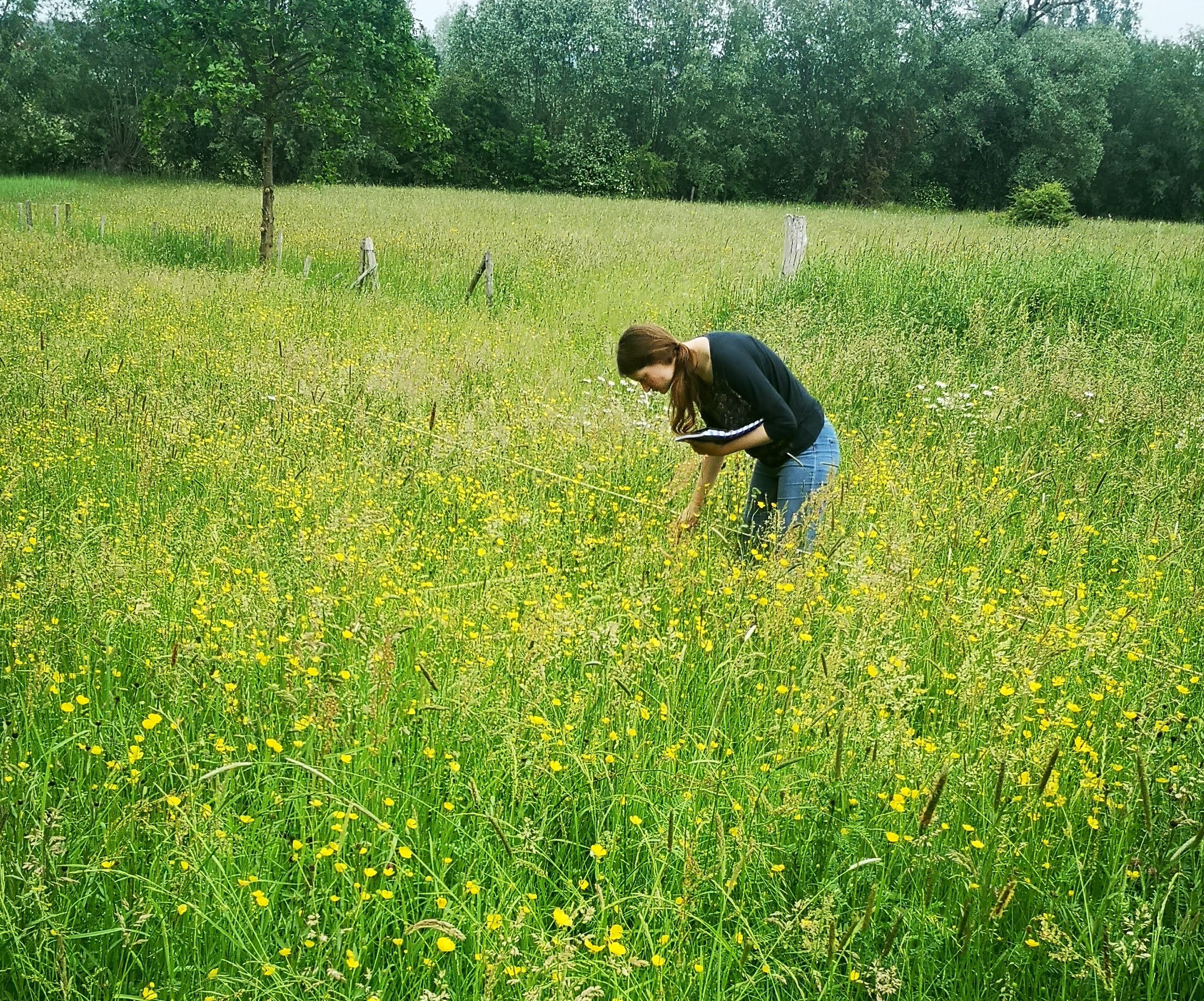
Apparently, a typical PhD journey has to be accompanied by challenges, and my case was no different. While the sampling of wild bee specimens in Belgian and German locations was initially supposed to be carried out by all teams from the consortium, this was not practically feasible during the COVID-19 pandemic. We solved this problem by dividing the field work effort, whereby the German team coordinated the sampling in Germany, while I organized the sampling in Belgium. Fortunately, as was the case for the team in Germany, I could count on the assistance of colleagues to help with bee collection, plant species determination and plant counting, which was fun, but also a vast amount of work. I would also like to specifically thank my dad, who accompanied me on many field days and always provided freshly made lunch. My dear grandfather, who sadly passed away a couple of years ago, had constructed conveniently foldable square-meter quadrat frames that were used to count plants along the transect lines. Together, all these people helped to relieve the burden of field work and made it more feasible.
Lab work
To analyze bee pathogens, RNA had to be isolated from the bee specimens first. Since commercial RNA extraction kits were barely available in our lab during the pandemic, we had to rely on the more ‘old-school’ isolation protocol with TRI Reagent. While being a robust method, it takes longer to extract RNA compared to commercial kits, especially when processing a relatively high number of samples (1,301 bees). Furthermore, the protocol first needed to be optimized for bee samples to make sure the isolated RNA had a satisfactory yield and purity. Combined, this resulted in quite an extra amount of time spent on the extraction step. Subsequently, after some downstream steps, the presence of bee pathogens (unicellular parasites and viruses) in our samples was analyzed with qPCR. With every sample being tested for several pathogens (and a certain amount being rerun when a sample indicated problems with one of the downstream steps), this was no small feat either. Luckily, I could once again rely on the support of colleagues and students during this phase of my research. They helped with sample processing, such as removing the pollen-containing legs (that were to be analyzed for bee and plant species determination), RNA isolation, and qPCR analysis.
Data analysis
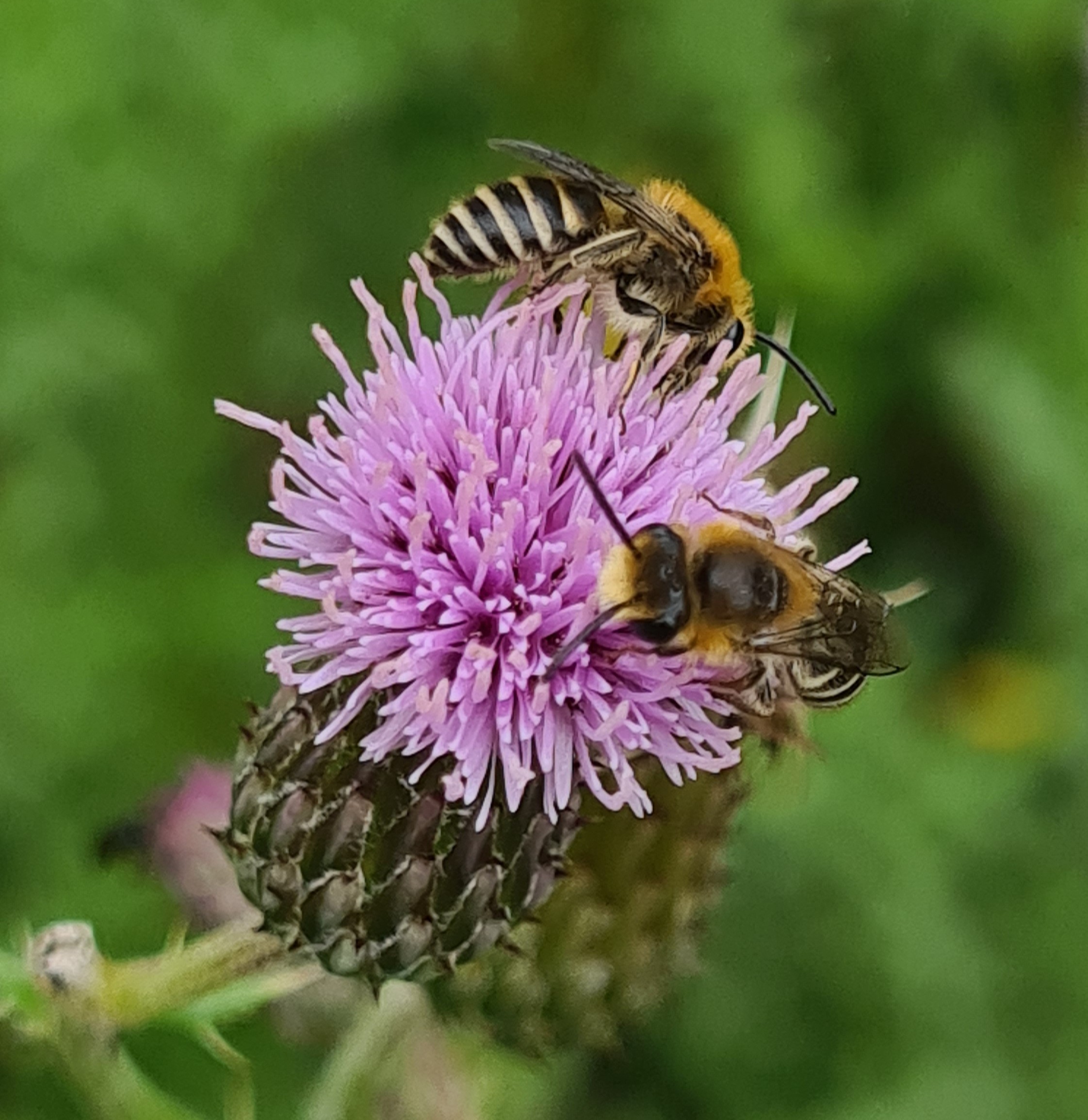
Species determination for bee and pollen samples was coordinated by the German team and provided the data necessary to construct plant-bee networks. During a writing retreat organized by the consortium, Professor Alexander Keller came up with the idea of using a niche overlap parameter to compare plant and pathogen sharing among bees. Pathogen prevalence and pathogen sharing between bee species were compared with patterns of plant sharing between bee species by analyzing bee-pathogen and plant-bee networks from the same locations and periods. We found that increased sharing of plant species between bee species in the plant-bee networks was associated with increased sharing and prevalence of pathogens in the bee-pathogen networks, particularly among bee species that were more closely related to each other. Our results thus underline the importance of providing abundant and diverse foraging resources for bees to minimize flower overlap and support bee health.
The Bee-team
Another important take-home message is that you can achieve so much more when you are surrounded by a supportive team. Thanks to the amazing ‘B(ee)-team’ consisting of my caring family and the colleagues and students from both NutriB2 as well as my own lab, I was able to overcome several research hurdles and lead the analysis and writing of this manuscript. Enjoy the read!
References
Brown, M. J. F. (2022). Complex networks of parasites and pollinators: moving towards a healthy balance. Philosophical Transactions of the Royal Society B: Biological Sciences, 377, 20210161. https://doi.org/10.1098/rstb.2021.0161
Graystock, P., Ng, W. H., Parks, K., Tripodi, A. D., Muñiz, P. A., Fersch, A. A. et al. (2020). Dominant bee species and floral abundance drive parasite temporal dynamics in plant-pollinator communities. Nature Ecology & Evolution, 4, 1358–1367. https://doi.org/10.1038/s41559-020-1247-x
Meeus, I., Pisman, M., Smagghe, G., & Piot, N. (2018). Interaction effects of different drivers of wild bee decline and their influence on host–pathogen dynamics. Current Opinion in Insect Science, 26, 136–141. https://doi.org/10.1016/j.cois.2018.02.007
Singh, R., Levitt, A. L., Rajotte, E. G., Holmes, E. C., Ostiguy, N., Vanengelsdorp, D. et al. (2010). RNA viruses in hymenopteran pollinators: evidence of inter-taxa virus transmission via pollen and potential impact on non-Apis hymenopteran species. PloS one, 5(12), e14357. https://doi.org/10.1371/journal.pone.0014357
Follow the Topic
-
Communications Biology
An open access journal from Nature Portfolio publishing high-quality research, reviews and commentary in all areas of the biological sciences, representing significant advances and bringing new biological insight to a specialized area of research.