Can Slow Photons and Plasmonic Nanostructures Unlock the Future of Solar Hydrogen?
Published in Materials

Explore the Research

 sciencedirect.com
Just a moment...
Please confirm you are a human by completing the captcha challenge below.
Turning Light into Fuel
Imagine producing a clean fuel using nothing more than sunlight and water. This vision has inspired scientists for decades, yet achieving efficient solar hydrogen production remains one of the greatest challenges in sustainable energy research. Although titanium dioxide (TiO₂) has long been considered one of the most promising photocatalysts because of its stability and low cost, it captures only a small fraction of sunlight and loses much of the absorbed energy through rapid electron–hole recombination. These limitations continue to restrict its practical performance.
Rather than searching for a single solution, we asked a different question:
What if several light-management strategies could work together inside one photocatalyst?
This question became the starting point of our research, bringing together photonic engineering, plasmonic nanostructures, graphene, and semiconductor design into a single hierarchical architecture capable of harvesting sunlight more efficiently.
What We Found
Our work demonstrates that the interaction between slow-photon effects, localized surface plasmon resonance (LSPR), and graphene-assisted charge transport creates a powerful synergy that substantially improves photocatalytic overall water splitting. Instead of relying on one enhancement mechanism, each component contributes a specific role:
1) Photonic structures increase the interaction between light and the catalyst.
2) Gold nanoparticles extend light harvesting into the visible region through plasmonic excitation.
3) Reduced graphene oxide provides rapid pathways for electron transport while suppressing charge recombination.
4) TiO₂ nanosheets supply highly active catalytic sites for the water-splitting reaction.
Working together, these mechanisms produce a photocatalyst that not only generates significantly more hydrogen under solar irradiation but also exhibits excellent stability over repeated reaction cycles. The study highlights how integrating multiple physical phenomena can outperform conventional catalyst design strategies.
Why This Matters
The transition toward a carbon-neutral society will require sustainable methods for producing green hydrogen without relying on fossil fuels or energy-intensive processes. Photocatalytic water splitting offers an elegant solution: converting abundant sunlight directly into hydrogen using only water as the feedstock. Although commercial implementation still faces important challenges, improving how materials absorb, manipulate, and convert light is a critical step toward making solar hydrogen production economically viable. More broadly, this research illustrates how advances in nanomaterials and light–matter interactions can contribute to cleaner energy technologies while addressing one of the world's most pressing environmental challenges.
Behind the Research
Perhaps the most exciting aspect of this project was not a single experiment or result but the realization that meaningful innovation often happens at the intersection of disciplines. This research brought together ideas from materials chemistry, nanophotonics, plasmonics, surface science, and photocatalysis fields that are often studied independently but can become remarkably powerful when combined. Like many scientific journeys, this work was built through countless iterations, unexpected challenges, and gradual improvements rather than one dramatic breakthrough. Every experiment helped refine our understanding of how light behaves inside complex nanostructured materials, eventually revealing a strategy that none of the individual approaches could achieve alone. 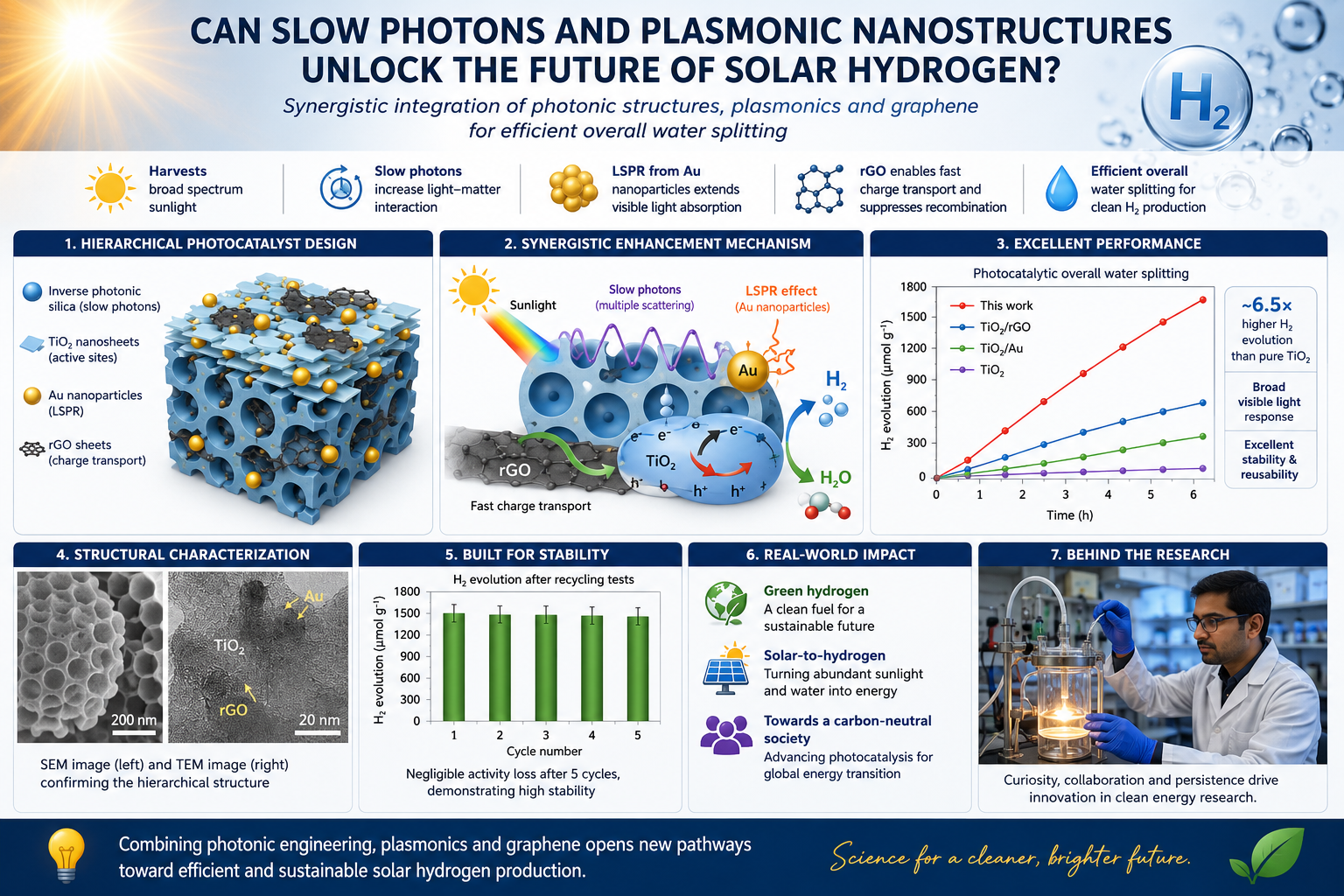 I hope these findings encourage new collaborations across disciplines and inspire researchers to explore even more creative ways of engineering light–matter interactions for sustainable energy conversion. Science advances most rapidly when ideas are shared, questioned, and improved collectively. I would be delighted to hear your thoughts, discuss potential collaborations, and explore where the next generation of solar hydrogen research might lead.

I am a researcher at the University of Namur (Belgium), where my research focuses on advanced photocatalytic materials for sustainable energy production and environmental remediation.
My work explores the design of hierarchical nanostructured materials by combining photocatalysis, photonic crystals, plasmonic nanostructures, graphene-based materials, and porous architectures to enhance solar energy conversion. I am particularly interested in photocatalytic overall water splitting for green hydrogen production, pollutant degradation, carbon-based adsorbents, and light–matter interactions.
My research integrates materials chemistry, nanotechnology, spectroscopy, and computational approaches to develop next-generation functional materials with real-world environmental and energy applications.
Beyond research, I actively contribute to the scientific community as a Guest Editor, reviewer for international journals, and member of several professional scientific societies. I enjoy sharing research stories, discussing emerging ideas, and building international collaborations that advance sustainable materials and clean-energy technologies.