Centenarians: Who They Are and What We've Learned
Published in Paediatrics, Reproductive Medicine & Geriatrics


Question of This Study
Centenarians, who reach the remarkable age of 100, have become more common over the years, but we don't know much about them. This study sought to uncover the characteristics of Sweden's centenarian population, shedding light on their living arrangements, socio-demographic profiles, health, and geriatric care, meaning formal home care or residing in a care home.
Study Findings
- Who Are Sweden's Centenarians?
- Mostly Women: Of the 5,882 centenarians studied, the majority (81%) were women, emphasizing the remarkable longevity of the female population.
- Living Arrangements: Many centenarians (40%) lived alone, while a small proportion (8%) cohabited. The rest of the centenarians lived in care homes (52%). Male centenarians (18%) were more likely to cohabitate than female centenarians (6%).
- Familial Proximity: About 67% had a child living within a 50 km radius.
- Income: The majority (77%) had incomes below the median for older adults in Sweden, highlighting economic vulnerability.
- Health Status of Centenarians (Figure1)
- Comorbidities: Over half of the centenarians had at least one chronic health condition, with 1 out of 3 experiencing multiple health issues. Heart failure was the most common diagnosis, followed by myocardial infarction and cerebrovascular disease.
- Prescribed Medications: Almost none were free from drugs, with a high proportion of polypharmacy (Men, 62%; Women, 66%), indicating a substantial medication load.
- Gender Difference: Women received more prescribed drugs than men, although men had more morbidities.
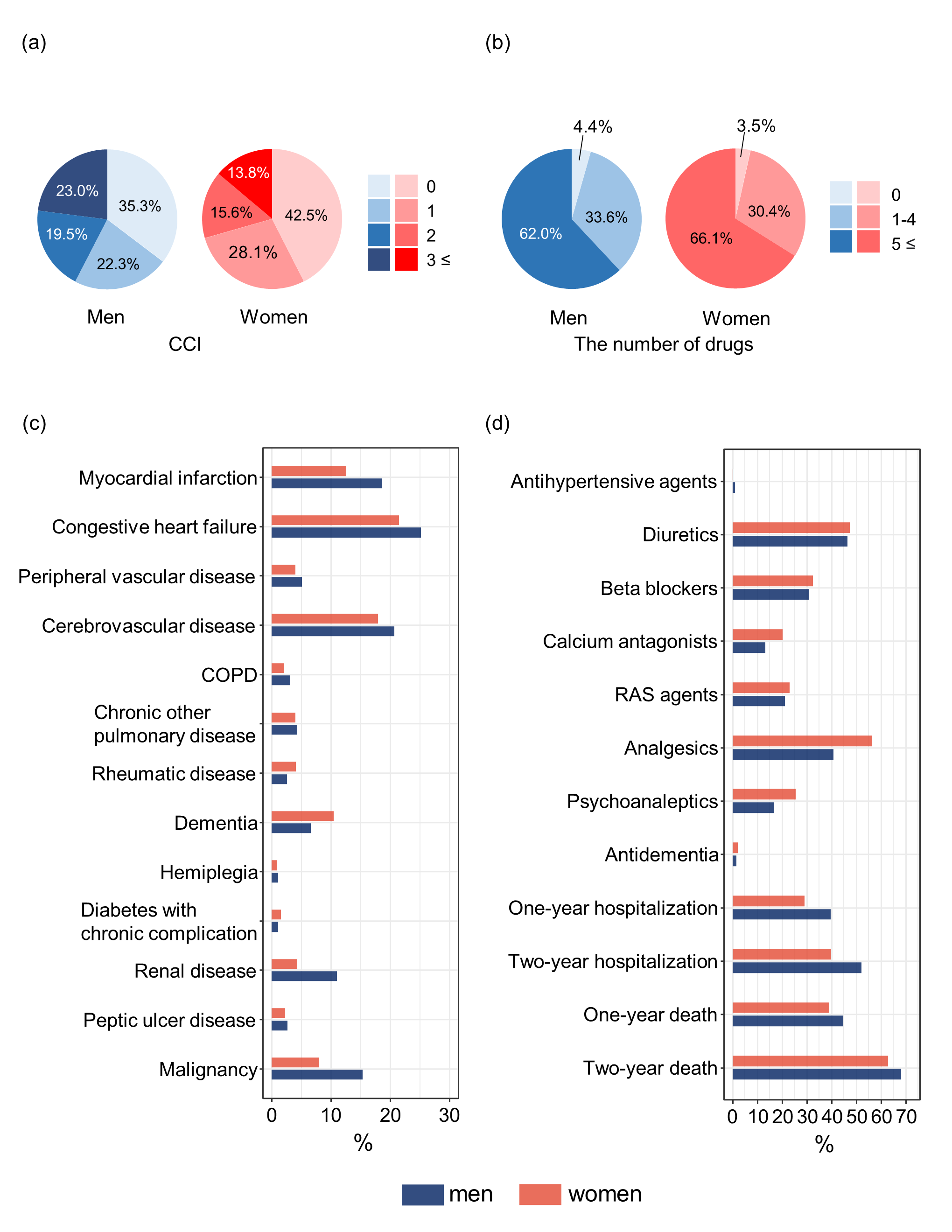
CCI Charlson comorbidity index, COPD Chronic obstructive pulmonary disease, RAS Renin-angiotensin system
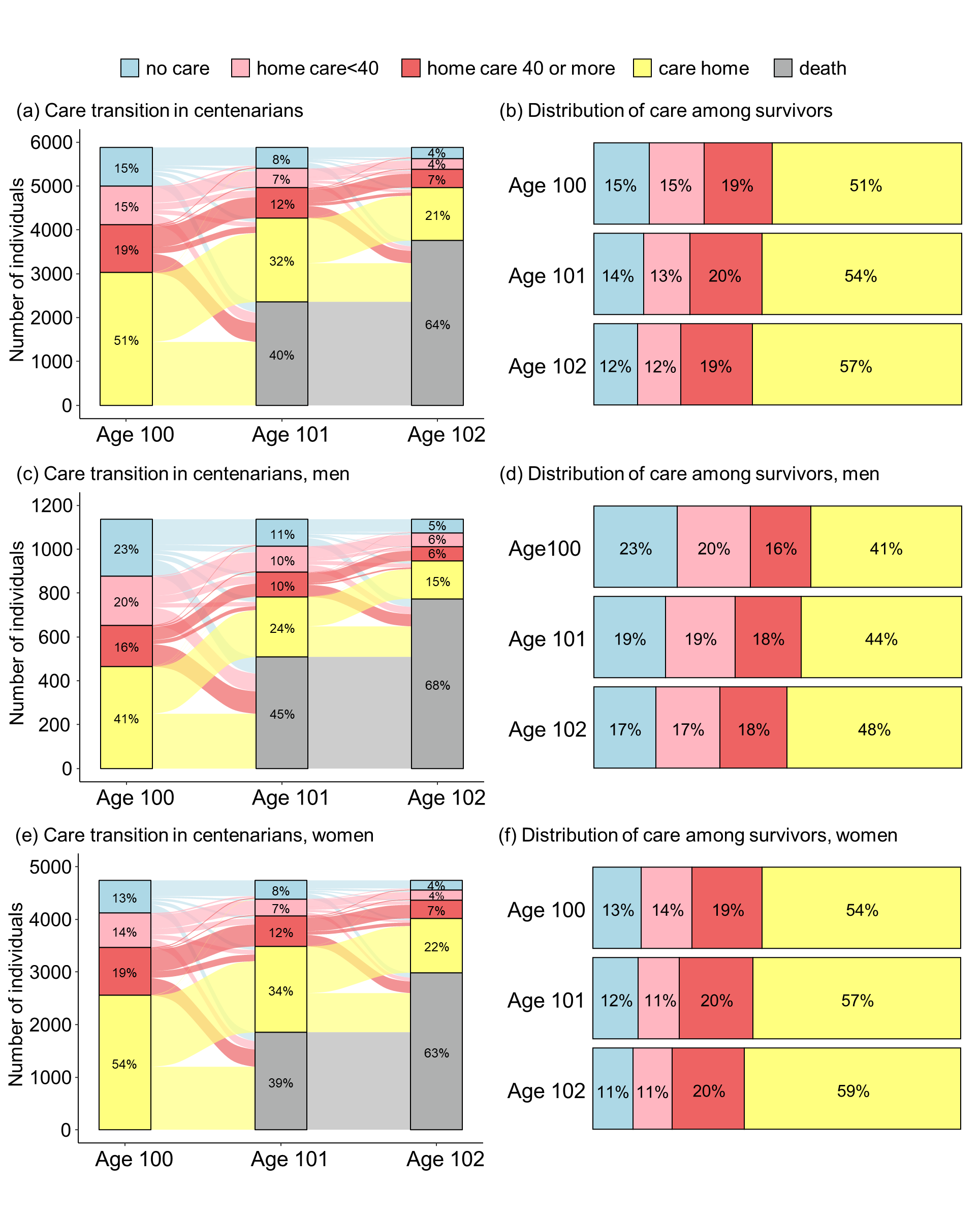
- Geriatric Care Transitions (Figure2)
- Care Homes: Roughly half of centenarians at the age of 100 resided in care homes, with a higher proportion of women (54%) than men (41%).
- Care Needs: Two years later, only 4% continued to live at home without formal care, while 64% had passed away.
Conclusion
Sweden's centenarian population is not characterized by exceptional health or independence. Instead, they face many health issues, polypharmacy, and a heavy reliance on geriatric care. With most centenarians living alone and having limited incomes, they belong to a vulnerable demographic group. Strategies need to be devised and implemented to address the healthcare and social support demands of this growing population. Only 2% of the centenarians had no diagnosed morbidity, a maximum of 1 drug, and no geriatric care. This study provides valuable insights into the lives of centenarians, dispelling the myth that they are uniformly healthy and independent. As the number of centenarians continues to rise, understanding their unique needs and challenges becomes increasingly critical for healthcare and social services planning.
Follow the Topic
-
Aging Clinical and Experimental Research
This journal offers a multidisciplinary forum on the progressing field of gerontology and geriatrics. The areas covered by the journal include: biogerontology, neurosciences, epidemiology, clinical gerontology and geriatric assessment, social, economical and behavioral gerontology.

Related Collections
With Collections, you can get published faster and increase your visibility.
Successful Aging and Health in Older Adults (with ESCEO Collaboration)
Successful ageing is a multidimensional concept encompassing the maintenance of physical health, cognitive function and social engagement alongside psychological well‐being. Researchers characterise healthy ageing not only by the absence of disease or disability, but also by the utilisation of compensatory mechanisms that allow older adults to adapt to physiological and psychosocial challenges. Global studies have shown that the integration of lifestyle factors, early health interventions and continuous social participation can promote a trajectory of healthy ageing. This integrated approach has important implications for public health policy and clinical practice, as it highlights both modifiable risk factors and the need for comprehensive assessment tools that capture the bio‐psycho‐social model of ageing.
Publishing Model: Open Access
Deadline: Jan 01, 2027
Advances in Diagnostic Approaches for Older Adults
The field of geriatric diagnostics is rapidly evolving in response to the unique health challenges of an ageing population. Advances in medical imaging, biomarkers, precision medicine, and artificial intelligence are transforming the early detection, diagnosis, and management of age-related diseases, while offering new opportunities for more personalised and effective care.
At the same time, the increasing prevalence of multimorbidity, frailty, and cognitive impairment highlights the need for innovative diagnostic approaches that capture the complexity of health in older adults. Integrating clinical assessment with emerging technologies has the potential to improve diagnostic accuracy, support timely interventions, and ultimately enhance health outcomes and quality of life.
This Collection welcomes original research, reviews, perspectives, and other article types that advance the science and practice of diagnostics in older adults. Topics of interest include, but are not limited to, medical imaging, biomarkers, artificial intelligence, digital health technologies, precision medicine, frailty and geriatric assessment, multimorbidity, cognitive and neurological diagnostics, remote monitoring, and novel diagnostic tools and strategies for geriatric care. Interdisciplinary contributions that bridge basic, translational, and clinical research are particularly encouraged.
Publishing Model: Open Access
Deadline: May 20, 2027