Climate disinformation: Why correcting false claims is not enough
Published in Earth & Environment, Behavioural Sciences & Psychology, and Education


Climate disinformation is more than a collection of misleading claims. It is sustained by interconnected systems of funding, political influence, persuasive messaging, and digital amplification. Our new integrative review, published in Climatic Change, examines why correcting individual falsehoods is necessary -- but insufficient.
Why look beyond individual claims?
Climate disinformation differs from misinformation: it involves the deliberate production or circulation of misleading claims, rather than inadvertent error. Such claims can manufacture doubt about established science, weaken trust in expertise, and delay collective action.
Responding with better facts and clearer explanations is important. Yet this leaves a larger question: who produces misleading narratives, how do they gain influence, and what allows them to persist? Addressing this question requires looking beyond isolated messages to the structures that support their circulation.
How we approached the research
Our review brings together three complementary strands of evidence. First, we synthesised literature on the political and economic drivers of climate disinformation, including funding networks, institutional alliances and media infrastructures.
Second, we analysed two illustrative forms of climate obstruction: narratives denying human-caused climate change, and narratives portraying climate policies as threats to economic well-being or personal freedom. We interpreted these using the PESTEL framework, which considers political, economic, social, technological, environmental and legal influences.
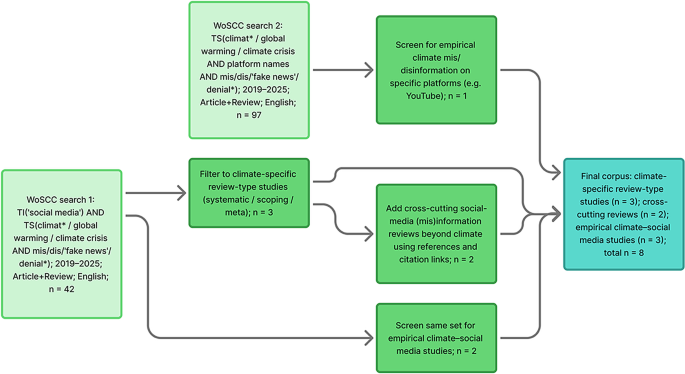
Third, we conducted a focused Web of Science search covering 2019–2025, identifying eight studies relevant to disinformation mechanisms across social and hybrid media. These formed one strand of a broader integrative review, rather than its entire evidence base.
From outright denial to policy delay
The literature identifies familiar techniques of climate denial: cherry-picking evidence, presenting false experts, demanding impossible certainty, and promoting conspiracy theories. These strategies can create the appearance of scientific controversy where substantial expert agreement exists.
A subtler approach acknowledges climate change but casts proposed responses as threats to jobs, household finances, national sovereignty or individual liberty. Legitimate disagreements about the costs and fairness of climate policies deserve scrutiny. Our focus is on misleading narratives used strategically to discredit or delay action.
Denial and delay are therefore not unrelated problems: they can operate as connected forms of climate obstruction.
How digital platforms amplify doubt
Social media can carry misleading narratives far beyond their original audiences. Influencers, coordinated networks and recommendation systems may amplify emotionally charged material, while repeated exposure can make fringe claims appear commonplace.
One study included in our review analysed 21.6 million climate-related posts across Facebook, Instagram, Twitter/X and YouTube. It found that links to unreliable sources represented approximately 7% of posts but attracted around 1.2 times the engagement of links to reliable sources. This was evidence synthesised in our review, not new data collected by our research team.
Other studies describe emerging 'post-denial' narratives: messages that accept basic climate science while attacking climate policies, institutions or advocates through wider cultural and political grievances. These developments underline the limitations of focusing exclusively on overtly false scientific claims.
Why corrections alone are insufficient
Taken together, the evidence points to a self-reinforcing system. Funding sustains organisations that develop persuasive narratives; institutional networks spread them; and digital platforms can reward their most provocative forms. Visibility and engagement may then encourage further production and circulation.
A correction may successfully challenge a particular claim without changing the conditions that produce and amplify the next one. For example, a misleading claim may be repeatedly repackaged for different audiences, allowing the same underlying narrative to survive even when particular versions have been challenged. That is why the review considers climate disinformation a structural problem as well as a communication problem.
What would a more effective response involve?
The research supports a combined approach. Fact-checking, prebunking, inoculation, and consensus messaging can help audiences recognise manipulation and resist misleading claims. Media and information literacy also builds the capacity to assess information critically.
But message-level responses need structural complements: greater transparency around advocacy funding, stronger scrutiny of digital amplification and improved access to platform data for independent research. Governance should be proportionate and attentive to legitimate debate and freedom of expression.
We also identify gaps in the evidence. Research remains concentrated in North America, Europe and Australasia. More comparative work across Africa, Asia, and Latin America is needed, alongside studies that connect funding networks, message circulation and engagement in real-world settings.
The central message: To counter climate disinformation effectively, we must address the systems that sustain it, not just individual claims. Better information matters, but so do the political, economic and technological conditions shaping what people encounter and trust.
What would make responses to climate disinformation more effective in your own research or professional context?
Read the article here: https://doi.org/10.1007/s10584-026-04320-3

Johannes M. Luetz is Professor of Sustainability and Religion and Director of Graduate Research and Research Development at Alphacrucis University College, based in Brisbane, Australia.
He is an interdisciplinary social scientist whose work examines ecological and climate adaptation challenges through spiritual, humanitarian, and policy lenses, with a particular focus on worldview-inclusive learning.
Raised across Sierra Leone, Switzerland, Germany, and Australia, he has conducted research at the science–faith, interfaith, and science–policy interfaces.
He is Adjunct Associate Professor at the University of New South Wales and Adjunct Professor at the University of the Sunshine Coast, and serves on the editorial boards of international journals.
Follow the Topic
-
Climatic Change
This journal is dedicated to the totality of the problem of climatic variability and change - its descriptions, causes, implications and interactions among these.