Changing Cultural Landscape of the Tons River Basin
Published in Social Sciences
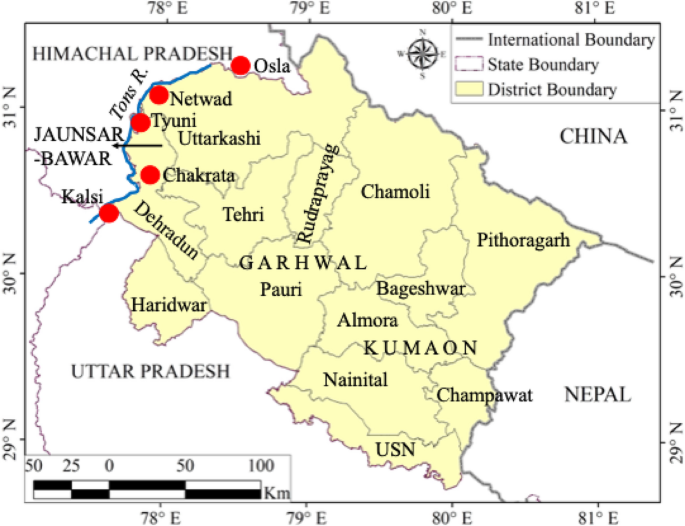

The cultural landscape of the Tons River Basin of the Himalayan region is one of the most culturally diversified regions in the world with deep-rooted history, migration, settlement of different communities and it is shaping this landform over centuries . This dynamic cultural corridor situated between the Indian subcontinent and the Tibetan plateau has undergone several changes due to trade, movement of people creating distinctive cultural zones reflecting through vibrant fairs and festivals, rich oral traditions, different communities’ delectable cuisines, mythological belief systems which are widely practiced over this region with utmost enthusiasm. Within the broader Himalayan context, the Uttarakhand Himalaya is identified as pivotal juncture of archeological remnants, topographically modified by the rivers Alakananda, Bhagirathi, Yamuna, Tons, Ramganga and Sarayu and agrarian society which made it a culturally significant place from the past till today beckoning as ‘Dev Bhumi’, the land of Gods and Goddesses associated with riverine morphology and sacred cultural sites. The Tons River Basin is such evidence of cultural geomorphological region where precipitous slope, rugged terrain, river valleys of the Rupin and Supin rivers (tributaries of the Tons River), terraced agricultural fields, forest lands have shaped the land as distinctive yet colloquial Himalayan cultural den. Among the three sub cultural realms of Uttarakhand Kumaon, Garhwal and Jaunsar-Bawar and Rawain reign the Tons River Basin forms part of the Jaunsar-Bawar and Rawain sub cultural realm reflecting history and culture through each architectural structure, traditions, cultural practices. Local mythology echoed in every corner of this small riverine place where major rural settlements such as Purola, Mori, Hanol, Netwar, Gaichwan, Dharkot, Gangad, Osla (the very first village of the Tons River Basin) and Har ki Dun are the treasure house of regions’ temple history, folk deities and their present forms practiced during vibrant festivals.
Navigating through this place, interacting with the villagers, priests, elderly people, spending hours in informal chatting and formal interviews have given multiple insights regarding traditional livelihood practices and their role in cultural identity, cultural riches, folk deities, mythology and its impact on social and cultural landscape. Seasonal migration is the essential character of practicing traditional agriculture and livestock rearing. The temperate- cold climate and vast grazing lands profoundly support cultivation of coarse grains, temperate fruits, livestock products and selling them from farms to local markets. Interestingly customary customary rituals are closely interconnected, as cultivation and harvesting processes traditionally begin with offerings to local deities. Drawing references for Uttarakhand it is popularly known that important Hindu scripts and Mythological derivation like the Rigveda, Mahabharata, and the Skanda Puran, all have given sacred status to this state which in evidently reflects through cultural riches of the Tons Valley too. It’s a valley predominantly comprising the Hindu population consisting of various castes like Bhramins, Rajputs, Scheduled Castes and Scheduled Tribes. It’s a saying that the residents of this region are considered more ancient compared to those in other parts of Uttarakhand.
The Tons Basin Region due to its strong mythological reference exhibits exquisite diversity expressed through traditions, folklore, religious beliefs, festivals, and food practices closely shaped by the physical environment and sacred temple landscape dedicated to the Lord Shiva, Lord Vishnu the Pandavas and the Kauravas. From social organization to cultural practices, the worship of deities in diverse forms is regarded as sacred and deeply integrated into the regional culture.
The presence of the Lord Shiva, considered as the guardian deity is felt in structural and non-structural form in every nook and corner of this Himalayan reign. Shiva resides here in Someshwar form, he is the chief of the villages, lives in a wood, stone carved temple and makes his annual appearance – Dev Avataran, with an annual journey in a palanquin to ensure the well-being, prosperity of this region’s inhabitants.
The evolution of the temple region, the Tons also comes from its mythological scripts. It is said ‘Tons’ come from ‘Tamas’(sorrow) River after Karna’s death his followers wept profusely and tears became ‘Tamas’. The people here worship the Pandavas and the Kauravas which is the unique sacred identity of this region which distinguishes this region from the rest of the country. However, Tons River Valley is popularly known for Mahasu Devta- as an incarnation of the Lord Shiva whose temple is located on the left bank of the Tons River in Hanol village. The journey to the temple and villages itself is an experience as the road passes through cedar trees, lush green meadows and steep agricultural fields. One can relish the regional cuisines like Mandu ki Roti, Chaulai ka Saag, Rajma and popular fermented drink made with millets while conduiting through these highlands and river valleys of this region.
For a longer time, Tons Valley was cut from the contemporary world and retained its unique rich cultural traditions and heritage. But in recent times even with minimal infrastructural development, connectivity and a shift in cultural practices have been noticed. For a recreational retreat, development of the transport system has contributed to the growth of cultural and adventurous tourism. As a significant amount of youth out migrated, women of the villages took charge in conserving cultural traditions and led to community-based tourism activities. Regardless of any changes Tons River Basin is maintaining its history, captivating natural beauty and mythological stories will continue to emulate through its oral traditions.
Follow the Topic
-
Discover Global Society
This is an interdisciplinary, international journal that welcomes research on the complexities of modern global society, its development and its challenges.

Related Collections
With Collections, you can get published faster and increase your visibility.
Sustainable and Democratic Governance: Intersecting Law, Society, and Digital Ecosystems
The world today stands at a crossroads between rapid technological advancement and the urgent need for sustainable governance. Digitalization is no longer merely an administrative tool, but rather a governmental infrastructure that regulates rights and social behaviour on a global scale. However, this phenomenon is ambivalent: it promises transparency and participation, while simultaneously risking the creation of exclusion, concentration of power, and the fragility of democracy that transcends national borders.
From a global perspective, digital governance can no longer be viewed as a purely domestic issue. Transnational digital architecture has challenged traditional legal sovereignty. As data flows without regard for territorial boundaries, tensions arise between the dominant regulatory models of the Global North and the socio-political realities of the Global South.
There are five main themes to be discussed:
(1). Digital Governance & Democratic Resilience: Focusing on algorithmic accountability and data transparency to safeguard democratic values from the erosion of civic space at the global level;
(2). Legal Boundaries in the Digital Ecosystem: Examining the readiness of legal systems to regulate global platforms and data privacy as a fundamental human right;
(3). Social Equity & the Digital Divide: Critiquing marginalization in the Global South and promoting the empowerment of vulnerable groups through equitable access to technology;
(4). Sustainable Technology & Environmental Governance: Balancing the use of Big Data for global climate mitigation with responsibility for carbon footprints;
(5). Cyber Ethics & Social Resilience: Formulating international strategies against disinformation and polarization through digital literacy grounded in the value of honesty.
Through these interdisciplinary discussions, it is hoped that a global understanding will emerge regarding how law and society can adapt to ensure that the digital ecosystem continues to support the principles of democracy and future sustainability.
Keywords: Digital Governance, Democratic Resilience, Legal Boundaries in the Digital Ecosystem, Sustainable Technology, Environmental Governance, Cyber Ethics, Social Resilience
Publishing Model: Open Access
Deadline: Mar 31, 2027
Agentic Artificial Intelligence, Gender Equity, and Inclusive Digital Futures
This proposed Collection examines how Artificial Intelligence (AI), particularly agentic AI systems capable of autonomous decision-making and adaptive orchestration, can advance gender equity and inclusive development within digital societies. While AI-driven transformation reshapes governance, labor markets, financial systems, and public service delivery, structural gender inequalities risk being encoded and amplified within algorithmic systems.
This Collection seeks interdisciplinary research that critically evaluates both the empowering potential and structural risks of agentic AI, with emphasis on women’s economic participation, algorithmic governance, digital inclusion, and institutional accountability. Contributions are encouraged that explore AI-enabled financial inclusion, gender-responsive digital policy, bias auditing in autonomous systems, women’s participation in digital entrepreneurship, and AI’s role in strengthening social cohesion and public institutions.
The Collection prioritizes empirical research, comparative studies, computational audits, and policy frameworks, particularly from developing and emerging economies, aligned with Sustainable Development Goals. By foregrounding women not only as users but as designers, innovators, and decision-makers within AI ecosystems, this Collection advances structural approaches to equitable digital transformation.
This Collection aims to:
1. Advance rigorous, evidence-based research on AI and gender equity.
2. Develop governance and regulatory frameworks for responsible agentic AI deployment.
3. Highlight empirical cases from developing economies and Global South contexts.
4. Foster cross-disciplinary dialogue among Information Systems, Sociology, Economics, Public Policy, and Gender Studies.
5. Provide actionable policy insights aligned with sustainable digital development strategies.
Submissions using quantitative (SEM, causal modeling), qualitative (case studies, institutional analysis), computational auditing, and mixed-method approaches are particularly encouraged.
Publishing Model: Open Access
Deadline: Dec 18, 2026