Decoupling Ion–Dipole Interactions via Competitive Coordination for Durable Dendrite-Free Zinc Metal Batteries
Published in Materials
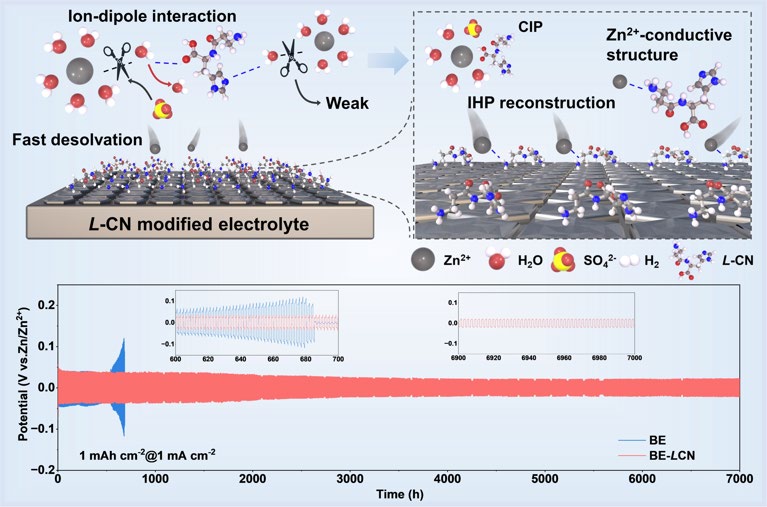
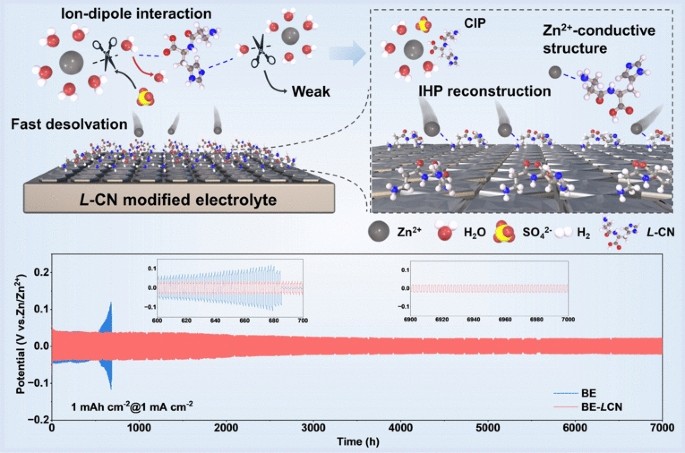

Aqueous zinc metal batteries are attracting growing attention as promising energy-storage systems because of their inherent safety, low cost, and high theoretical energy density. However, their practical development remains hindered by sluggish zinc-ion transport, uneven metal deposition, dendrite formation, and parasitic hydrogen evolution. Researchers from the Suzhou Institute of Nano-Tech and Nano-Bionics, Chinese Academy of Sciences, Jiangsu University, Helmholtz Institute Ulm, and Karlsruhe Institute of Technology have developed a molecular-level electrolyte strategy using L-carnosine (L-CN) to regulate interfacial chemistry. By weakening zinc-ion–water interactions and reconstructing the electrode’s Helmholtz plane, the approach enables faster ion transport and more stable zinc deposition, offering a promising route toward durable aqueous zinc batteries.
Why This Zinc-Battery Strategy Matters
In conventional aqueous electrolytes, strong interactions between Zn2+ ions and surrounding water molecules create a high desolvation barrier, slowing ion transport at the zinc surface. Uneven Zn2+ flux can then promote dendritic growth, while reactive water molecules trigger hydrogen evolution and corrosion. These interconnected problems reduce Coulombic efficiency, consume electrolyte, and shorten battery life. Rather than relying solely on an artificial protective coating, this study targets the molecular interactions governing zinc-ion solvation and the electrode–electrolyte interface.
Innovative Design and Mechanism
The researchers introduced L-carnosine, a naturally occurring dipeptide containing carboxyl, amino, carbonyl, and imidazole groups, as a multifunctional electrolyte additive. Its permanent dipole moment of 5.34 D is approximately 2.5 times that of water, allowing it to compete for coordination with Zn2+ and partially replace water molecules in the primary solvation shell. This weakens Zn2+–water interactions and facilitates desolvation. L-CN also preferentially adsorbs onto the zinc surface, reconstructing the inner Helmholtz plane into a Zn2+-conductive interfacial structure. Together, these effects accelerate ion transport, redistribute Zn2+ flux, suppress parasitic reactions, and promote uniform metal deposition. The optimized additive concentration was just 10 mmol L-1 in 2 M ZnSO4 electrolyte.
Outstanding Performance
The L-CN-modified electrolyte delivers a 99.72% average Coulombic efficiency over 2,000 cycles in Zn||Cu cells. Zn||Zn symmetric cells operate stably for more than 7,000 hours, compared with failure after approximately 680 hours in the unmodified electrolyte. Even at a high depth of discharge of 85.4%, the cells remain stable for over 200 hours. The additive also reduces the desolvation activation energy from 46.14 to 27.93 kJ mol-1 and increases the Zn2+ transference number from 0.283 to 0.574. In full cells, the Zn||V2O5-x system delivers 289 mAh g-1 after 500 cycles at 1 A g-1 with a low negative-to-positive capacity ratio of 3.98.
Applications and Future Outlook
The strategy also demonstrates promise beyond laboratory-scale coin cells. A large-format pouch cell maintained approximately 100% capacity retention over 200 cycles at 1 A g-1 and successfully powered a smart electronic device. Because L-CN regulates the electrolyte–electrode interface through molecular coordination rather than relying exclusively on a separate protective layer, the approach offers a potentially versatile route to improving zinc-metal stability. Further validation under practical operating conditions will help establish its suitability for scalable energy storage, including applications requiring safe, durable, and cost-effective aqueous batteries.

Editor of Nano-Micro Letters, which is an Open-Access, peer-reviewed journal reported papers that have at least one dimension ranging from a few sub-nanometers to a few hundreds of micrometers. The journal is published by Springer Nature and indexed by SCI, EI, SCOPUS, Pubmed, etc. The 2025 JCR Impact Factor is 38.5. The 2025 CiteScore is 58.9.
Follow the Topic
-
Nano-Micro Letters
Nano-Micro Letters is a peer-reviewed, international, interdisciplinary and open-access journal that focus on science, experiments, engineering, technologies and applications of nano- or microscale structure and system in physics, chemistry, biology, material science, and pharmacy.