Deep-learning-enabled multi-omics analyses for prediction of future metastasis in cancer
Published in Cancer, Computational Sciences, and Mathematics




Future metastasis introduction
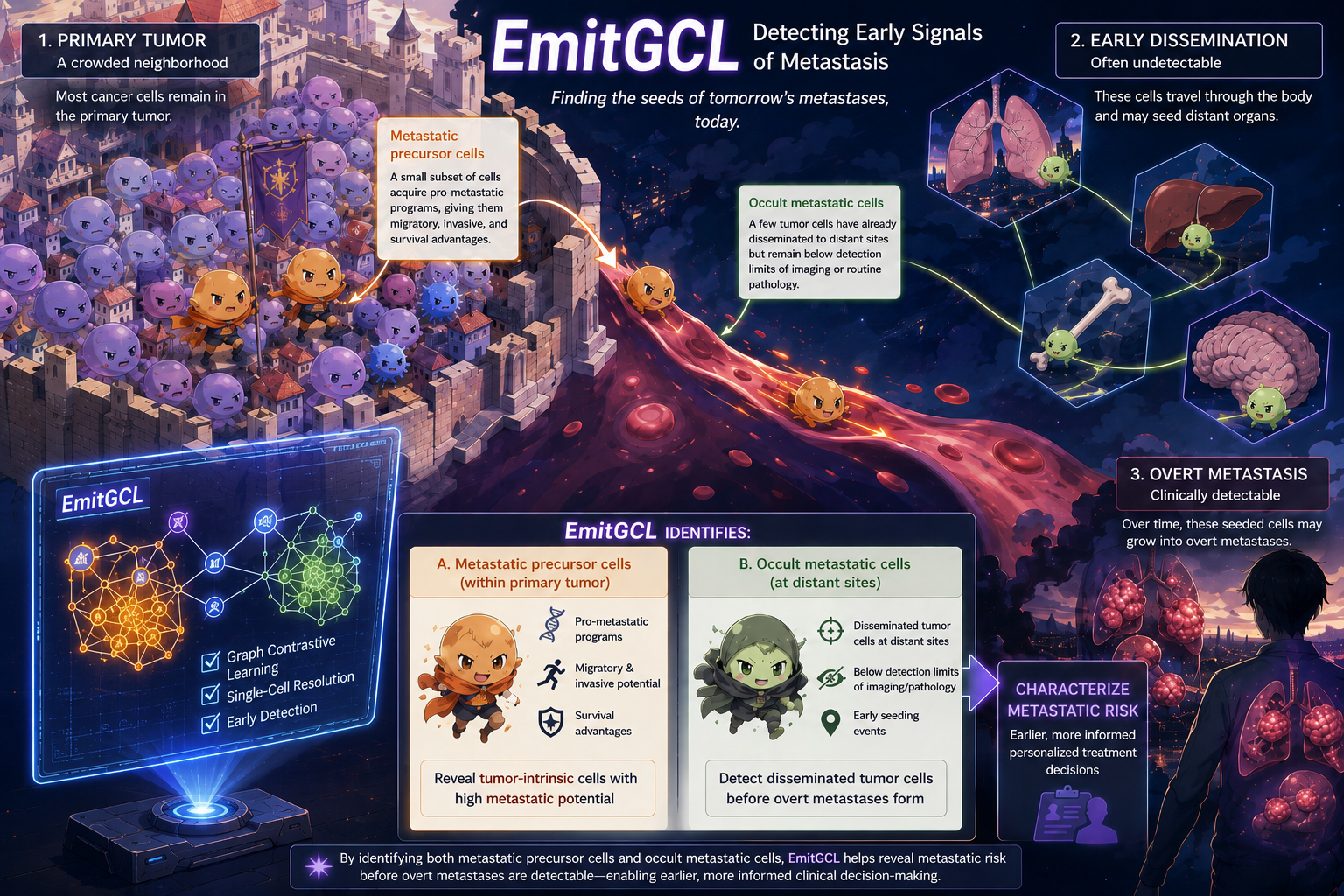
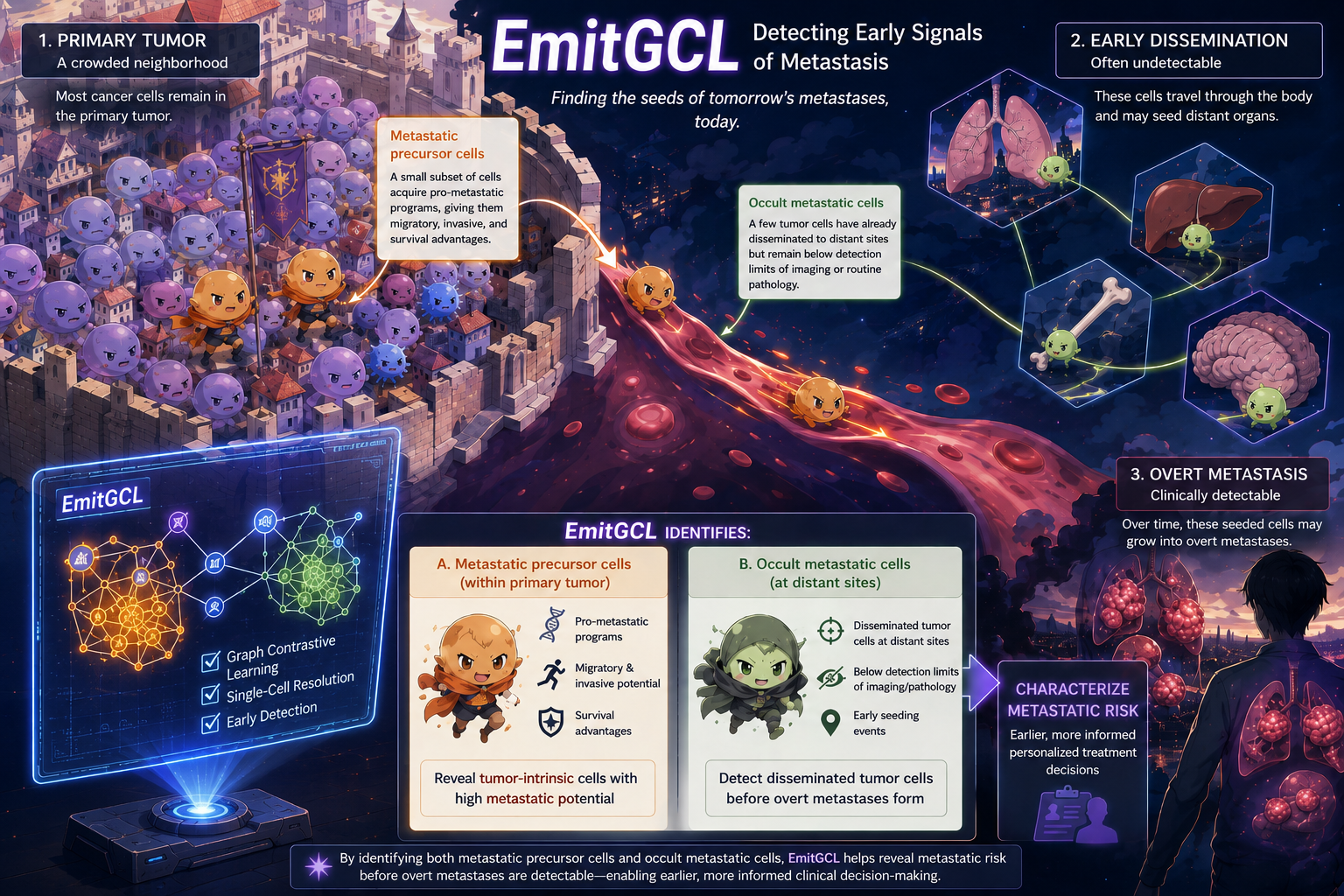
We have developed a new tool named EmitGCL that reads single-cell RNA sequencing (scRNA-seq) data to predict whether a cancer patient, one who shows no detectable metastasis today, is likely to develop it in the future and identifies the biomarkers behind that risk. Existing prediction methods are largely learnt from patients with established metastases or from bulk tissue measurements, making them good at recognizing metastatic outcomes but unable to directly detect the rare cells that seed future metastasis. EmitGCL was built to fill this gap by identifying those earliest metastatic cells before overt metastases appear.
Imagine a tumor as a crowded neighborhood in the body, with cancer cells as its residents. Most of them stay put. But a few are quietly preparing to leave, packing their bags and learning how to survive somewhere new. Think of these as the metastatic precursor cells. A handful had already slipped away and settled into a distant neighborhood, such as a lymph node, where they blend in among the locals. There are so few of them that no scan or pathologist can spot them. These are occult metastatic cells
Here is the problem. By the time metastasis shows up on imaging, these travelers have already escaped and put down roots, the journey started long before anyone could see it. So, doctors are often left reacting to something that began much earlier, which can mean overtreating patients who were never going to spread, or missing those who quietly already have.
That is why we built EmitGCL. Instead of waiting for metastasis to become visible, it looks for the earliest travelers: the rare cells already hiding at a distant site, and the precursor cells still at home preparing to go. By catching them, we can tell, before conventional imaging ever could, who is likely to develop future metastasis.
Input and output
EmitGCL takes in matched scRNA-seq data from a patient's primary tumor and metastatic site, along with prior knowledge of metastasis-related pathways. It represents cells and genes as a heterogeneous graph, then uses knowledge-aware graph contrastive learning to amplify the subtle differences between primary and metastatic cells of the same tumor lineage while suppressing background noise.
It yields three things: the occult metastatic cells hiding at the metastatic site, the metastatic precursor cells back in the primary tumor, and the biomarker genes that flag future metastasis, the ones you can actually test for in the clinic.
Strengths of EmitGCL
- EmitGCL was benchmarked across six cancer types from seven patient cohorts (28 patients, 516,093 cells). It identified occult metastatic cells with the highest true positive rate, improving on the second-best tool by 12.44%, while other methods raised false alarms.
- In a breast cancer patient whose lymph nodes were declared negative and disease-free by conventional imaging, EmitGCL caught the occult metastatic cells that were later confirmed to be metastatic. At the same time, it correctly flagged no metastasis in non-metastatic lung cancer patients, keeping a 0% false positive rate where other tools misfired.
- EmitGCL identified HSP90AA1 and HSP90AB1 as biomarkers of future breast cancer metastasis, genes that traditional differential-expression analysis would miss. Pharmacological inhibition of HSP90 reduced breast cancer cell migration in the lab, and the biomarkers held up across five independent cohorts of patients (n=420).
- Beyond biomarkers, EmitGCL uncovered the transcription factor YY1 as a driver of breast cancer metastasis and a candidate therapeutic target. This was supported by in-silico knockout, CRISPR-based perturbation, migration assays, an in-vivo mouse lung colonization model, and four independent clinical cohorts.
Application
We recommend EmitGCL if you particularly want to
- predict whether a patient with no detectable metastasis is likely to develop it over time (i.e., future metastasis), enabling earlier risk stratification and more timely treatment.
- identify occult metastatic cells at metastatic sites and metastatic precursor cells in the primary tumor from matched scRNA-seq data, and trace the transition between them.
- discover clinically applicable biomarkers and potential therapeutic targets for preventing or intercepting metastasis before it becomes visible.
Future perspectives
Looking ahead, we see several directions for EmitGCL. Extending the framework to spatially resolved transcriptomics and integrating histopathology (H&E) with molecular references, would add tissue context and further strengthen its biological and clinical relevance. Larger patient cohorts would improve generalizability, and prospective clinical trials will be the crucial next step in turning EmitGCL's predictions into actionable strategies in precision medicine.
Follow the Topic
-
Nature Communications
An open access, multidisciplinary journal dedicated to publishing high-quality research in all areas of the biological, health, physical, chemical and Earth sciences.

Related Collections
With Collections, you can get published faster and increase your visibility.
Women's Health
Publishing Model: Hybrid
Deadline: Ongoing
Tumor Microenvironment Crosstalk and Therapeutic Implications
Publishing Model: Hybrid
Deadline: Nov 02, 2026