Defect‑engineered liquid‑gated MoS₂ field‑effect transistor for pH Sensing
Published in Materials



Key Experimental Findings
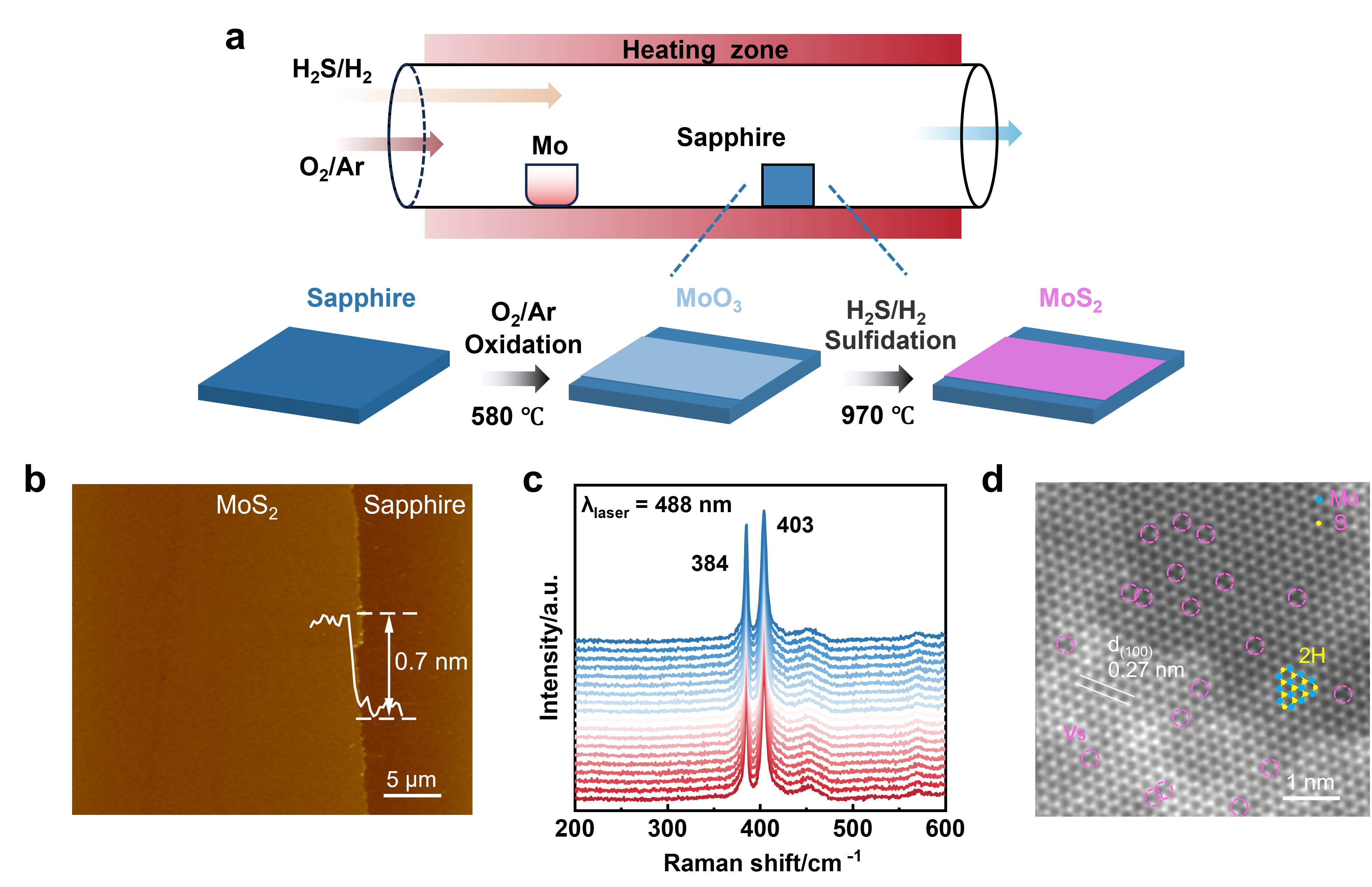
- Synthesis and Characterization of Defective MoS2 Films
- High-temperature CVD with H₂ assistance produced uniform monolayer MoS2(~0.7 nm thick) with ~1.8% S-vacancies.
- Raman spectra showed peaks at 384 cm⁻1 (E2g) and 403 cm⁻1 (A1g), confirming high crystallinity; TEM verified 2H phase and defects.
- Fabrication and Electrical Performance of Liquid-Gated FETs
- Devices featured 20×40 µm2 channels, Ti/Au electrodes, PMMA passivation, and Ag/AgCl gate in PBS electrolyte.
- Achieved Ion/Ioff of 105, SS of 70 mV/dec (near theoretical limit), and stable operation with negligible drift after 36 hours.
- pH Sensing Performance
- Transfer curves shifted negatively with increasing pH (4.6–9.5), yielding voltage sensitivity of 44 mV/pH.
- Record current sensitivity of 534.8%/pH in subthreshold region; minimal hysteresis (5 nA) after cycling, with rapid response.
Technological Implications
The findings overcome key limitations in MoS2-based sensors, enabling:
- Biomedical Applications: Label-free, real-time pH monitoring in physiological environments.
- Device Optimization: Defect control for tunable sensitivity in ionic detection.
- Biosensor Stability: Guidelines for minimizing hysteresis in complex media.
Challenges and Future Directions
While the study establishes foundational knowledge, several challenges remain:
- Scalable Defect Control: Developing methods to precisely modulate sulfur vacancy density across large-area films without introducing structural disorder or compromising crystallinity.
- Integration Advances: Exploring hybrid architectures that combine MoS2 with other 2D materials or functional layers to enable multifunctional or selective sensing beyond pH.
- Real-World Validation: Extending testing from controlled buffer solutions (e.g., PBS) to complex biological fluids (e.g., serum, cell culture media) to evaluate interference, fouling, and long‑term stability.
- Mechanistic Depth: Integrating advanced simulations (e.g., DFT combined with molecular dynamics or electrochemical models) with in‑situ experimental characterization to further elucidate the ion‑adsorption and charge‑transfer dynamics at defect sites.
Toward a Defect‑Engineered MoS2 Sensing Platform
This work demonstrates that defect‑engineered MoS2 liquid‑gated FETs can achieve highly sensitive, reproducible, and stable pH detection, surpassing the performance of many conventional 2D‑based sensors. The proposed strategies—combining controlled vacancy introduction, direct electrolyte‑channel coupling, and theoretical guidance—provide a clear pathway toward next‑generation biosensing platforms. These advances hold promise for applications in real‑time health monitoring, point‑of‑care diagnostics, and environmental surveillance, where efficient, miniaturized, and reliable sensing is critical.
Follow the Topic
-
Moore and More
This is the first top-tier journal dedicated to Beyond Moore technology in the field of integrated circuit.