Delivering Light on Topical Collection “Discover Advances in the Design and Synthesis of Nano- Optics and Applications”
Published in Bioengineering & Biotechnology, Chemistry, and Earth & Environment
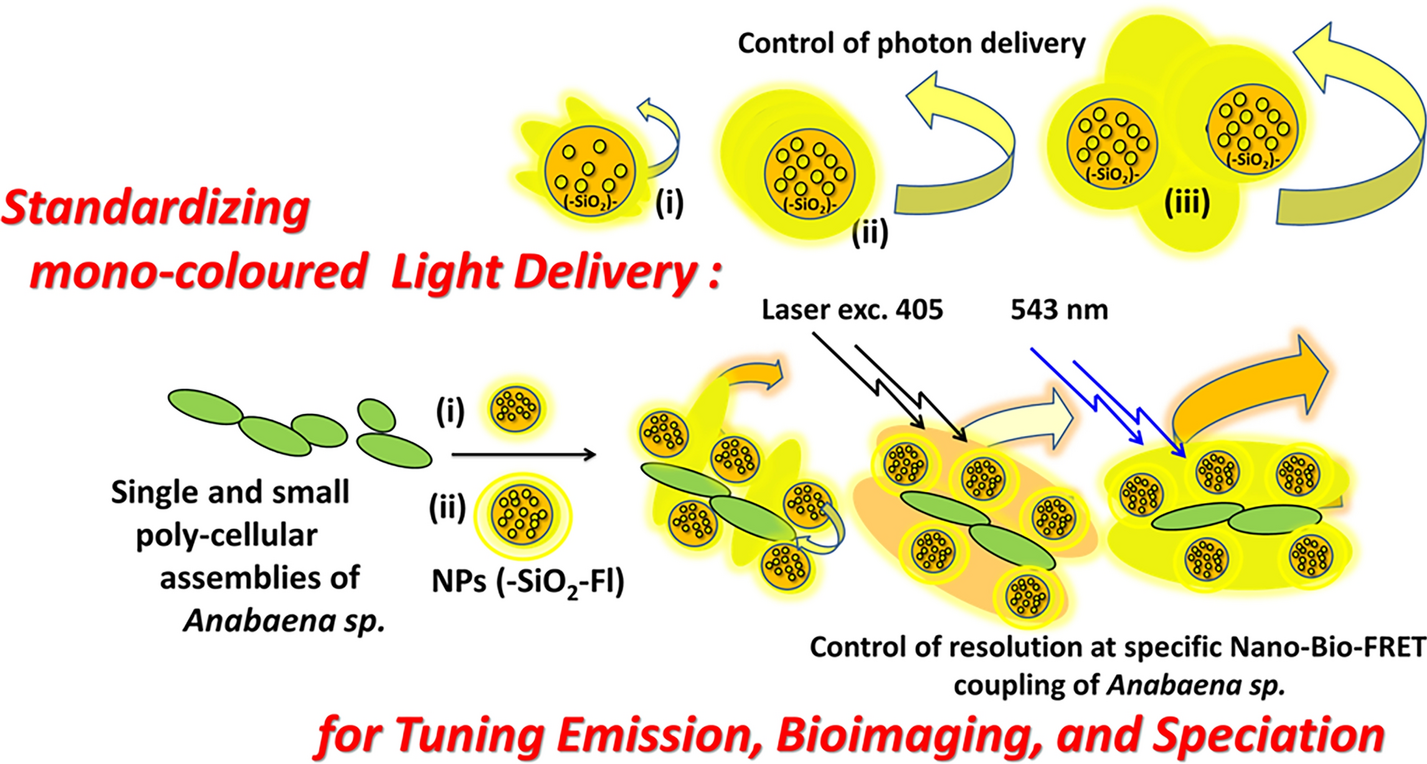

It was tuned mono-coloured Silicon Nanophotonics incorporating Fluorescein (Fl) confined within silica nanoparticles (SiO2-Fl NPs). Silicon within modified organosilanes permitted to tune delivery of photons. Therefore, varied emission intensities were calibrated varying the as Laser dye incorporation. It was observed the particular characteristic of dimeric formation that showed higher emissions than single ones ( https://link.springer.com/collections/iffbffbjdg).
This fact opened to the discussion about electronics and topological photonics such as based on nanoantenna and resonant phenomena. The dimeric forms were spontaneously formed by non-covalent interactions between modified inter-nano-surfaces with silanol groups and Fl Laser dyes with different chemical groups, electronic domains of interactions and Van der Walls forces. It was applied these Nano-emitters for Anabaena sp. from Patagonia lakes. The Nano-Biostructures maintained longitudinal shapes with pass of time as natural ones exist in absence of nanolabellers.
The natural bio-optics with two natural Photosystems nominated as I and II (PS I and II) permitted to couple the light delivered from SiO2-Fl NPs as nanolabellers. In this manner, it was generated higher emissions towards longer emissions wavelengths stimulating within shorter excitation intervals of wavelengths. So, it was showed and discussed how the non-classical light delivery summed to light scattering phenomena from other modes of resonances afforded to different emission modes of energy. The non-classical light produced in the bioimaging event was explained by confined laser dyes within the nanoscale producing photon delivery to targeted acceptor bio-optics. The nano-assembly produced shapes with different scattering and intrinsic electronic properties that generated new bioluminescence energy emission modes towards the NIR non-observed before. In this manner, from single nano emitters to dimeric forms and further nano-bio-assembling, it was generated different optical pathways. This fact afforded to the discussion as well on how this simple nanotechnology could permit speciation of unicellular organism. In this regard, it was showed insights in this field and compared with previous results recorded by us with Microcystis aeruginosa sp.

Follow the Topic
-
Discover Chemistry
A fully open access, peer-reviewed journal supporting multidisciplinary research and policy developments across all fields of chemistry.

What are SDG Topics?
An introduction to Sustainable Development Goals (SDGs) Topics and their role in highlighting sustainable development research.
Continue reading announcementRelated Collections
With Collections, you can get published faster and increase your visibility.
Chemistry in Action: Multidisciplinary Approaches in Current Research and Novel Applications
This topical collection aims to highlight the role of Chemistry in multidisciplinary cutting-edge research. Currently, the traditional and siloed research approach is inadequate to solve the complex global challenges. Therefore, a new paradigm of multidisciplinary research is emerging, proposing innovative solutions that address issues from multiple angles by integrating insights from different fields. We call for submissions of papers reporting original Research, Reviews, Perspectives, Comments, Brief Communications, Case Studies, Registered Reports, and Data Notes that integrate chemical concepts and techniques with other fields such as Biology, Medicine, Pharmacy, Physics, Engineering, Environmental Science, Materials Science, and Food Science, among others. This collection is particularly interested in, but not limited to, manuscripts that address:
• Development of new materials with tailored features for specific applications.
• Design and synthesis of molecules for therapeutic or diagnostic purposes.
• Chemical approaches to clean generation and storage of energy.
• Sustainable chemical processes for environmental care and remediation.
• Integration of chemical principles with advanced engineering and fabrication
• Techniques.
Keywords: Materials chemistry, chemical synthesis, chemical engineering, sustainable chemistry, environmental sciences, biochemistry, pharmacy.
Publishing Model: Open Access
Deadline: Oct 31, 2026
Selected Papers from International Conference on Green Chemistry and Sustainable Development
Green chemistry advances sustainable development by enabling innovative chemical processes that minimize toxicity, waste, and resource consumption. The International Conference on Green Chemistry and Sustainable Development brings together scientists, researchers, industry leaders, and policymakers from around the world to share innovations, research findings, and strategies for promoting environmentally friendly chemical practices. The conference focuses on advancing green technologies, reducing environmental impact, providing renewable energy solutions, waste management, and supporting global efforts toward sustainable economic and social development. It serves as a platform for collaboration, education, and the exchange of ideas aimed at building a greener and more sustainable future through responsible scientific practices and sustainable industrial development.
Homepage: https://www.acsfuo.org/abstract
Keywords:Sustainability, Renewable resources, Biodegradable materials, green chemistry, Waste reduction, Renewable energy, Eco-friendly processes
This Collection supports and amplifies research related to SDG 7, SDG 9, SDG 10, SDG 13, and SDG 15.
Publishing Model: Open Access
Deadline: Nov 30, 2026