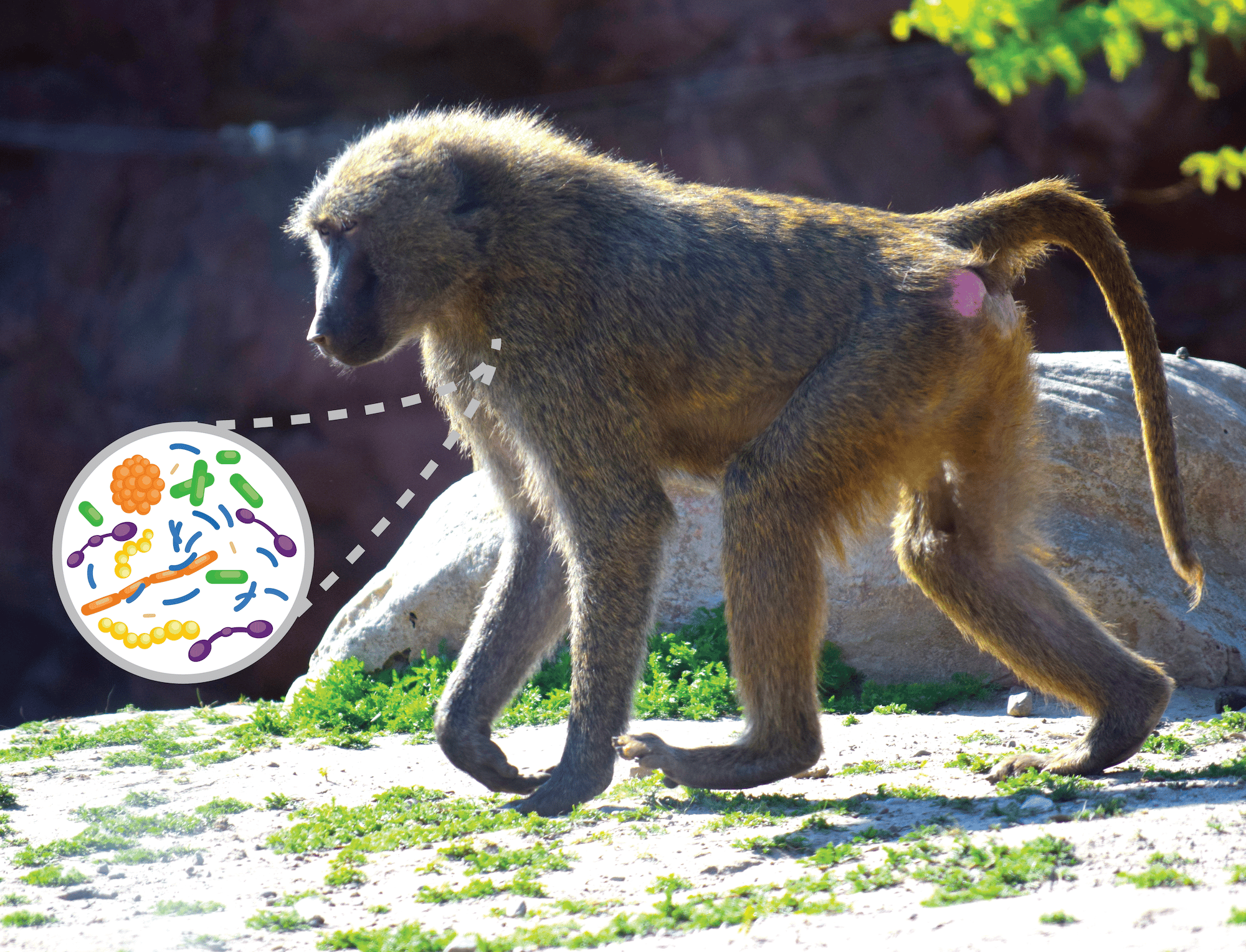
It is an exciting time for microbiologists who study the skin microbiome! High-throughput sample processing and bioinformatics workflows allow researchers to use simple swabs to collect and analyze the many microbial species that inhabit the skin, including bacteria, archaea, viruses, and fungi. Identifying these microorganisms, their roles, and factors that shape skin microbial communities offers enormous potential for applications related to the treatment of disease, development of probiotics and skin care, and discovery of potentially novel conservation options for endangered species.
The curiosity-driven research of Ashley Ross (undergraduate student, then MSc student in the Neufeld lab) skin microbiome began five years ago when she began studying the microbial biogeography of door handles across the University of Waterloo campus. Unsurprisingly, these surfaces were covered in skin bacteria from the multitude of campus dwellers and we were able to see patterns related to building usage. One experiment led to another, and we became intrigued by the skin microbiome of both humans and animals. Channeling the spirit of innovation of the University of Waterloo, we embarked on an extensive sampling effort to collect as many human and non-human animal skin swab samples that we could in Southwestern Ontario. In partnership with the Toronto Zoo, the African-Lion Safari, the Kitchener Waterloo Humane Society, the University of Guelph, and numerous farms and pet owners, we collected hundreds of mammalian skin swabs from 38 species. Key findings of this work indicated that co-habiting human partners can be linked via their skin microbiomes, and that parallels exist between mammalian skin microbes and host evolutionary histories.
Although many other microbiologists have swabbed and characterized microbes on skin from a plethora of animals around the world, we noticed that existing skin microbiome literature reviews focused primarily on humans. To help us better explore the broader vertebrate literature context of our work, we partnered with Aline Rodrigues Hoffmann (Texas A&M University) to summarize current knowledge related to the vertebrate skin microbiome. This collaborative review helped us appreciate that, despite extensive biological differences in skin composition among diverse vertebrate species, general trends were nonetheless apparent. For example, host species and geographic location are important for shaping skin microbiome composition. In addition, the external placement of this organ results in the presence of commensals that are transferred maternally, as well as other microbes immigrating via contact with soil, air, or water. Other factors that influence skin microbial communities among vertebrates include the biological sex of the host and whether the animal is in captivity or cohabiting with other animals of the same or different species.
Overall, we believe that synthesizing these trends in our review will help establish a strong basis for researchers that continually seek to explore exciting and timely new research directions within the context of the skin microbiome. For example, our review draws attention to a paucity of high-throughput sequencing studies conducted on reptile skin, despite these animals being afflicted with numerous and often-fatal skin diseases. In addition, amphibians are currently being decimated by chytrid fungi. Conservationists urgently need more tools for preventing the spread of this skin disease. Novel probiotics composed of microorganisms that resist the establishment of fungal infections could potentially improve the outlook for these animals. Probiotics also have the potential to help address other skin diseases that affect humans and other animals. For all of these reasons, we are excited to offer this review as a state-of-knowledge that can assist microbiome scientists as we delve further than "skin deep" into the vertebrate skin microbiome.

Follow the Topic
-
Microbiome
This journal hopes to integrate researchers with common scientific objectives across a broad cross-section of sub-disciplines within microbial ecology. It covers studies of microbiomes colonizing humans, animals, plants or the environment, both built and natural or manipulated, as in agriculture.

Related Collections
With Collections, you can get published faster and increase your visibility.
Oncobiome
This collection of papers delves into the burgeoning field of oncobiome research, exploring the intricate relationship between cancer and the microbiome. The oncobiome encompasses the diverse microbial communities residing in and on the human body, which influence cancer development, progression, and treatment responses. By examining these interactions, our aim is to unravel the complex mechanisms through which the microbiome impacts oncogenesis and therapeutic outcomes.
This compilation highlights cutting-edge research, offering insights into potential diagnostic markers and novel therapeutic strategies, thereby advancing our understanding of cancer biology and paving the way for innovative, microbiome-targeted cancer treatments.
This is a cross-journal collection between:
Experimental Hematology and Oncology
Articles will undergo the standard peer-review process of the journal to which they are submitted and are subject to either the BMC editorial policies or those of BJC Reports. Articles will be added to the Collection as they are published. The Editors have no competing interests with the submissions which they handle through the peer review process. The peer review of any submissions for which the Editors have competing interests is handled by another Editorial Board Member who has no competing interests.
Publishing Model: Open Access
Deadline: Ongoing
Animal Gut Nutrition and Greenhouse Gas Mitigation
Animal Microbiome, Journal of Animal Science and Biotechnology and Microbiome call for submissions to the collection on Animal Gut Nutrition and Greenhouse Gas Mitigation.
Efforts to reduce greenhouse gas emissions from livestock systems increasingly hinge on innovations in animal gut nutrition. The dynamic relationship between the gut microbiome and nutrient utilization plays a pivotal role in shaping methane output, feed efficiency, and overall sustainability. Advances in microbial ecology—particularly in understanding the role of gut microbiome in nutrient metabolism—are opening new pathways for mitigating emissions while enhancing productivity. These developments support the implementation of climate-smart agricultural strategies to address climate change and its impacts.
Looking ahead, continued research in this field has the potential to yield innovative solutions such as targeted probiotic supplementation, which could further optimize gut function and enhance nutrient absorption. These advancements may lead to reduced greenhouse gas emissions while improving animal health and productivity. By deepening our understanding of the animal gut microbiome, we can contribute significantly to sustainable agricultural practices that benefit both the environment and food security.
We invite researchers to contribute to this special Collection on Animal Gut Nutrition and Greenhouse Gas Mitigation. Topics of interest include but are not limited to:
- Animal Gut Microbiome and Feed Efficiency
- Greenhouse Gas Mitigation Strategies
- Rumen Fermentation Dynamics
- Nutrient Utilization in Livestock
- Probiotic Supplementation Effects
- Sustainable Livestock Production Practices
- Climate-Smart Agriculture Innovations
This Collection supports and amplifies research related to SDG 13, Climate action.
All submissions in this collection undergo the relevant journal’s standard peer review process. Similarly, all manuscripts authored by a Guest Editor(s) will be handled by the Editor-in-Chief of the relevant journal. As an open access publication, participating journals levy an article processing fee (Animal Microbiome fees, Journal of Animal Science and Biotechnology fees, Microbiome fees). We recognize that many key stakeholders may not have access to such resources and are committed to supporting participation in this issue wherever resources are a barrier. For more information about what support may be available, please visit OA funding and support, or email OAfundingpolicy@springernature.com or the Editor-in-Chief of the journal where the article is being submitted.
Publishing Model: Open Access
Deadline: Dec 05, 2026