Designing Nanofiltration Membranes with Ultrahigh Negative-charge Density for Water Treatment
Published in Chemistry, Earth & Environment, and Materials

Water scarcity is one of the most pressing challenges of our era. Driven by strong determination, we strive to develop high-performance polyamide nanofiltration (NF) membranes. In recent years, numerous methods for the precise regulation of membrane pore size have emerged; however, limited research has focused on enhancing the membrane charge. The Donnan effect—an essential mechanism for ion rejection in nanofiltration—is intrinsically linked to the membrane surface charge density. While pore size tuning enables selective ion sieving, it inevitably compromises water permeability. We propose a strategy: enhancing the charge density alongside pore size optimization. This approach could allow moderate pore enlargement (boosting water permeance) while leveraging the strengthened Donnan effect to improve the rejection of highly charged ions.
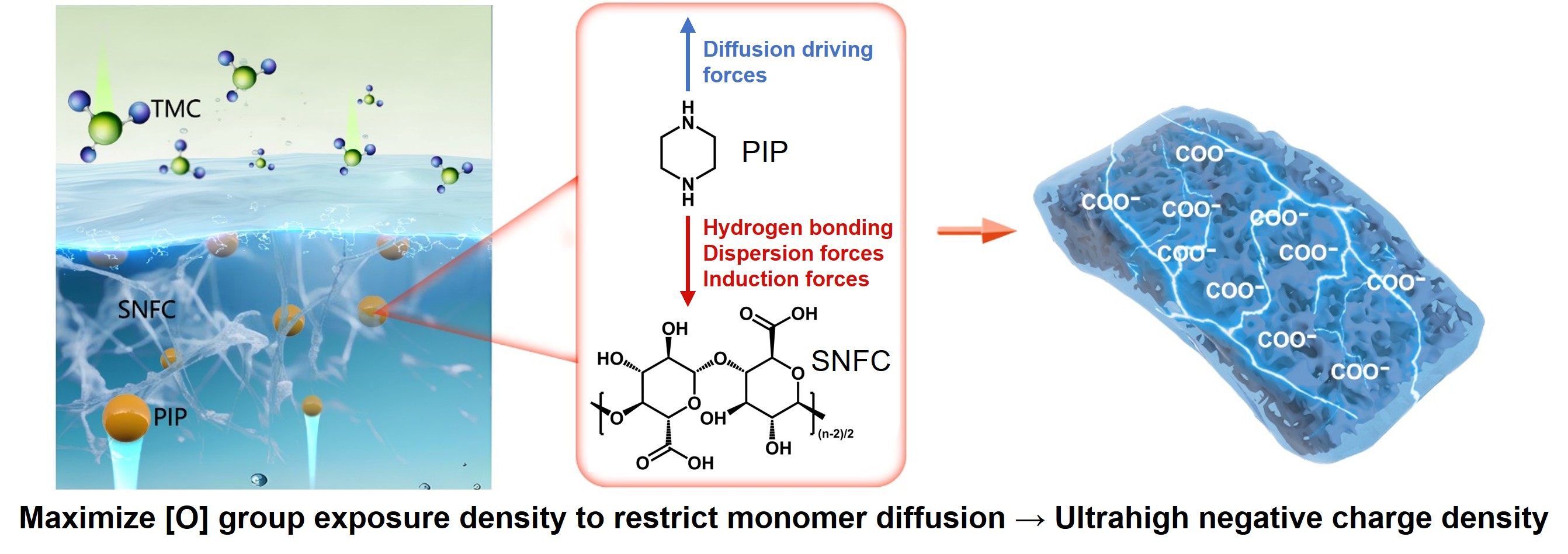
How can highly negatively charged membranes be engineered? Our solution lies in manipulating interfacial polymerization kinetics. Theoretically, maximizing acyl chloride monomer incorporation while minimizing amine monomer consumption would yield polyamide surfaces rich in carboxyl groups post-hydrolysis, achieving strong electronegativity. To realize this "less-amine-multiacylchloride" configuration, we hypothesize that introducing oxygen-rich additives (e.g., carboxyl/hydroxyl-bearing compounds) into the aqueous phase could retard amine diffusion through electrostatic attraction (carboxyl-amine) and hydrogen bonding (hydroxyl-amine).
A decade ago, the water permeance of NF membranes typically ranged from approximately 10–20 L m-2 h-1 bar-1. A paradigm shift occurred in 2016 when Jin's group pioneered the use of single-walled carbon nanotube (SWCNT)/microfiltration hybrid substrates, which propelled the permeance of NF membranes to a new level. While SWCNTs enable ultralow-resistance supports, their energy-intensive synthesis conflicts with sustainability goals. Biomass-derived nanofibers have emerged as a promising candidate, particularly given their inherent oxygen-rich functional groups, which are critical for interfacial polymerization. Through systematic evaluation of diverse biomass sources and extraction methodologies, we ultimately identified sea-squirt nanofibrillated cellulose as the optimal solution, meeting both charge enhancement and green chemistry requirements.
Breakthrough performance: The optimized membrane has an exceptional surface charge density (-148 mV zeta potential at pH 7, charge density of -32.6 mC m-2). As illustrated in Fig. 1, this innovation achieves an excellent Cl-/SO42- selectivity of 144.5 while maintaining high permeance (41.5 L m-2 h-1 bar-1), coupled with superior organic micropollutant rejection—a critical advancement for next-generation sustainable desalination technologies.
This work pioneers an ultrahigh charge density construction paradigm, demonstrating that biology material design and reaction kinetic control can transcend traditional permeability–selectivity trade-offs in membrane science.
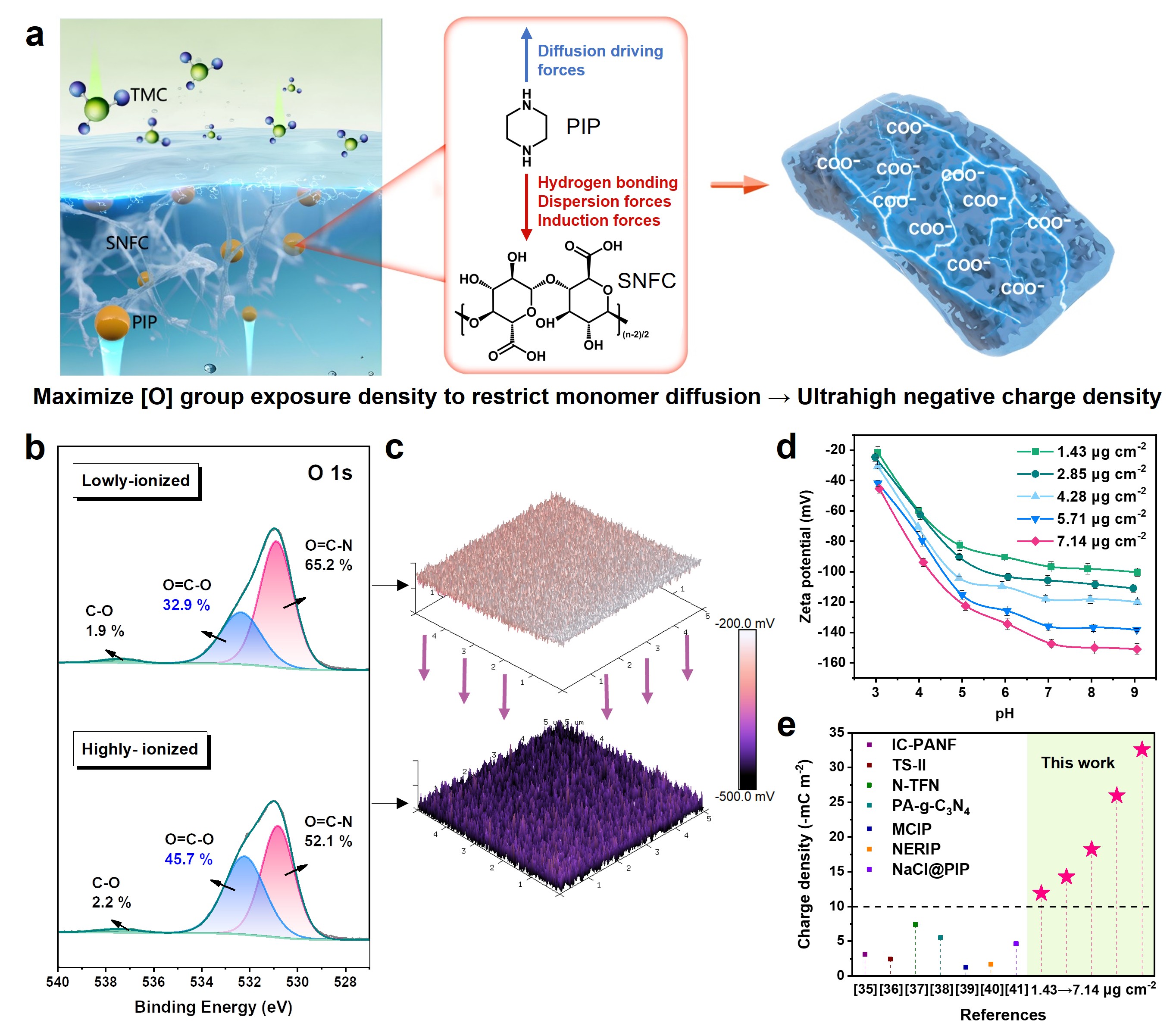
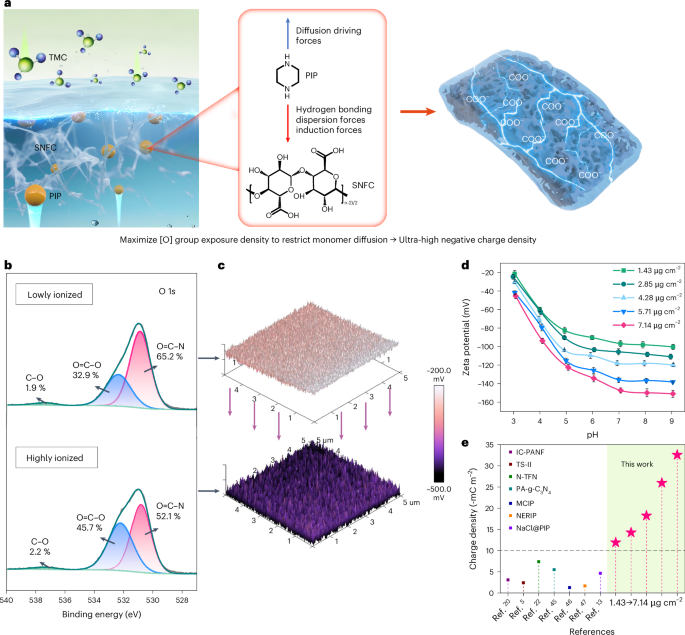
Fig. 1 Regulation and highly ionized characteristics of PA‒SNFC membranes. a Schematic illustration of highly ionized membranes. b XPS O 1s high-resolution spectra and c corresponding KPFM images of the lowly ionized membrane and highly ionized membrane. d Zeta potential of PA-SNFC membranes with different SNFC dosages. e Comparison of the charge densities of PA-SNFC and other state-of-the-art membranes.

Follow the Topic
-
Nature Water
This journal publishes research on the evolving relationship between society and water resources on a monthly basis. It covers the natural sciences, engineering, and social sciences, with a particular interest in regards to interdisciplinary research.

Related Collections
With Collections, you can get published faster and increase your visibility.
Antibiotic Resistance in the Environment
Publishing Model: Hybrid
Deadline: Apr 24, 2027


