Development and Evaluation of a Taxonomy for Platform Revenue Models
Published in Business & Management




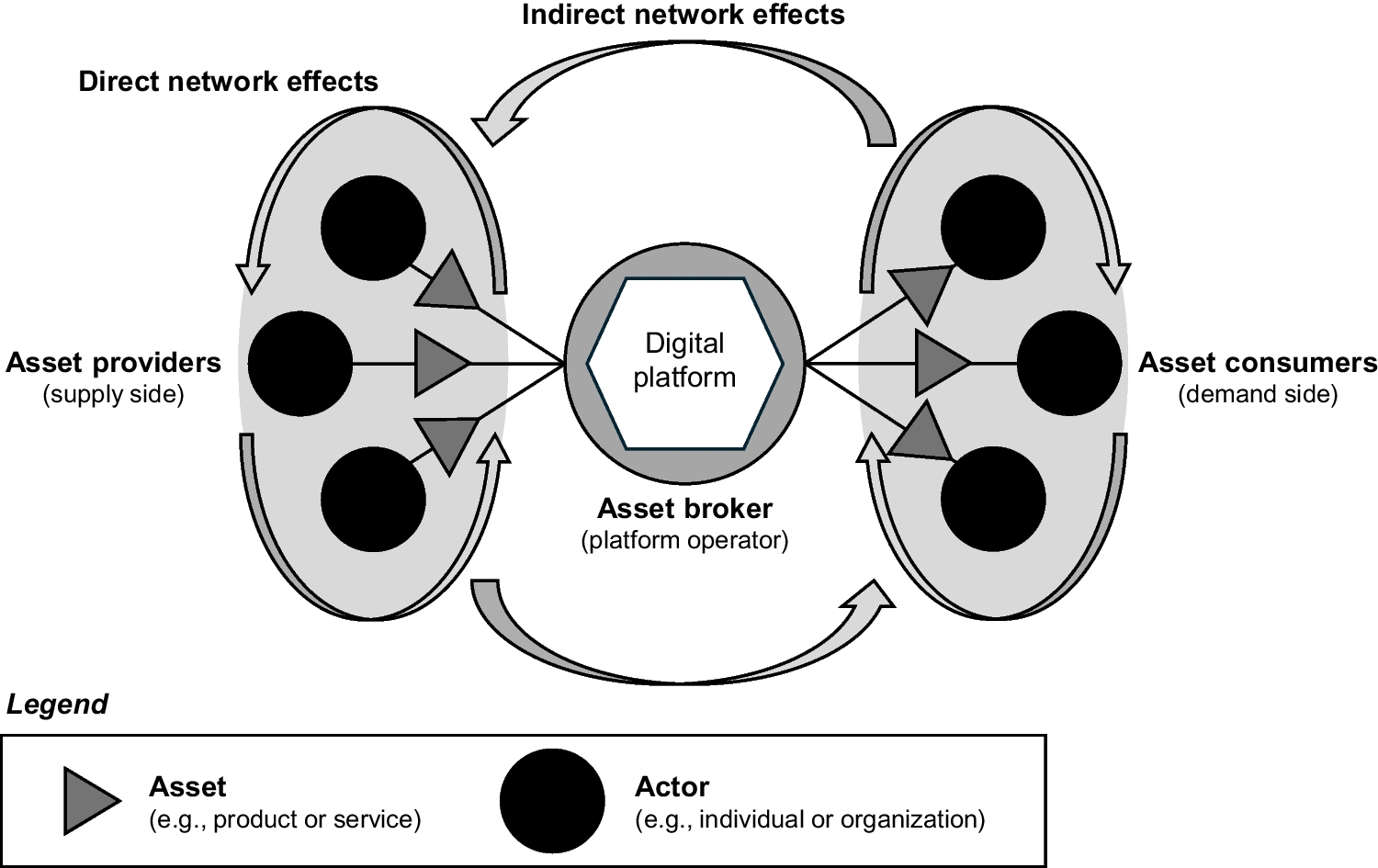

In our paper, we studied how platform revenue models—the mechanisms through which platforms capture value—can be structured and designed systematically. While digital platforms such as Airbnb, Uber, or Spotify are widely studied, their monetization logic remains surprisingly fragmented.
Our goal was to address this gap by developing a taxonomy that brings structure to platform revenue models and supports both research and practical design.
Platform revenue models
Digital platforms are often analyzed in terms of how they enable interactions and generate network effects. They reduce transaction costs, scale rapidly, and reshape entire industries.
However, focusing only on value creation tells only part of the story. A platform’s long-term viability depends also on how it captures value. Designing a revenue model in this context is particularly challenging. Platform operators must decide:
- which market side to monetize,
- how to structure payments,
- and how to balance monetization with network effects.
These decisions are interdependent and often difficult to evaluate systematically.
While prior research has provided valuable insights into platform business models, value capture—and especially revenue model design—remains underexplored. This observation motivated our work.
Building a taxonomy for platform revenue models
When reviewing the literature, we found a wide range of concepts related to platform monetization: revenue streams, pricing mechanisms, price discrimination, and more. However, these elements are rarely integrated into a coherent structure.
To address this, we developed a taxonomy of platform revenue models—a classification framework that organizes the key design dimensions of platform monetization (see Figure 1).
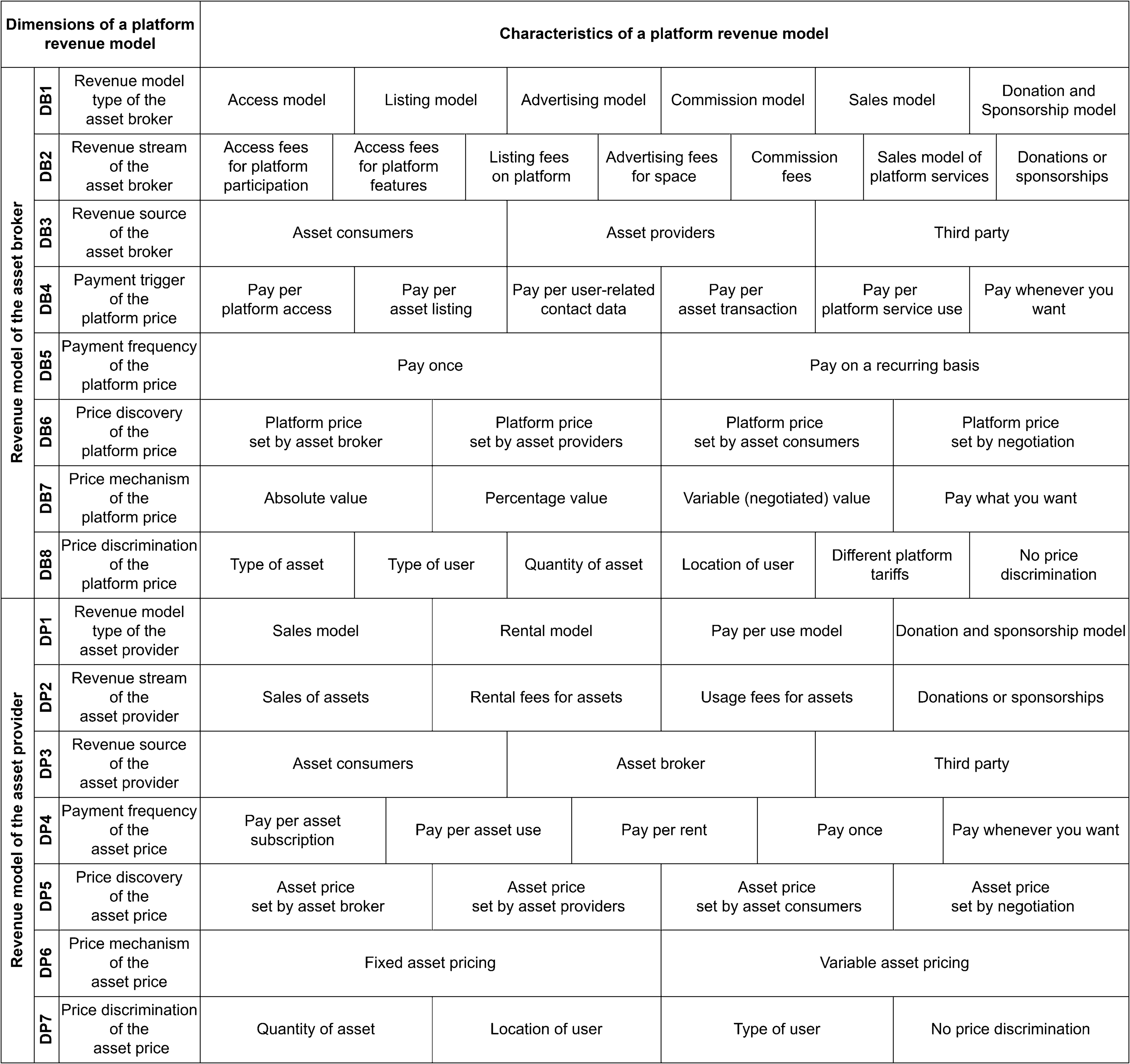
Our taxonomy consists of 15 dimensions and 64 characteristics and is built around two perspectives:
- the platform operator (asset broker)
- the supply-side actors (asset providers)
This distinction reflects a central insight: platform revenue models are not limited to how the platform earns money, but also involve how value is distributed across different actors.
Examples of key dimensions include:
- Revenue source: who is monetized (providers, consumers, or third parties)
- Revenue stream: how revenue is generated (e.g., access fees, commissions, advertising)
- Pricing structure: how prices are set and differentiated
By structuring these elements, the taxonomy enables systematic description, comparison, and design of platform revenue models.
From literature to real-world platforms
Developing the taxonomy required combining conceptual and empirical insights.
We first conducted a structured literature review, identifying relevant dimensions and characteristics discussed across prior studies. However, literature alone was not sufficient. Many concepts remained abstract or inconsistently defined.
To refine the taxonomy, we analyzed seven platform cases, including examples such as Tyre24, empto, MyHammer, Vinted, and nebenan.de. These cases helped us identify how revenue models are implemented in practice.
One key observation was the diversity and combination of revenue models. Across the cases, we identified 26 distinct revenue model types. While commission-based models are common, platforms frequently combine multiple monetization strategies—for example, access fees with transaction-based commissions.
This highlights that platform revenue models are rarely singular. Instead, they are configurations of multiple interdependent strategies.
Evaluating the taxonomy
A central question for us was whether the taxonomy is not only conceptually sound but also practically useful.
To answer this, we conducted a controlled experiment with digital innovation designers. Participants were asked to design a platform revenue model, either with or without the taxonomy.
The results were clear:
- Designs created with the taxonomy were more complete
- and more accurate and structured
These findings suggest that the taxonomy provides meaningful guidance in structuring complex design decisions.
At the same time, participants also highlighted challenges. Some found the taxonomy complex and suggested improvements in usability, such as clearer guidance and more intuitive formats.
What we learned
Looking back, one key insight stands out:
platform revenue models are not single design choices but multi-dimensional systems.
Decisions about pricing, payment timing, and monetized actors are tightly interconnected. Changing one element often affects others.
The taxonomy helps make these interdependencies explicit. It does not prescribe a “correct” solution but provides a structured way to explore the design space.
Why this matters for practice
Our taxonomy offers a structured approach. It can be used as a checklist or design framework to ensure that all relevant aspects are considered.
Typical questions it supports include:
- Which side of the platform should be monetized?
- Should revenue be generated through access, transactions, or other mechanisms?
- How should pricing be structured and differentiated?
By making these dimensions explicit, the taxonomy enables more transparent and comparable decision-making.
Conclusion
With our taxonomy, we provide a structured framework for analyzing and designing platform revenue models. It integrates insights from literature and practice and is empirically evaluated.
As digital platforms continue to shape modern economies, understanding how they capture value becomes increasingly important. By bringing structure to this domain, our work aims to support both research and the practical design of sustainable platform business models.
Follow the Topic
-
Electronic Markets
This is a leading academic journal that offers a forum for research on all forms of networked business.