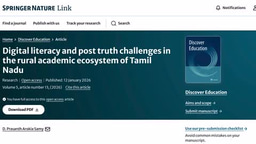
Digital literacy and post truth challenges in the rural academic ecosystem of Tamil Nadu
Published in Education and Arts & Humanities

The article investigates how digital technologies interact with “post-truth” dynamics (where subjective belief can outweigh verifiable fact) within rural higher education in Tamil Nadu, India. It aims to understand how students and faculty use digital tools, their perceptions of truth and misinformation in academic contexts, and what challenges and opportunities arise in digital pedagogy.
Research Design:
The study follows a mixed-methods approach, combining:
• A survey of 284 participants (240 students and 44 faculty) from multiple rural and semi-urban colleges.
• Six focus group discussions to gather deeper qualitative insights.
• Content analysis of institutional digital resources (such as learning management systems, WhatsApp academic groups, and YouTube lectures).
Key Findings:
• High usage of smartphones for learning: 85 % of students reported using smartphones for academic activity, but access to computers and smart classrooms was unequal.
• Low verification of information: Only 20 % of respondents routinely checked information before using it academically, while a majority (60 %) encountered inaccurate or unverified academic content.
• Digital confidence can improve with training: Participants in a supplementary digital literacy certificate course showed improved confidence in using digital tools, although verification skills remained a challenge.
• Technology both helps and complicates learning: While digital tools increase access to content and pedagogical options, lack of infrastructure, training, and curriculum integration can exacerbate the spread of unsubstantiated material and post-truth effects in academic settings.
Conclusions and Implications:
The article concludes that digital literacy is critically needed in rural academic ecosystems to mitigate the risks of misinformation and “post-truth” influences. It recommends institutional supports, such as structured digital literacy training, fact-checking procedures, and localized digital curriculum strategies, to strengthen the quality and credibility of academic engagement with digital tools.
Why This Research Matters:
• The study provides empirical data from rural India, a context that is underrepresented in digital literacy research.
• It bridges education, media studies, and technology use, offering insights of broad interdisciplinary relevance.
• Its findings can inform policy, faculty development and curriculum design in similar rural higher education settings globally.

Short Bio:
With more than eight years of teaching experience, my research explores transhumanism, posthuman literature and AI-generated narratives, recently submitted my PhD thesis on "A Transhumanist Study of AI-Generated Novels". I have edited four books, delivered over thirty guest lectures, conducted intercollegiate certificate courses and published extensively on AI, literature and digital culture. Awarded Best Teacher (2023–24), I also been the coordinator of JOSLEX, a literary start-up & Editor-in-chief for ENGZINE (ISSN 3049-1363), the department’s literary magazine. My work bridges technology and humanities, foregrounding the evolving role of artificial intelligence in storytelling and education.
Follow the Topic
-
Discover Education
An international, peer-reviewed open access journal that publishes original work in all areas of education, serving the community as a broad-scope journal for academic trends and future developments in the field.

Related Collections
With Collections, you can get published faster and increase your visibility.
Advancing Health Professions Education: Innovations, Strategies, and Global Perspectives
Health Professions Education (HPE) plays an important role in preparing competent, ethical, and compassionate healthcare professionals capable of responding to the complex demands of contemporary healthcare systems. In recent years, the field of HPE has witnessed a paradigm shift towards learner-centred, competency-based, and interprofessional education models that prioritize not only clinical expertise but also communication, professionalism, teamwork, and leadership skills.
This Collection invites original research, systematic or scoping reviews, case studies and brief reports and that critically examine the evolving landscape of HPE across medicine, dentistry, nursing, pharmacy, and other allied health disciplines. Key areas of interest include curriculum design and reform, innovative teaching and assessment methods, integration of digital and blended learning technologies, interprofessional education (IPE), faculty development, educational management, student support and well-being, and strategies to promote equity, diversity, and inclusivity in HPE.
We also welcome contributions that explore challenges and best practices in clinical training, rural and underserved community placements, global health education, policy development, accreditation, and institutional leadership in health education. Studies from low- and middle-income countries are strongly encouraged to enhance global representation and to promote scholarly exchange on scalable and contextually relevant innovations.
By consolidating scholarly work in this Collection, we aim to advance the discourse on high-quality, evidence-informed HPE that supports the achievement of Sustainable Development Goals (SDG 3 and SDG 4) and ultimately contributes to improved healthcare outcomes worldwide.
Publishing Model: Open Access
Deadline: Nov 30, 2026
Research Trends in STEAM Education
Science, Technology, Engineering, Arts, and Mathematics (STEAM) education has gained global momentum by integrating innovative curriculum, pedagogy, assessment, and community-driven research approaches to promote sustainable citizenship education. The hallmark of STEAM programs lies in engaging students in inquiry-driven learning, connecting theory with practice, and fostering innovation and creativity in teaching and learning. Over time, STEAM education has evolved to integrate various forms of arts, creativity, and humanities, mirroring the scientific breakthroughs and technological advancements of the 21st century. Creativity is a crucial component of STEAM education, and it is often defined as the ability to generate innovative ideas or products that serve their intended purposes. With the development of STEAM educational approaches, it is crucial to explore emerging trends, future research areas, the impact of STEAM education on student outcomes and career readiness, and the role of community and industry partnerships to promote STEAM education for equity and inclusion.
This Collection, "Research Trends in STEAM Education," aims to look at innovative research and practices, creative teaching methods, and growing trends in incorporating STEAM education into primary to university curricula, pedagogy, assessment and research and innovation by enhancing diversity in STEAM fields, addressing gender and socioeconomic disparities, and ensuring the inclusion of students with special needs in all activities. For this Collection, we invite researchers, educators, and practitioners to submit original contributions—empirical studies, reviews, commentaries, perspectives, and case studies—addressing, but not limited to, the following themes:
1. Arts-based pedagogy in STEAM education
2. Innovative research and practices in STEAM education
3. Curriculum development models and/or frameworks for STEAM education
4. Assessment models and/or frameworks for STEAM education
5. Creative teaching methods in STEAM Education
6. Pedagogical models in STEAM education
7. Techno-educational trends in STEAM education
8. Research methodological trends in STEAM education
Keywords: STEAM education; arts-based pedagogy; innovative research; pedagogical approaches; creativity; innovative research and practices; creative teaching methods; curriculum development models; pedagogical models and assessment models; techno-educational trends
Publishing Model: Open Access
Deadline: Dec 04, 2026