Directed Evolution Without the Flask: Moving Selection Into a Protein Language Model
Published in Bioengineering & Biotechnology, Chemistry, and Ecology & Evolution


Directed evolution won a Nobel Prize for a loop that is very simple. Make a library of variants. Apply a selection pressure. Keep whatever survives. Do it again. The method works precisely because you do not need to understand the protein, only to be able to test it.
What limits it is throughput. Depending on the assay, a laboratory can build and screen somewhere between ten thousand and a hundred million variants, and the sequence space of even a modest protein is astronomically larger than that. Nature runs the same loop across geological time with the entire organism serving as the assay, which is why evolution routinely arrives at solutions no design campaign would have proposed.
Our approach keeps the loop and relocates one step. Variants are generated computationally. The selection pressure is the model's judgment about whether a sequence looks like something evolution would produce. Survivors go forward, and the search runs again across their neighbours.
No flask, no library, no assay.
We tested it on a transporter in the human gut that decides whether a drug can be swallowed or has to be injected.
Whether a drug can be a pill
PepT1 is a peptide transporter, and it is unusually relaxed about what it will carry. Beta-lactam antibiotics ride it. So do ACE inhibitors and several antiviral prodrugs. Medicinal chemists have learned to design compounds that resemble a dipeptide closely enough for PepT1 to pick them up, because a molecule PepT1 recognises can be swallowed, and a molecule it ignores usually has to be injected.
That makes PepT1 worth screening against. The difficulty is getting it into a form you can screen with.
The stable cousin
Human PepT1 is awkward to work with. It is a large, flexible membrane protein, and membrane proteins have to be coaxed out of the lipid bilayer with detergents before most structural methods can touch them. Many of them stop behaving once you do.
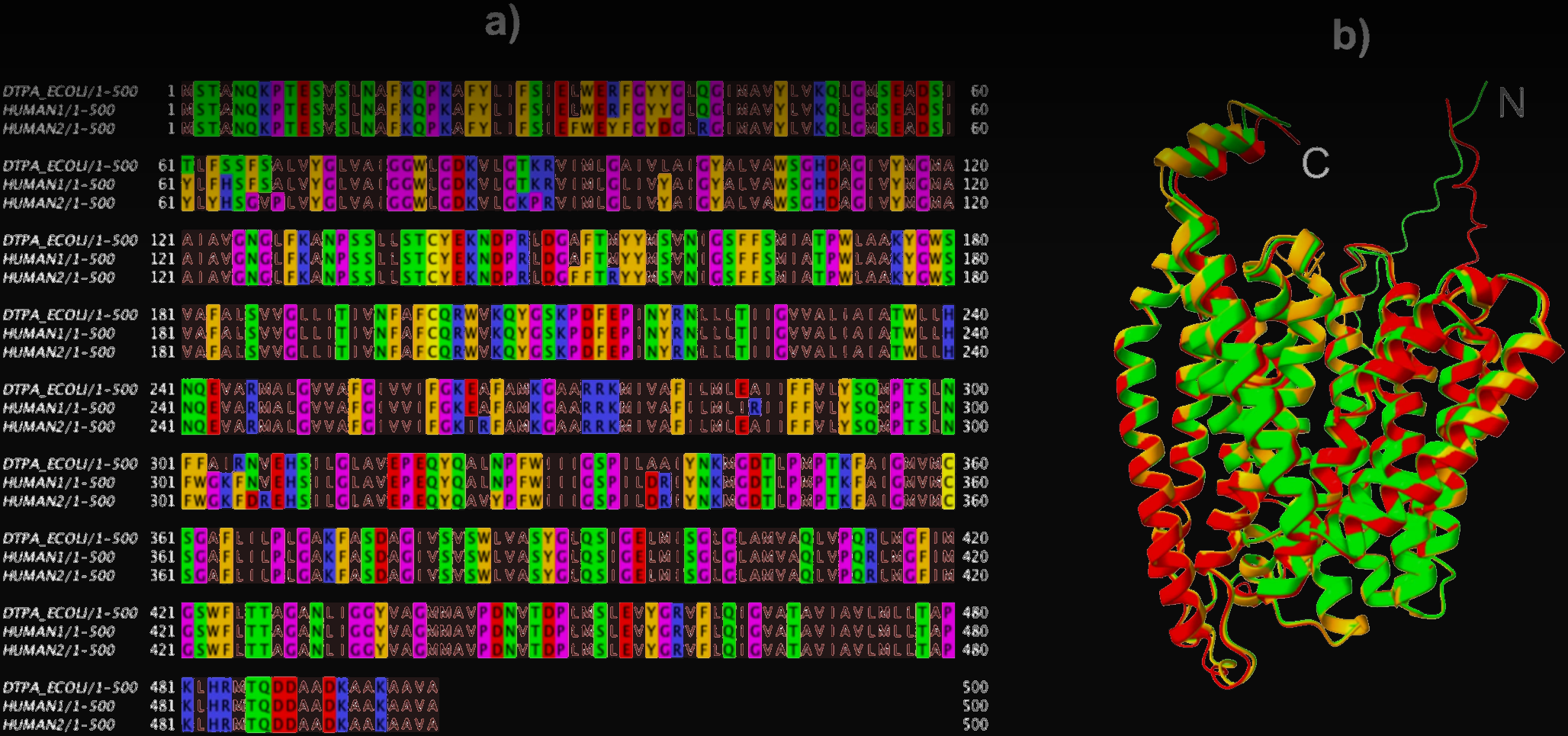
There is a well-known workaround. DtpA, a bacterial relative from E. coli, does the same job and is far better behaved. It expresses well, it holds together, and its structure has been solved. The trouble is that it is bacterial, and it binds its substrates differently enough that what you learn from it does not transfer cleanly to human pharmacology.
So the obvious idea presents itself. Take the residues that make human PepT1 bind the way it does, and move them onto the stable bacterial scaffold. Keep the robustness, acquire the human specificity.
The obvious idea does not work, and we wanted to understand why before spending a year of bench time finding out.
We asked the model first
We identified 19 residues in human PepT1 that matter pharmacologically, mapped them onto the equivalent positions in DtpA, and handed every substitution to ESM-2, a protein language model trained on a very large number of natural protein sequences.
A model like this does not know chemistry in the way a force field does. What it has absorbed is which amino acid sequences evolution actually produces, and which it never does. Ask it how likely a sequence is, and you are asking something close to: does this look like a protein that exists?
Fourteen of the nineteen came back with likelihoods below 10 to the minus 5.
That is the model saying, as clearly as it can, that proteins carrying these substitutions are not found in nature.
The model was right, and that was the interesting part
Our first instinct was that the model was being conservative. It was not.
Those 19 residues did not evolve in isolation. Each one sits in a neighbourhood, packing against specific partners, and over evolutionary time the neighbourhood adjusted to accommodate it. Lift a residue out of human PepT1 and drop it into a bacterial protein, and it arrives without the neighbours it depends on. The local packing breaks. The model had learned this pattern from millions of sequences, and it was flagging exactly the failure mode that makes naive grafting fail at the bench.
Epistasis, in other words. The contribution of one residue depends on what sits around it.
Normally this is where a project stops, or turns into a combinatorial screen with more variants than anyone can build.
Asking the opposite question
Instead of accepting the model's verdict, we asked it a different question: if this substitution breaks the local environment, which neighbouring residue would you change to repair it?
We ran an automated search over the surrounding positions, scoring compensating mutations the same way we had scored the originals, and looking for pairs where the second change restored the plausibility of the first.
It found them.
Q41R, one of the worst offenders in the original set, was rescued by Y38D. R305F was rescued by I304K. The likelihood the model assigned to those primary substitutions rose by factors of 5,215 and 11,614.
Each rescued design then went through molecular docking and 50 nanoseconds of molecular dynamics in a membrane, to check that the proposed structures were not merely plausible as sequences but stable as proteins.
What used to be a blind combinatorial problem became a short list.
What the model actually knows
Relocating the selection step is not free. A fitness assay measures whether a protein does its job. The model measures whether a sequence resembles proteins that already exist. The two correlate, since sequences that fail tend not to persist in nature, and they are not the same measurement. A design the model scores highly could still transport nothing at all, and we would only discover that once somebody built it.
The fold-changes above describe how much more plausible the model considers a sequence. They are not measured binding affinities, and they are not calculated free energies. A design whose likelihood climbs by four orders of magnitude has become a far more reasonable protein to attempt, and it has not thereby been shown to bind anything.
The honest position on this work is that it is a computational design that still requires experimental validation of folding, binding and transport. The gain is in scale and cost. The loss is in what the selection criterion actually knows.
What it does deliver
A much smaller experimental space.
Grafting 19 residues and then searching for compensating mutations by hand is not a tractable experiment. The combinations run past anything a lab can express and assay. What this approach produces is a ranked, structurally checked handful of designs with a stated reason for each one, which is the difference between a screen you can run and a screen you cannot.
It also generalises past this one protein. The problem of moving a functional site from one organism's protein onto another organism's scaffold shows up constantly in protein engineering, and it fails for the same reason every time. A method that locates the compensating mutations computationally applies anywhere that pattern holds.
Paper: Molecular Diversity (Springer Nature): https://doi.org/10.1007/s11030-026-11710-3
Alper Karagöl and Taner Karagöl
Follow the Topic
-
Molecular Diversity
This journal presents refereed papers describing the development, application and theory of molecular diversity, and combinatorial chemistry in basic and applied research and drug discovery.

Related Collections
With Collections, you can get published faster and increase your visibility.
Molecular Similarity for Environmental Cheminformatics
text
For more information on the Special Issue, please contact Prof. Kunal Roy (kunal.roy[at]jadavpuruniversity.in)Publishing Model: Hybrid
Deadline: Dec 31, 2026
Carbene Chemistry for Molecular Diversity and Function: In Honor of Michael P. Doyle
Carbene chemistry has long stood as a cornerstone of modern organic synthesis, offering a uniquely versatile platform for bond construction, molecular editing, and the rapid generation of structural complexity. From its early conceptual development to its current status as a powerful tool in catalytic synthesis, carbene reactivity continues to shape the landscape of molecular science.
This Special Issue of Molecular Diversity is dedicated to celebrating the profound contributions of Michael P. Doyle to carbene chemistry and its applications in synthesis and catalysis. It aims to highlight both foundational advances and emerging frontiers in this rapidly evolving field.
The issue will focus on recent progress in several key areas:
- New carbene reactivity modes
- including novel metal-carbenoid and free-carbene transformations, unconventional insertion processes, rearrangements, and cascade reactions that expand the boundaries of known reactivity.
- Generation of new molecular architectures via carbene chemistry
- highlighting strategies for building complex scaffolds, stereochemically rich frameworks, and structurally diverse molecules using carbene-mediated transformations.
- Advances in carbene-based catalysis
- covering developments in metal-carbene catalysis, organocatalytic carbene transfer, enantioselective carbene reactions, and cooperative catalytic systems enabling improved selectivity, efficiency, and functional group tolerance.
- Functional molecules and applications
- showcasing how carbene chemistry enables the synthesis of biologically active compounds, functional materials, pharmaceutically relevant scaffolds, and molecular probes for chemical biology.
By bringing together contributions from leading researchers and emerging scientists, this Special Issue seeks to provide a comprehensive snapshot of the current state of carbene chemistry while outlining future directions in reactivity design, catalyst development, and functional molecule synthesis. It further aims to honor the enduring scientific legacy of Michael P. Doyle, whose work has profoundly shaped the field.
Publishing Model: Hybrid
Deadline: Dec 31, 2026