Diverse Views in Science | My child is growing up, how do I grow with them?
Published in Social Sciences and Education


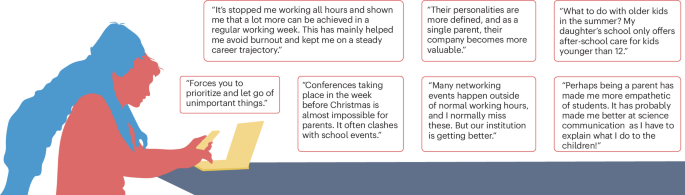

This post accompanies the Nature Reviews Chemistry comment piece 'Growing Pains' and is written by Jennifer Leigh and Emily Draper with the Women and Inclusivity Supramolecular Chemistry Network.
There is lots of talk about how hard it is for ‘new parents’ or parents of ‘young’ children, but how old is young? Pre-school? What isn’t discussed as much are the pinch points that hit you as a parent as your children get older. Take starting school as an example. Even if your kid has been going to nursery from 8am-6pm every day, most schools will have a ‘settling in’ period or ‘staggered starts’ for the first few weeks. Sometimes it can last a month. During this time they are only allowed to be at school for a couple of hours, slowly working up to staying for lunch, then after lunch, before they can stay a whole day. This means that you are going to have to be available to take them, pick them up, and entertain them the rest of the time.
When they are settled, it is important to remember that the whole school day is often only 9am – 3pm and that unlike many nurseries schools are not open in half-term, holidays, or on random ‘teacher training days’ and strikes. If your teaching terms do not match up with the school’s, you will need to investigate options for childcare in the holidays such as sports or arts camps your kid can go to. Depending on the school, in term time you may be able to access breakfast and/or after school clubs – though some will restrict this to children older than Y1 (age 5-6). Some schools require you to book terms in advance or limit the number of days per week your child can go. Even if you do have access many start later and finish earlier than desired making drop off and travel to work or travel for work more challenging. In order to guarantee being there for pickup time you may find your hours rather constrained unless you are happy to run the gauntlet of your kid being the last to go home.
Working parents can feel guilty if their child is always at a before or after school club and they are not going in to read / help out or be there for whatever 'come in to the school mid-week' thing is on that week. However, before and after school club may offer a way to avoid the school playground and its cliques (for parents as much as kids)! Missing the school run can make it challenging to organise or accommodate the obligatory ‘play dates’ and activities which seem to be such a vital aspect of primary school socialising though. When every other kid gets to go swimming / woodcraft folk / circus skills / horse riding / Japanese why can't they? You may find less formal 'enrichment' activities are cancelled at short notice, or involve you being available to pick them up, take them there, and most likely sit frantically working (or not and potentially feeling guilty about it) waiting for them. Maybe they do not understand that you cannot do your job if you finish at 2:30 every day. Or they do, but they just don't really care or think it's that important. Of course, all that socialising means that school-age children generally seem to come down with EVERY bug going. Your kid is likely to pick up and bring home sickness bugs, chicken pox, scarlet fever, head lice and more for you to share. Schools generally ask for a child to be 48 hours clear of illness before returning.
The end of primary school is not necessarily the end of child- or self-induced guilt about being a working parent. Starting ‘big school’ is a tough transition for many children, and even older teens need just as much ‘parenting’ as younger kids, albeit at different times of day. Children and young people face the pressure of learning to become more independent and navigate peer relationships, school, homework, exams, while being scrutinised through social media and living in the fallout of a worldwide pandemic. The jury is still out on the impact of phone addiction in young people. It is hardly surprising that anxiety disorders peak in adolescence given so many teenagers struggle with aspects of their emotional, psychological or mental health.
So what can you as a parent of older children do? Thankfully, there is positive evidence that mindfulness can help teens overcome anxiety and neuroscience interventions can help minimise depression. Books like Anthony Kessel’s Don’t Doubt the Rainbow contemporary detective series aim to equip young people with the skills they need to build their mental wellbeing. A simple way to increase connection with your child and learn practices that can help ‘defrag’ their brain at the end of the day is to take a little time and try the following:
- Ask them to share, without diving into the emotions, three events that have happened in their day. This allows them to remember and recount what has happened, and gives you insight into what is important and memorable to them day-to-day.
- Ask them to share one challenge they have overcome that day. Again, this will help you understand what they find challenging and why. It also becomes a natural and positive space to acknowledge their success and reflect on the strategies they are developing to navigate the world.
- Ask them to share one positive, measurable step they are going to do the next day. They may need some support with this – it is not okay to have a negative step ‘I am not going to bite my nails’ nor something too big or vague ‘I am going to do better’ or something out of their control ‘I’m not going to argue with Carla’. If this is what they think of try suggesting a couple for them ‘I am going to paint my nails a pretty colour’, ‘I’m going to put my dirty clothes in the laundry basket’ ‘I’m going to count to 10 before I say anything to Carla’.
- Take a big, long, breath out.

Follow the Topic
-
Nature Reviews Chemistry
This journal aims to cover both the traditional core subjects of the field — organic, inorganic, physical and analytical chemistry — while also providing insight to non-specialists where chemistry is a significant component of interdisciplinary research.