Dual Life of Liquid Light: Superfluid and Insulator
Published in Physics


The Superfluid of Light
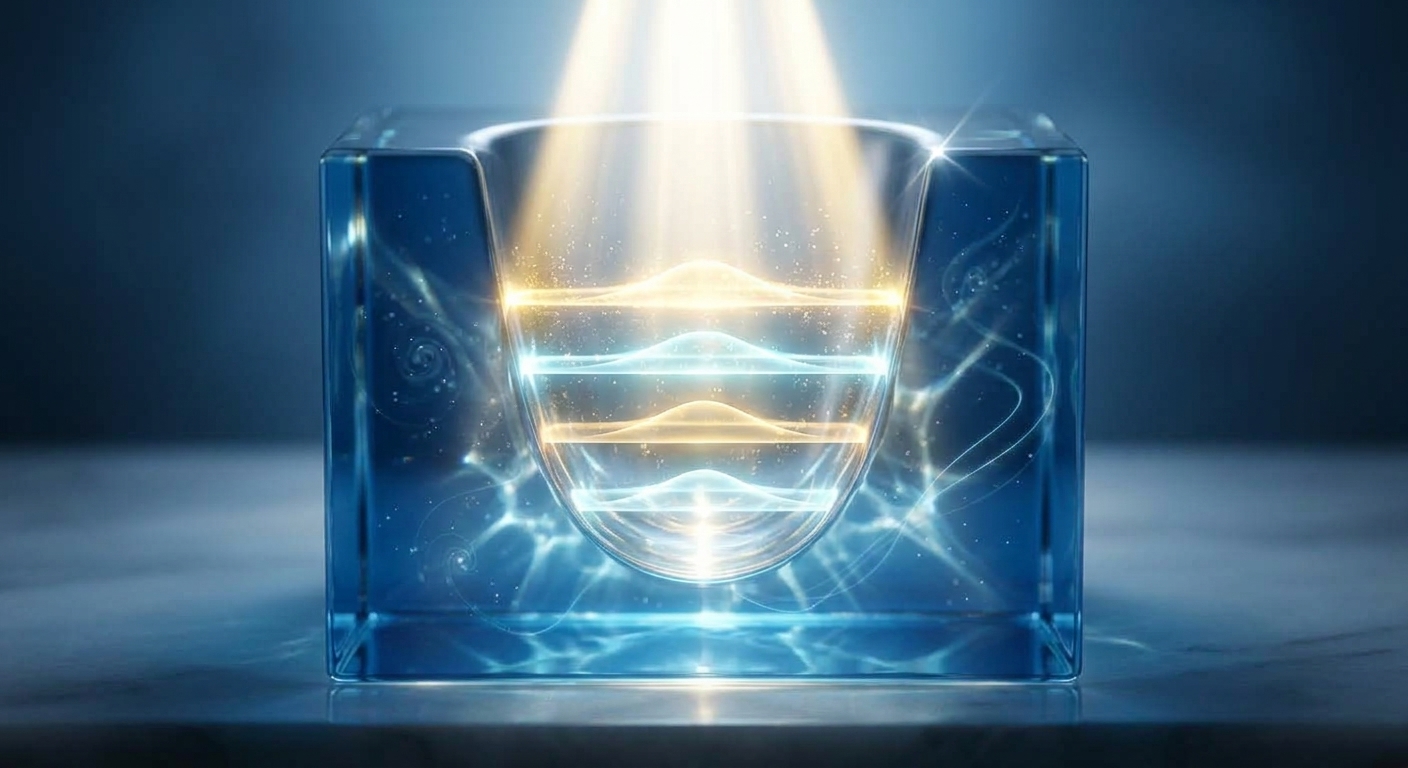
When light interacts strongly with matter, it can create a "fluid of light". Remarkably, this fluid can behave like an extremely cold substance known as a Bose-Einstein condensate, even at room temperature. In this state, it exhibits mysterious quantum behaviors—such as flowing without any friction or resistance, even over rough surfaces. This frictionless flow is known as the superfluid phase of light.
A new twist: The Insulator Phase of Light
While this superfluid phase has been previously observed in various systems, this new research predicts the existence of a drastically different state: an insulator phase of light. In this phase, the fluid behaves in the exact opposite way a superfluid would. It comes to a complete halt, refusing to flow even when all the typical conditions for superfluidity are met.
Such an insulator phase has actually been observed before in atomic Bose-Einstein condensates. In those atomic systems, the repulsion between atoms is so strong that it prevents them from shifting around. As a result, this phase locks in a strictly fixed number of atoms at any specific point in space. This state is known as a Mott insulator, named after the British physicist Nevill Mott.
However, achieving a Mott insulator phase with a fluid of light is almost impossible. Why? Because in a light fluid, creating an extra liquid light particle is energetically "cheap"—it requires very little energy. Because these particles can fluctuate so easily, forcing a strictly fixed number of them into one point in space is highly impractical and has never been observed.
But as this new research reveals, an insulator phase of light can still appear—it just relies on a completely different microscopic mechanism than the Mott insulator.
What Causes It?
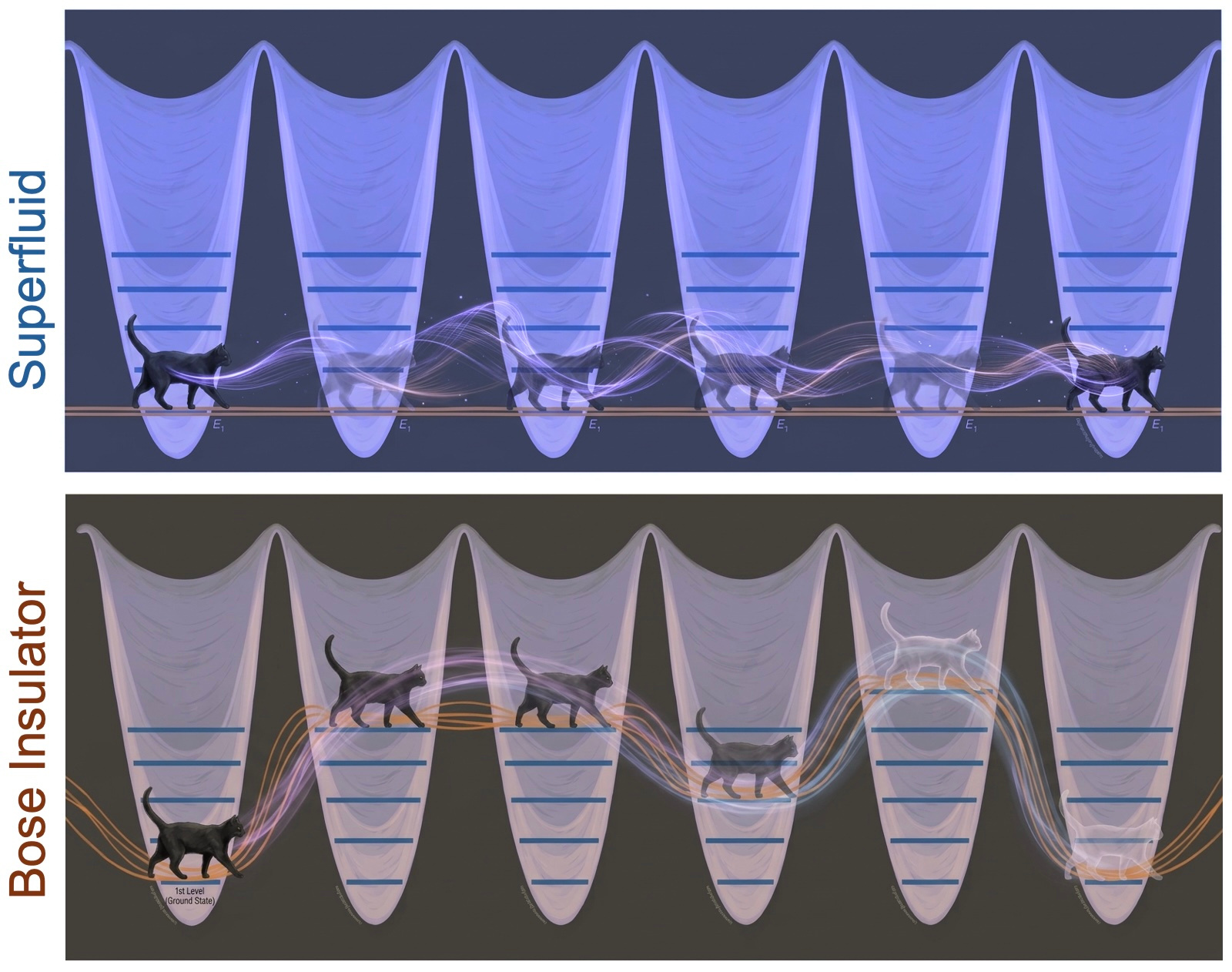
What causes this sudden halt? The key lies in the presence of quantized energy levels within the system, which act like a microscopic energy ladder for the light to climb. Strangely enough, this work predicts that when more of the light fluid is poured into the system, the particles are forced to move up this energy ladder. Once a critical threshold is crossed, the superfluid behavior is completely destroyed, locking the fluid in regions. Technically, this newly identified state is called a dynamical Bose-insulator phase of light.
Why is it Important?
The true significance of this phase lies in its name: a Bose-insulator.
In an ordinary material, a transition from a conducting phase to an insulating phase happens because of excessive scattering. The flowing particles bounce around randomly, and because they are moving in all different directions, the net flow becomes zero. This is intuitive and easy to picture.
However, the insulating phase found for this liquid light is entirely different. On a macroscopic (large) scale, it looks exactly like an ordinary insulator. But zoom in to the microscopic scale, and it behaves in complete contradiction to that. Microscopically, it remains a perfect, frictionless Bose-Einstein condensate. The fluid is still flawlessly flowing at the micro-level, but these small internal currents perfectly cancel each other out, producing a net flow of zero. This bizarre contradiction—a perfect, frictionless fluid that freezes itself in place through canceled macroscopic motion—is what makes this phase so uniquely fascinating to physicists.
What is Next?
While this study firmly establishes the theoretical existence of the Bose-insulator phase of light, observing it in a real-world experimental system is the next great challenge.
To guide experimentalists, this research acts as a precise "treasure map", outlining a specific combination of observable signatures that will definitively verify the existence of this new phase. These defining markers include:
- The "Smoking Gun": A measurable property called the condensate fraction is the primary indicator.
- A Tale of Two Extremes: This condensate fraction will be extremely high when the light is in the superfluid phase, but it will drop to a very small amount in the insulating phase.
- An Abrupt Shift: The transition from flowing superfluid to frozen Bose-insulator won't be a slow, gradual fade. It is predicted to happen sharply and abruptly.
- A Sudden Drop in Flow: Directly observing the physical flow (current) of the light will serve as independent evidence, showing a similarly dramatic, sudden plunge from high to zero at the critical threshold.
- Superfluid Stiffness: Finally, a highly technical measurement known as "superfluid stiffness" is also predicted to collapse abruptly alongside the transition.
By objectively hunting for this specific checklist of facts in a lab, scientists now have exactly what they need to turn this strange theoretical prediction of insulating liquid light into a verified scientific reality.
For more details, see the study in Communications Physics.
Authors & Affiliations
Authors
Sanjib Ghosh
Affiliations
- School of Science and Engineering, The Chinese University of Hong Kong (Shenzhen), Longgang, Shenzhen, People’s Republic of China
- Beijing Academy of Quantum Information Sciences, Beijing, People’s Republic of China
Corresponding Authors
Sanjib Ghosh
Email: sanjibghosh@cuhk.edu.cn
How to Cite This Article
Ghosh, S. Dynamical superfluid and Bose-insulator phases in quantized microcavity lattices. Commun Phys (2026). https://doi.org/10.1038/s42005-026-02934-8

I’m an Assistant Professor of Physics at CUHK, Shenzhen, leading the Quantum Light-Matter research group. We investigate quantum information theory, strong light-matter interactions, and physical machine learning.
Follow the Topic
-
Communications Physics
An open access journal from Nature Portfolio publishing high-quality research, reviews and commentary in all areas of the physical sciences.

Related Collections
With Collections, you can get published faster and increase your visibility.
Quantum machine learning: understanding capabilities, limitations, and perspectives for quantum advantage
Publishing Model: Open Access
Deadline: Dec 31, 2026
Nonlinear dynamics of living systems
Publishing Model: Open Access
Deadline: Nov 09, 2026