EEG criticality as a monitoring biomarker in Cognitive Impairment
Published in Neuroscience, Anatomy & Physiology, and Mathematics
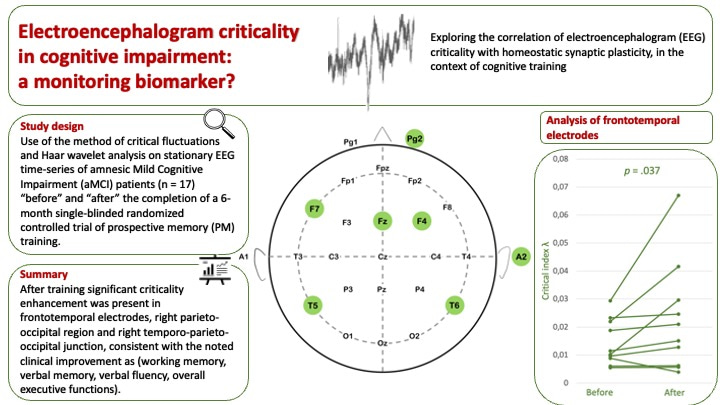
I am happy to share to all interested Neurologists and Clinical Neuroscientists my relatively recent publication on EEG criticality as a monitoring biomarker in patients with cognitive impairment. 📈📊👴🏼🧠
In our study the improvement observed in EEG criticality after a month programme of prospective memory training was linked to the patients' clinical improvement.
A link is herein attached.
#EEG #Criticality #Alzheimer #MildCognitiveImpairment #Cognition #Neuroscience

Neurology resident doctor with special interest in Multiple Sclerosis, Neuroimmunology and Dementia.
MSc Medical Research Methodology. Data Science and Public Health enthusiast.
Representative and Communication Liaison of the Resident and Research Fellow Section, European Academy of Neurology
Follow the Topic
-
Cognitive Neurodynamics
This journal provides a unique forum of communication and cooperation for scientists and engineers working in the field of cognitive neurodynamics and intelligent science and applications, bridging the gap between theory and application.

Related Collections
With Collections, you can get published faster and increase your visibility.
Graph Neural Networks and Link Prediction
Special Issue Objectives
This Special Issue aims to gather cutting-edge research and unique insights into Graph Neural Networks and Link Prediction, focusing on fundamental open questions and future directions in the field. Based on the substantial and ongoing attention in the machine learning and data science communities, we seek to provide a platform for researchers to present their latest findings, innovative ideas, and theoretical breakthroughs that address major scientific issues in network analysis. Specifically, we will focus on pivotal areas including Graph Convolution Operators, Graph Attention Mechanisms, Negative Sampling Strategies, Temporal Dynamics Modeling, and Multimodal Fusion for heterogeneous data. Particularly in Temporal Dynamics Modeling, we will draw upon the modeling paradigms of Cognitive Neurodynamics (such as neural oscillation, synchronization mechanisms, and information propagation models) to more effectively process evolving network structures and perform dynamic relational inference. Through the in-depth integration and discussion of the content mentioned above, this Special Issue hopes to promote a deeper understanding of relational inference mechanisms within the academic community (especially their similarity to human cognitive processes), facilitate cross-disciplinary collaboration between Cognitive Neuroscience, Neurodynamics, and Computer Science, and lay an important theoretical foundation for the breakthrough development of Graph-based Artificial Intelligence and next-generation network analytics technology.
Guest Editors
Professor Yichao Zhang, Tongji University
Professor Lu Liu, University of Exeter
Professor Tianyu Zheng, Shanghai Tenth People's Hospital
Professor Zhengpin Fan, Sun Yat-Sen University
Professor Yao Chen, Southwestern University of Finance and Economics
Call for Papers
We invite researchers, scientists, and scholars to submit original research articles, review papers, and perspective essays that address the following topics:
• Fundamental open questions in Graph Neural Networks and Link Prediction and their implications for network science and artificial intelligence, including the limits of current relational inference models.
• New theoretical frameworks and models for relational inference, such as architectures capturing topological dependencies and dynamic interactions in complex networks.
• Interdisciplinary approaches integrating insights from machine learning, data science, mathematics, and computer science to advance graph representation learning.
• Theoretical foundations and mechanisms underlying graph-based artificial intelligence, particularly for link prediction and relational reasoning.
• Future perspectives for Graph Neural Networks research, including temporal graph modeling, multimodal data fusion, and quantum computing.
Submission Timeline
Submission Start Date: December 31, 2025
Submission Deadline: August 31, 2026
Submission Guidelines
Authors should submit their manuscripts through Cognitive Neurodynamics's online submission system. All submissions will undergo a rigorous peer-review process. Manuscripts should adhere to the journal's formatting and submission guidelines, which can be found on the journal's website. Authors are encouraged to highlight how their work addresses the key themes and open questions discussed in the Brain Theory Seminar in Shanghai.
Publishing Model: Hybrid
Deadline: Aug 31, 2026
Fast tracked publications in Cognitive Neurodynamics
To address the pressing need for rapid communications on timely topics, the journal Cognitive Neurodynaimics now offers fast track publications to manuscripts that meet the following additional criteria on top of the journal’s submission guidelines.
Manuscript Orientation and Core Requirements
Core Orientation: This category focuses on time-sensitive major findings, groundbreaking research progress, or important research briefings in the fields of cognitive neurodynamics and brain-inspired artificial intelligence. Submissions must demonstrate distinct originality and broad academic attention, making them suitable for rapid publication to secure academic priority.
Submission Prerequisites: Authors must include a cover letter with their submission, clearly stating the reasons why the manuscript qualifies for the rapid communication category (e.g., timeliness of findings, groundbreaking value). Additionally, two letters of recommendation from authoritative experts in the field must be provided alongside with institutional email addresses.
Originality and Compliance: Manuscripts must not have been formally published, be under review at other journals, or submitted to multiple journals simultaneously.
Formatting requirements
Length Limit: The full text (including figures, tables, and references) should be restricted to 3,000–3,500 English words, or approximately 5 manuscript pages. Redundant content should be avoided, with a focus on presenting core research outcomes.
Structural Requirements: A concise, structured framework is required, including a title page, abstract, keywords, main text (where "Results and Discussion" may be combined), conclusion, and references. An ethics statement, funding acknowledgments, and thanks section should be added as needed. Short subheadings may be used in the main text to ensure clear logic and direct presentation of core content.
Abstract and Keywords: The abstract should concisely summarize the research objectives, methods, core findings, and significance, with a length not exceeding 300 English words. Abbreviations and reference citations are not allowed in the abstract. 4–5 keywords should be provided, accurately covering the core themes of the research.
References: Priority should be given to citing literature published in the past 5 years, with the total number of references recommended to be around 25. The citation format must be consistent and standardized to ensure the credibility of sources.
Figure and Table Specifications: Figures and tables must be closely relevant to the content, with the quantity limited to no more than 4. Color figures should have a resolution of ≥ 300 dpi, black-and-white figures ≥ 500 dpi, and line graphs ≥ 1000 dpi. Preferred file formats include TIFF, EPS, and JPEG (LZW compression). Line widths should be set between 0.25–1.5 pt, and the RGB color mode is recommended. Clear legends must be provided for all figures and tables. They can either be embedded in the main text or uploaded separately, with individual file sizes not exceeding 20 MB.
Manuscript Format: The language should be fluent and the expression rigorous. Manuscripts should be formatted in single-column layout with single-line spacing and 10-point font size. Supported file formats include Word, PDF, and LaTeX. All essential elements such as formulas, data, and algorithms (models/protocols) must be fully included.
Title Specifications: The title should reflect the core content of the research and may include the type of research design. Declarative or assertive titles should be avoided. The label "Rapid Communication" may be included in the title to clearly indicate the manuscript category.
Peer review process and timeline
Review Process: A fast-track review channel will be adopted, with the review cycle controlled within approximately 10 days. The editorial office may adjust the cycle based on manuscript quality to ensure timeliness.
Revision and Publication: Up to one revision opportunity will be permitted during the peer review process, with the revision period limited to 10 days. The revised manuscript must be submitted as per the timeline. All formatting issues should be addressed during revision. Authors will receive a reject decision with invite to resubmit if minor issues remain after revision, including but not limited to formatting issues.
The manuscripts will undergo the same stringency of evaluation process overseen by the editorial team.
Publishing Model: Hybrid
Deadline: Feb 28, 2034



Please sign in or register for FREE
If you are a registered user on Research Communities by Springer Nature, please sign in