Efficient perovskite LEDs – If at first you don’t succeed, try, try again
Published in Electrical & Electronic Engineering


It’s not easy to get light out of a large-area LED. The problem is refraction – only a small cone of emission inside the emissive semiconductor can escape; the rest of the light experiences total internal reflection and bounces sideways inside the device. The higher the refractive index of the emitter the worse the problem, and usually no more than 20% of the light is in the escape cone.
No one wants to lose 80% of the light, so the LED community has developed various tricks to improve the situation. One approach used in organic LEDs is to carefully control the position and orientation of the emissive molecules so they preferentially emit light into the escape cone. Another strategy is to pattern the device to scatter out the sideways-going light. But none of this comes for free, so when a new LED technology suddenly demonstrates high external efficiencies without deliberately trying to optimise the optical outcoupling, it comes as a big surprise.
That’s exactly what happened recently with LEDs based on perovskites, a new class of solution-processible semiconductors that has attracted a lot of attention in the field of solar cells. In a short period, external efficiencies above 20% were being reported by a number of groups, including ours. Some of these efficiencies can only be explained with enhanced optical outcoupling, even if the internal efficiency is perfect. Were we just lucky with the optical structure so light is beamed in the forward direction, or is there something special about perovskites that helps with coupling out the light?
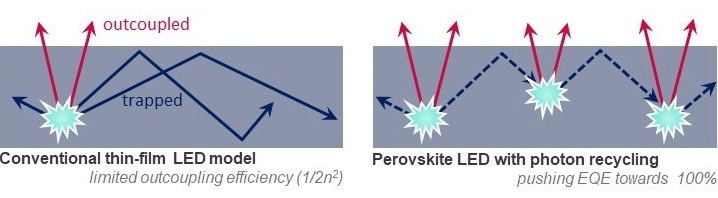
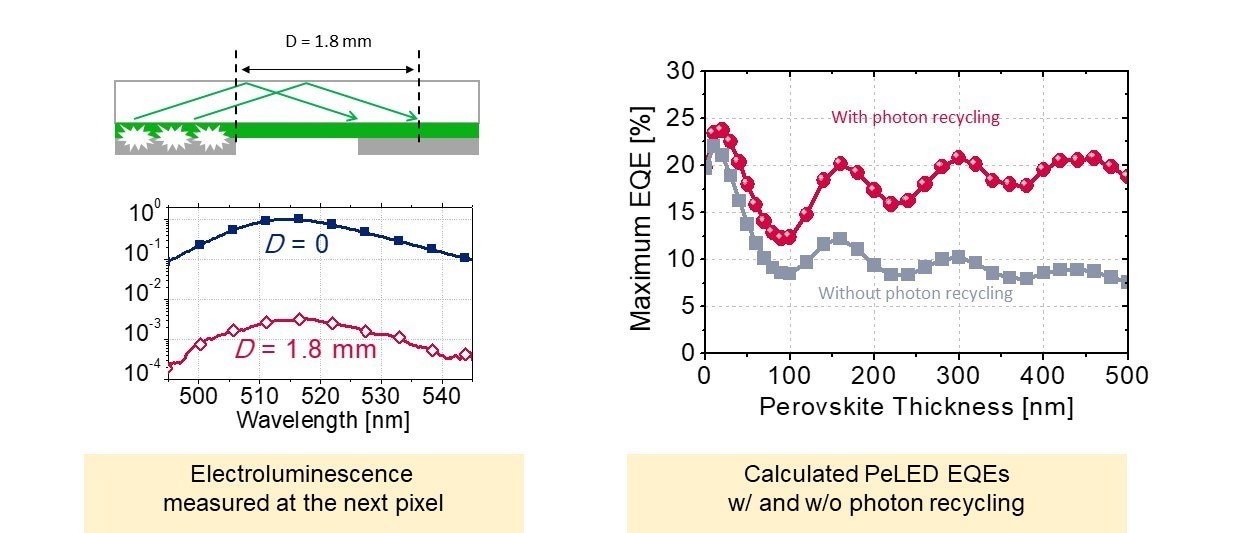
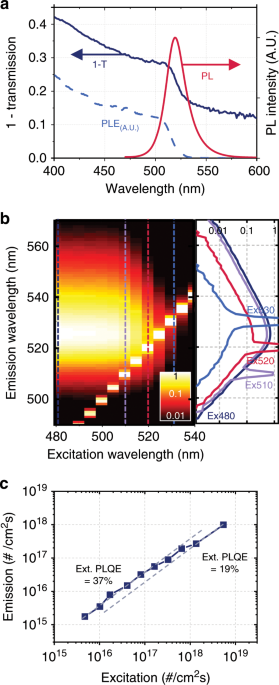
Our work, recently published in Nature Communications (Changsoon Cho et al., Nature Commun. 11, 611 (2020)) has answered this question. We have shown that the process of photon recycling is playing an important role in coupling out the light. The process is a simple one – the sideways-propagating light is reabsorbed in the emissive material, which then has a second chance to emit. Since the new emission is randomised in direction, there’s another chance to find the escape cone, and the emission that misses the escape cone can go through the cycle again. Unlike organic semiconductors, perovskites have enough overlap between the emission and absorption spectra for recycling to occur, and in the latest perovskite LED materials the emission efficiency is high enough that 30-70% of the electroluminescence could be coming from photon recycling. If we can reduce parasitic absorption by non-emissive electrode materials in the device, it could be possible to couple out all the light, pushing external efficiencies towards 100%.

Follow the Topic
-
Nature Communications
An open access, multidisciplinary journal dedicated to publishing high-quality research in all areas of the biological, health, physical, chemical and Earth sciences.

Related Collections
With Collections, you can get published faster and increase your visibility.
Women's Health
Publishing Model: Hybrid
Deadline: Ongoing
Tumor Microenvironment Crosstalk and Therapeutic Implications
Publishing Model: Hybrid
Deadline: Nov 02, 2026