Enabling advanced all-vdW plate-type beam splitters with vdW GaSeTe

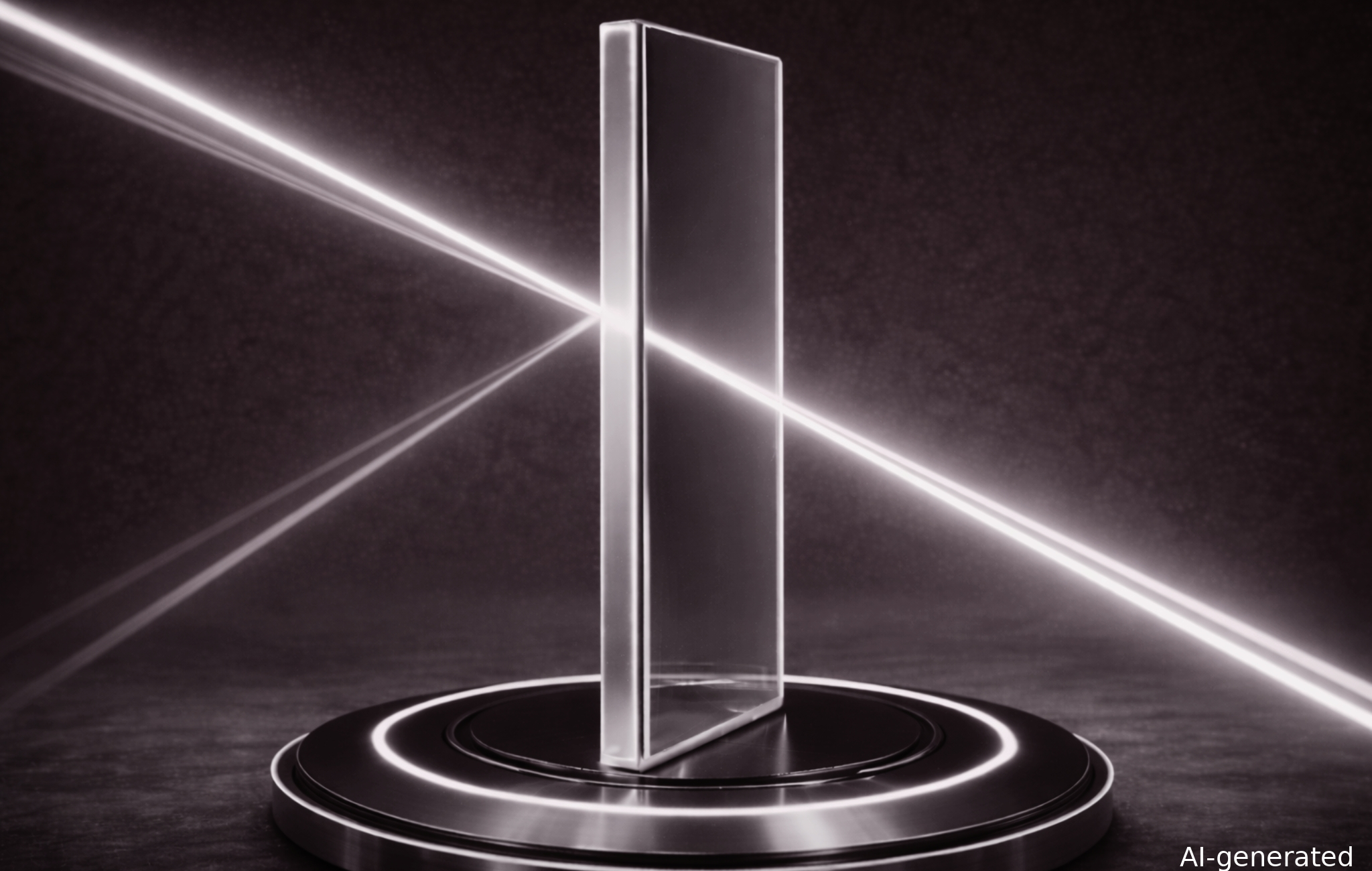




Over the past decades, the emergence of two-dimensional (2D) crystals have transformed the way we think about material design. In particular, a remarkable control over electronic, photonic and even topological properties was achieved when such atomically thin layers were stacked into artificial van der Waals (vdW) heterostructures. While most of these advances are often associated with exotic 2D physics, we show that their bulk crystals, when assembled into artificial vdW heterostructures, also offer compelling opportunities, for instance, for an optical design. Their contrasting refractive indices, low-losses and atomically smooth interfaces make them attractive candidates for the creation of compact optical elements, such as ultrathin beam splitters, where the functionality is achieved by alternating optically thick high-index and low-index layers with their thicknesses serving as a principal performance tuning parameter.
This naturally raises a question - which vdW crystals combine the required properties to enable such optical design?
A high-index crystal from vdW group-III monochalcogenide family
VdW GaSe and GaTe are prominent representatives of a group-III monochalcogenide vdW semiconductors spanning different crystalline symmetries with a structural phase instability crossover for the intermediate GaSexTe1-x ternary compounds1,2․ Pristine vdW GaSe crystallizes in a hexagonal (uniaxial) phase, whereas vdW GaTe typically adopts a monoclinic (biaxial) phase. An introduction of Te (Se) atoms into the uniaxial (biaxial) GaSe (GaTe) vdW crystals display an eminent decrease (increase) of bandgap suggesting a tunability of the optical dispersion with the variation of Se:Te composition. Here, prior to the studies of the optical response, we clarified the structural and stoichiometric properties of Se-rich vdW GaSexTe1-x compounds establishing uniaxial phase with x = 0.8 Selenium content. We then performed spectroscopic micro-ellipsometry studies of micro-mechanically cleaved samples to determine their dynamic dielectric function in the Vis-to-NIR spectral region (see Fig. 1(a)). The resulting dielectric response of vdW GaSe0.8Te0.2 displays that Se-rich ternary compounds provide simultaneous access to a high refractive index at the red-light (and above) wavelengths while maintaining moderate optical losses below the absorption onset, placing them amongst the layered semiconductors suitable for a use as high index layers within the architecture of the proposed compact plate-type beam splitters.
Enlisting low-index vdW hBN for all-vdW plate-type beam splitters
Hexagonal boron nitride (hBN) was next chosen to provide a low-index dielectric counterpart (see Fig. 1(b)) as it is optically transparent in Vis-to-NIR spectral region and compatible for the layered assembly – a natural choice for the most of multilayer vdW heterostructures. Using a generalized 4×4 transfer-matrix approach, we then computed the beam splitting characteristics of vdW GaSe0.8Te0.2/hBN multilayers accounting for out-of-plane anisotropy of individual layers for the commercially relevant splitting ratios and oblique incidence angles (see Fig. 1 (c-f)). Our results for sub-micron thick stacks yield controllable reflectance-to-transmittance beam splitting channels that are based on optical dispersion of composing layers and multiple interference effects arising in heterostructures. Importantly, the qualitative characterization of the dielectric response of the composing layers provides a foundation for the predictive multilayer modelling as even small changes in their optical dispersion may significantly alter the phase accumulation and band splitting characteristics.
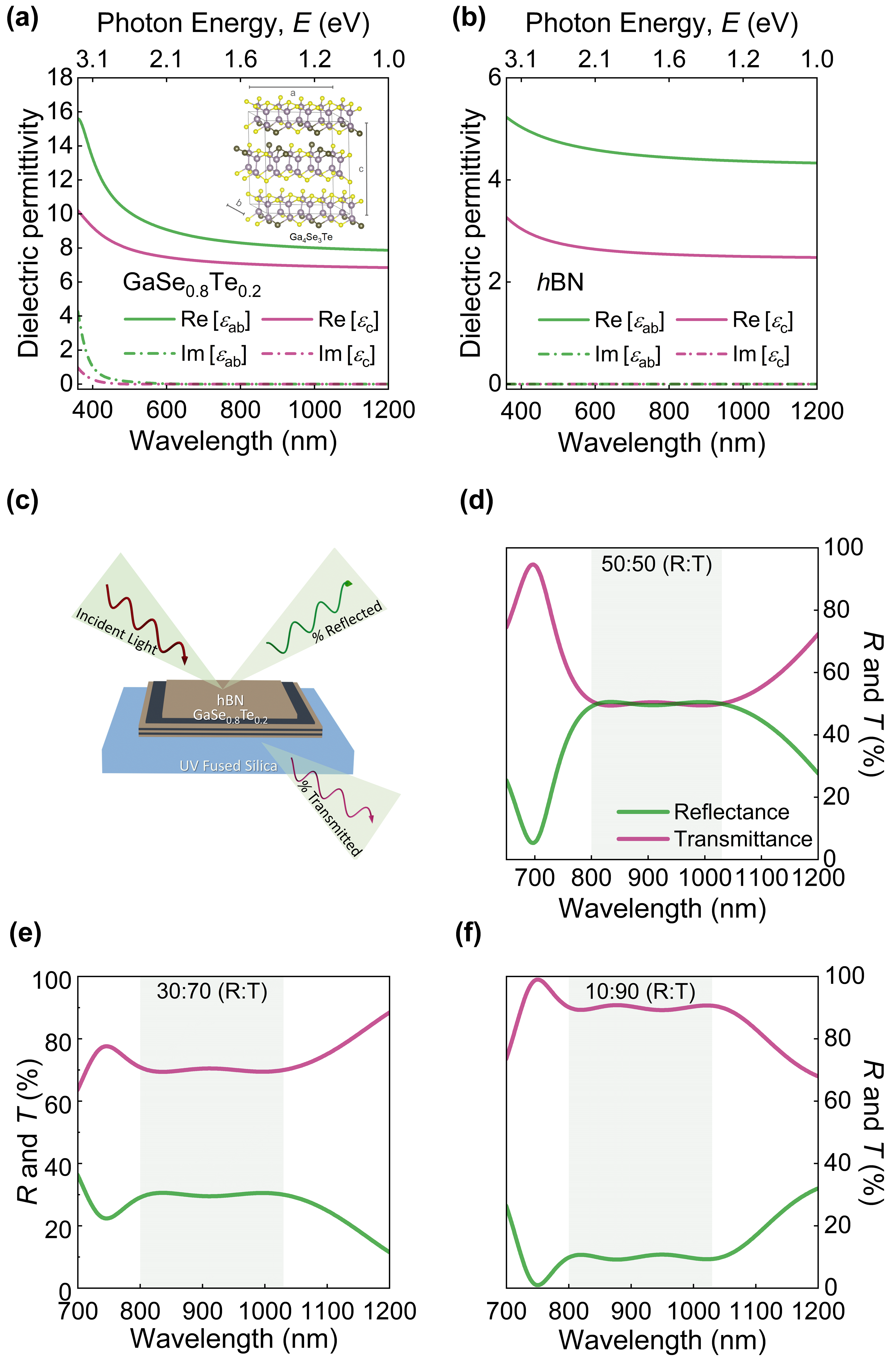
Fig. 1| Designing plate-type beam-splitters based on few-layer vdW GaSe0.8Te0.2/hBN stacks and dynamic dielectric permittivity of the composing layers. The real and imaginary parts of the dielectric permittivity of high–refractive-index vdW GaSe0.8Te0.2 (a) and low–refractive-index vdW hBN (b) over 360–1200 nm spectral region. The inset in (a) shows the uniaxial crystal structure of the closest rational composition of vdW GaSe0.8Te0.2 with the lattice parameters of a = 15.416 Å, b = 7.708 Å, c = 17.457 Å, Ga4Se3Te. (c) Schematic illustration of a plate-type beam splitter built on a seven-layer vdW GaSe0.8Te0.2/hBN stack placed onto a fused silica substrate. (d–f) Reflectance-to-transmittance (R:T) channels of sub-micron-thick beam splitters designed for an operation at an angle of incidence (AoI) of 45° in the 800–1030 nm spectral band (indicated by the shaded region). The splitting ratios of 50:50, 30:70, and 10:90 for seven-layer GaSe0.8Te0.2/hBN stacks with total thicknesses of 628 nm, 638.9 nm, and 751.8 nm.
As a proof-of-principle example, we further assemble and investigate the optical response of a simplified four-layer thick GaSe0.8Te0.2/hBN stack via deterministic dry-transfer procedure, placing it onto fused silica substrate. Our findings confirm the expected spectral behaviour and illustrate how thickness variation shifts, rather than eliminates, the operational NIR spectral band.
Check our manuscript at https://doi.org/10.1038/s41598-026-42182-y for more details.
References
- Cai, H. et al. Abnormal band bowing effects in phase instability crossover region of GaSe1–xTex Nat. Commun. 9, 1927 (2018).
- Muhimmah, L. C., et al. Near-infrared to red-light emission and carrier dynamics in full series multilayer GaTe1–xSex (0 ≤ x ≤ 1) with structural evolution. npj 2D Mat. Appl. 7, 3 (2023).
Follow the Topic
-
Scientific Reports
An open access journal publishing original research from across all areas of the natural sciences, psychology, medicine and engineering.

Related Collections
With Collections, you can get published faster and increase your visibility.
Cancer Prevention and Control
Publishing Model: Hybrid
Deadline: Feb 19, 2027
Healthy Aging
Publishing Model: Open Access
Deadline: Dec 31, 2026