From Rashba Physics to Qubit Operating Windows
Published in Physics, Computational Sciences, and Mathematics



Behind the Paper
From Rashba Physics to Qubit Operating Windows
My route to this work began in condensed matter physics. I was interested in how material properties shape quantum behavior, especially in semiconductor systems where spin, charge, confinement, and external fields interact in subtle ways. Among the phenomena that attracted my attention was the Rashba spin–orbit effect. At first sight, it appears as a condensed-matter mechanism that modifies energy spectra through structural inversion asymmetry. But the more I looked into it, the more I realized that it could also be treated as something more practical: a possible electrical handle for controlling spin qubits.
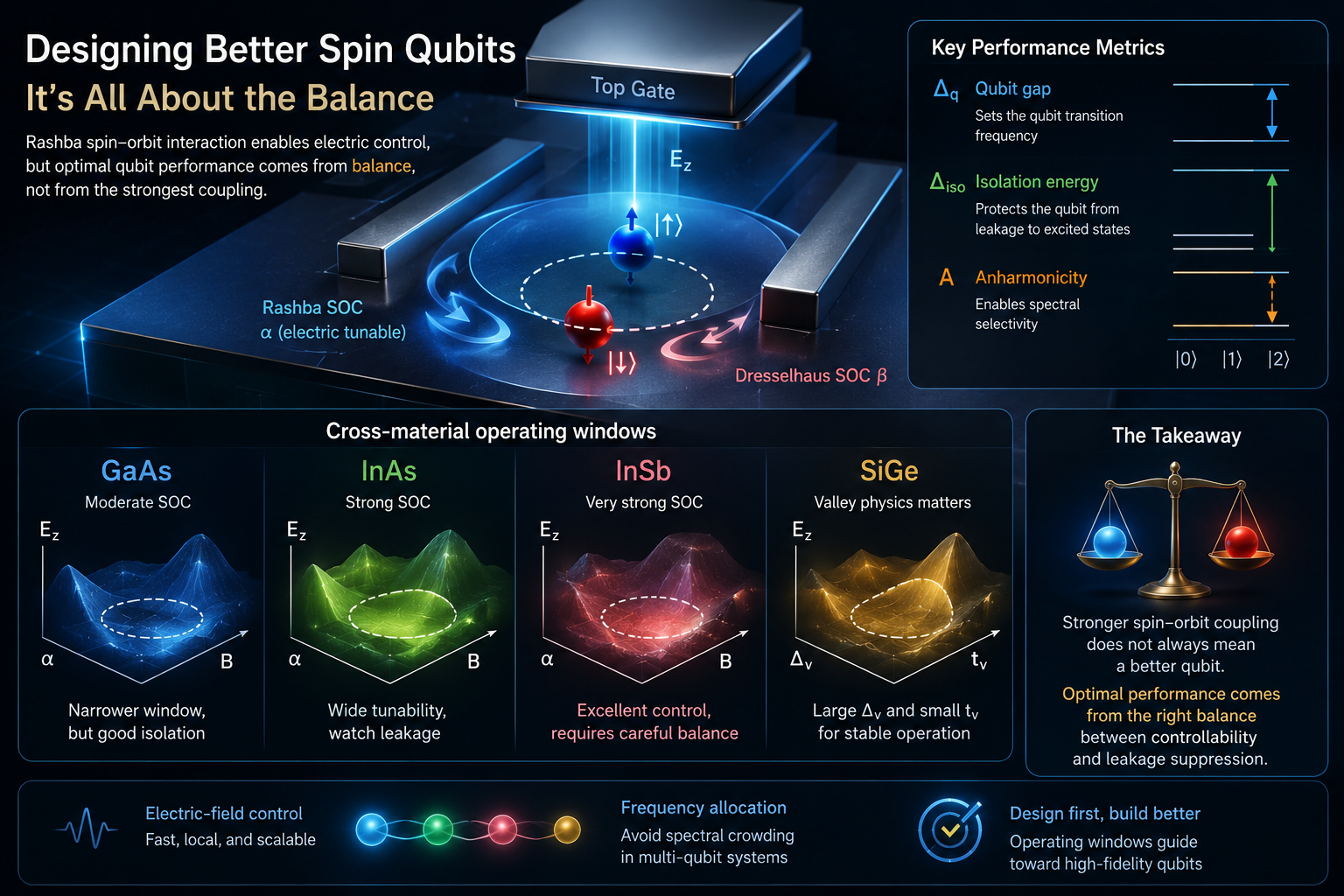
This shift in perspective was the starting point of the paper. Instead of asking only how Rashba coupling changes the spectrum, I began to ask whether this change could be used to design safer and more tunable qubit operating regions. In semiconductor spin qubits, electrical control is highly attractive because it may reduce the need for local magnetic control lines. However, stronger control is not automatically better. A useful qubit must be addressable, but it must also remain isolated from nearby leakage states. This is the balance that motivated the study.
The central idea was to compare different semiconductor platforms using the same design language. In the paper, I focused on GaAs, InAs, InSb, and SiGe. These materials were not chosen randomly. GaAs, InAs, and InSb are representative III–V semiconductor platforms, but with different strengths of spin–orbit coupling. SiGe, on the other hand, represents a silicon-based platform where valley physics becomes a crucial factor. In this sense, each material serves as an example of a broader class of physical behavior, allowing the comparison to be more than a list of numbers.
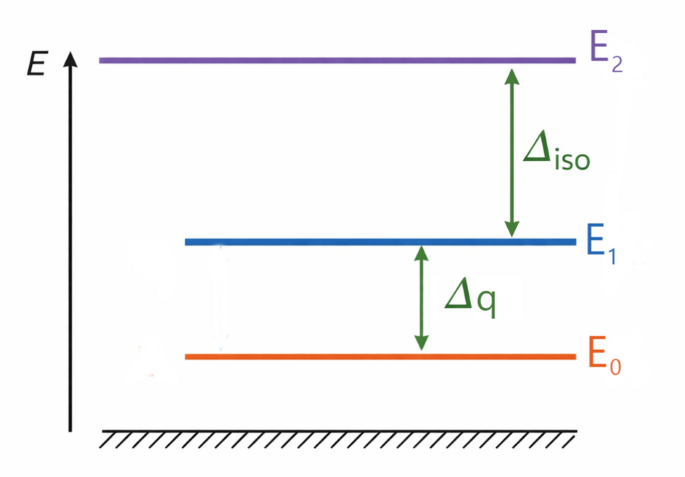
A major challenge was to make the comparison fair. Different materials naturally have different effective masses, g-factors, spin–orbit strengths, and, in the case of SiGe, valley parameters. Therefore, the work used a standardized confinement benchmark while allowing the material-dependent parameters to vary. This made it possible to compare operating windows without confusing intrinsic material effects with geometry-dependent ones. The main figures of merit were the qubit gap, the isolation energy, and the anharmonicity, which together describe transition frequency, leakage protection, and spectral selectivity.
Another important step was validation. Before extending the model to cross-material operating maps, the numerical implementation was checked against earlier Rashba quantum-dot results. This was essential because the purpose of the work was not only to produce new plots, but to build a design-oriented framework that could be trusted as a starting point for further theoretical or experimental studies. The final operating-window analysis then focused on realistic magnetic-field ranges: below about 2 T for GaAs and SiGe, and up to about 5 T for InAs and InSb.
One of the most interesting outcomes was that the strongest spin–orbit coupling is not always the best answer. Intuitively, one might expect a material with very strong spin–orbit interaction to be ideal because it gives stronger electrical control. The results show a more careful picture. Strong coupling can improve tunability and enlarge the qubit gap, but it may also reduce isolation from leakage states. In other words, the best platform is not simply the one with the largest coupling, but the one that offers the best compromise between controllability and leakage suppression.
This was especially clear in the comparison among III–V materials. InAs and InSb provide strong intrinsic spin–orbit effects and can support efficient electrical control, but they must be operated carefully to avoid unwanted mixing with nearby states. GaAs, although weaker in spin–orbit coupling, can still provide useful operating regions when the Rashba and Dresselhaus contributions are properly balanced. For SiGe, the problem changes: Rashba coupling is not the only key issue, because valley splitting and intervalley coupling strongly influence the safe operating window. The work shows that large valley splitting and small intervalley coupling are essential for stable SiGe qubit operation.
On a personal level, this project was also an attempt to open a door. Quantum computing is still not widely established in my academic environment, and researchers trained in condensed matter physics may find it difficult to enter qubit-based problems directly. I wanted to build a bridge from a familiar condensed-matter phenomenon—the Rashba effect—to a practical question in quantum-device design. My hope is that this kind of work can encourage more researchers in my department and similar environments to see quantum computing not as a distant field, but as a natural extension of problems they already understand.
The broader hope is that this framework can be useful for others. Experimentalists may use similar operating maps to narrow the search for suitable device parameters. Theorists may extend the model by including charge noise, phonon effects, decoherence, pulse optimization, or more detailed multi-level dynamics. Device designers may use the idea of frequency allocation to choose qubit operating regions that reduce spectral crowding while maintaining leakage protection.
For me, the main message of the paper is simple: qubit design is a problem of balance. Stronger coupling, faster control, and larger frequency tunability are valuable only when they remain compatible with isolation, selectivity, and stability. The Rashba effect provides a powerful route toward electrical control, but its real value appears when it is placed inside a broader operating-window framework. That is the story behind this work: turning a condensed-matter effect into a practical design tool for semiconductor quantum qubits.
Follow the Topic
-
Discover Quantum Science
This is a fully open access, peer-reviewed journal publishing research from all fields relevant to quantum science.

Related Collections
With Collections, you can get published faster and increase your visibility.
Advances in Quantum Machine Learning: Variational Algorithms and Tensor Network Methods
In the Noisy Intermediate-Scale Quantum (NISQ) era, Quantum Machine Learning (QML) offers a promising path toward quantum advantage. Variational Quantum Algorithms (VQAs), a cornerstone of QML, are tailored for near-term hardware but face significant hurdles, including hardware noise and theoretical limitations like barren plateaus. Concurrently, Tensor Networks (TNs) provide a powerful classical framework to simulate, analyze, and design novel QML models, bridging classical and quantum computation. This collection seeks to unite leading research at the intersection of QML, VQAs, and Tensor Networks.
We invite original research and review articles that address fundamental challenges and explore novel applications and theoretical insights. Topics of interest include, but are not limited to:
- Novel architectures for QML and Variational Quantum Algorithms,
- Application of Tensor Networks for QML analysis, simulation, and design,
- Quantum data encoding and hardware-aware algorithm development,
- Error mitigation and noise-resilience strategies for VQAs.
By gathering contributions in these areas, this collection will provide a valuable snapshot of the state-of-the-art and future directions in this dynamic field.
Articles will undergo all of the journal's standard peer review and editorial processes outlined in its submission guidelines.
Keywords:
Publishing Model: Open Access
Deadline: Jan 15, 2027
Advances in Quantum Precision Measurement
Quantum precision measurements refer to the use of quantum mechanics principles to achieve measurements with unprecedented accuracy, surpassing the limits of classical techniques. These methods exploit quantum phenomena such as superposition, entanglement, and squeezing to enhance sensitivity, reduce noise, and improve resolution in measuring physical quantities.
The purpose of this collection is to compile a comprehensive body of work that addresses the diverse aspects of quantum precision measurement and its applications. We invite contributions that explore theoretical foundations, experimental techniques, and technological innovations in quantum sensing and measurement methodologies.
Topics of interest include, but are not limited to:
- Quantum Sensing Technologies
- Methodologies for Precision Measurement
- Applications of Quantum Enhanced Sensors
- Fundamental Limits in Quantum Measurements
- Innovations in Measurement Protocols
Keywords: Quantum sensing, precision measurements, quantum metrology, matter wave, quantum spin sensor
Publishing Model: Open Access
Deadline: Dec 31, 2026