Engineering properties of expansive soil stabilized with barley husk ash and lime: case study of Jimma town subgrade soils
Published in Civil Engineering


Expansive soils are a prevalent issue in road construction, particularly in regions like Ethiopia. They pose significant challenges due to drastic shrink-swell behavior.
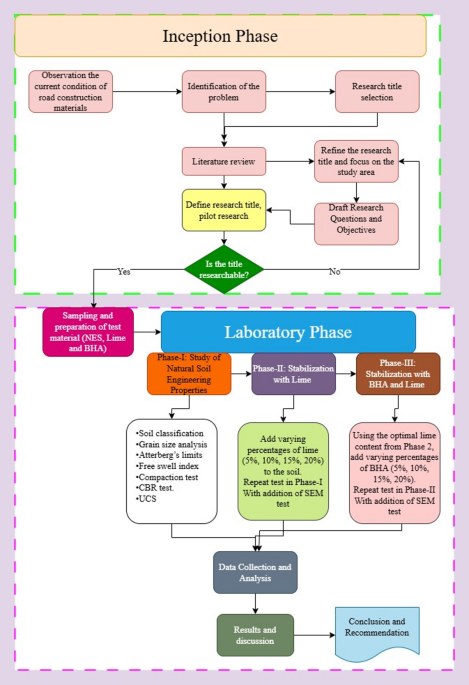
Traditional stabilizers such as cement and lime are effective but costly and raise environmental concerns. This necessitates exploring more sustainable, locally sourced alternatives. This research explores using Barley Husk Ash (BHA), an agricultural byproduct, as a pozzolanic additive to stabilize expansive soil from Jimma, Ethiopia. The untreated soil had an initial PI of 39% and a CBR of 0.8%.
The study had two phases. First, optimal lime content was determined by treating the soil with varying lime percentages (0–20%) in 5% increments. Second, this lime content was combined with BHA in similar 5% increments (0–20%). Adding 10% lime reduced the PI to 22%, increased the CBR to 9.72%, and raised the Unconfined Compressive Strength (UCS) to 137 kPa. This met the Ethiopian Roads Authority (ERA) S4 subgrade standard (CBR>5%). Adding 10% BHA to the 10% lime-stabilized soil further improved performance. The PI dropped to 18%, and the CBR increased to 18.42%, qualifying the soil for the higher S5 subgrade classification (CBR 15%-30%).
Microstructural analysis using SEM confirmed these findings. The BHA-lime blend created a denser, more cohesive soil matrix with enhanced interparticle cementitious bonding. This explains the improved strength and reduced swell potential. The mean porosity also decreased from 17.33% to 6.74%.
This research validates a 10% lime plus 10% BHA blend as a highly effective, sustainable, and locally available solution for modern road construction.
Follow the Topic
-
Scientific Reports
An open access journal publishing original research from across all areas of the natural sciences, psychology, medicine and engineering.

Related Collections
With Collections, you can get published faster and increase your visibility.
Cancer Prevention and Control
Publishing Model: Hybrid
Deadline: Feb 19, 2027
Healthy Aging
Publishing Model: Open Access
Deadline: Dec 31, 2026