Enhancing dielectric permittivity in barium ferrite: a novel material for energy storage and advanced electronics applications
Published in Electrical & Electronic Engineering, Materials, and Mechanical Engineering



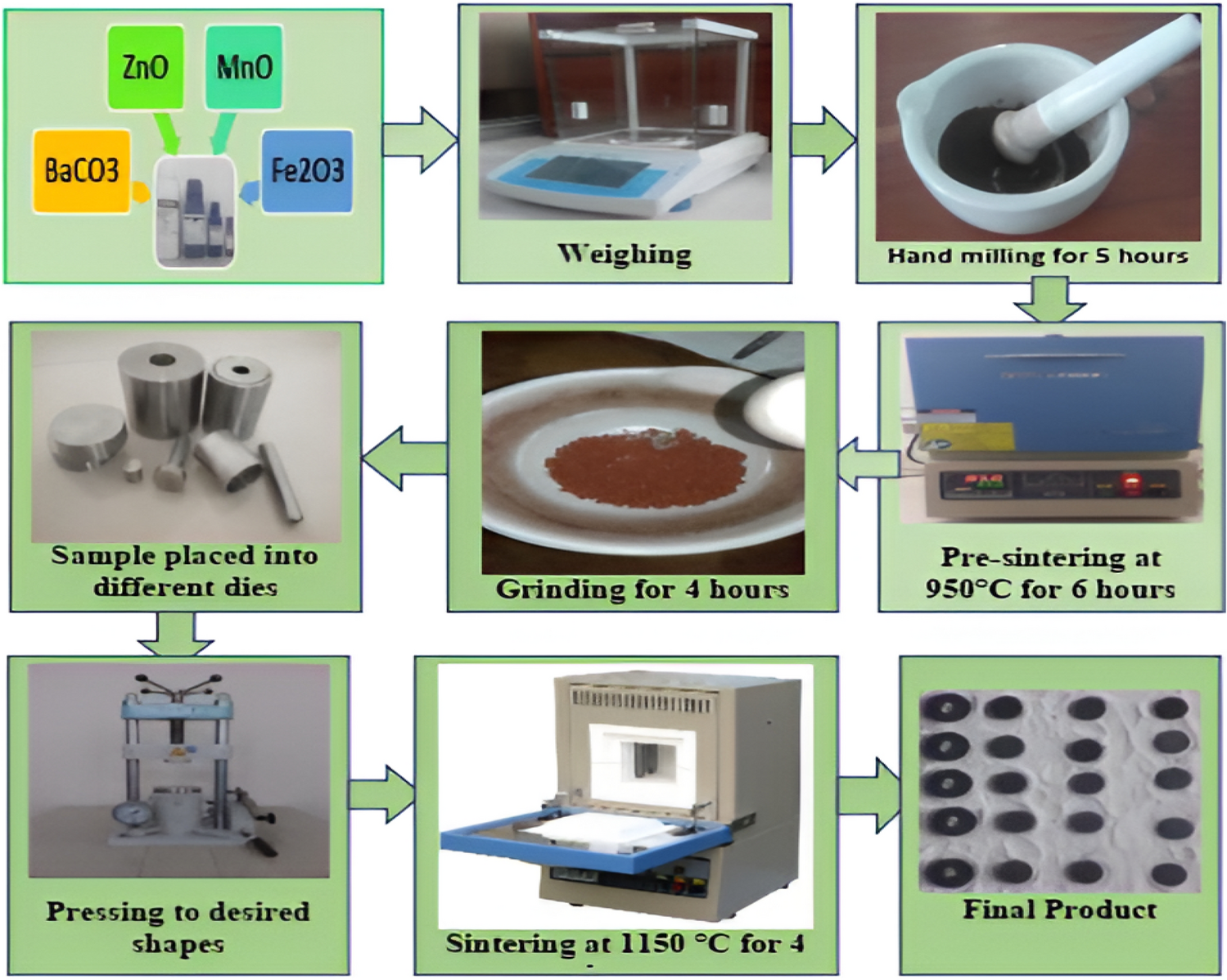

I'm thrilled to share our latest research on advanced materials for energy storage and high-frequency electronics. Our study focuses on Mn–Zn-doped barium ferrite, a material that shows significant improvements in dielectric permittivity and thermal stability, making it ideal for applications in supercapacitors, RAMs, and high-frequency capacitors.(https://doi.org/10.1007/s42452-025-06801-z)
In our experiments, we synthesized BaZn₁₊ₓMnₓFe₁₂₋₂ₓO₁₉ ceramics with varying concentrations of Mn and Zn. Using X-ray diffraction (XRD) and dielectric measurements, we observed that increasing the Mn–Zn ion concentration enhances the dielectric permittivity and positively impacts the thermal stability and Curie temperature of the material. These properties are crucial for the development of efficient energy storage systems and advanced electronic devices.([ResearchGate][2])
One of the key findings is the material's ability to maintain high dielectric permittivity across a range of temperatures and frequencies. This behavior is attributed to the Maxwell–Wagner-type polarization, which enhances the material's low dielectric loss and high permittivity, making it well-suited for electromagnetic interference (EMI) shielding and radar-absorbing materials (RAMs).([ResearchGate][2])
Our research demonstrates that Mn–Zn-doped barium ferrite is a promising candidate for next-generation energy storage and high-frequency electronic applications. The improved dielectric properties and thermal stability open up new possibilities for the design of capacitors, supercapacitors, and other electronic components that require materials with high energy storage capabilities and reliability under varying environmental conditions.
For a more detailed understanding of our work, you can access the full article here: https://doi.org/10.1007/s42452-025-06801-z
Feel free to reach out if you have any questions or would like to discuss potential collaborations. Let's advance the field of energy storage and electronics together

🎓 **Dr. Sadiq Khoreem**
🌍 Republic of Yemen | Assistant Professor, Al-Razi University
As a dedicated physicist with a Ph.D. in Physics from Sana’a University (2023), I specialize in advanced nanotechnology, material sciences, and their transformative applications in medicine and engineering. My research bridges cutting-edge physics and practical innovations, with over 15 published studies in peer-reviewed journals, focusing on nanoferrite materials, dielectric properties, and their applications in technology and healthcare.
📚 **Highlights**:
- Published groundbreaking work on Zn-doped ferrite nanoparticles in leading journals like *Biointerface Research in Applied Chemistry* and *Heliyon*.
- Contributed to international conferences in Canada, India, Korea, and beyond.
- Authored academic resources, including the forthcoming book *Nanotechnology and Its Application in Medicine* (Springer, 2024).
- Skilled educator teaching courses like Medical and Optical Physics, mentoring students for academic and practical excellence.
🌟 **Leadership**:
- Editor for the *International Journal of Natural Sciences and Nanotechnology*.
- Active member of scientific communities, including the Arab Physicists Association and the International Association for Scientific Researchers.
I am passionate about advancing science through collaborative research and education, driving innovation in nanotechnology, and inspiring the next generation of scientists.
📩 Feel free to connect with me:
Email: [sadiqkhoreem@alrazi.edu.ye](mailto:sadiqkhoreem@alrazi.edu.ye)
Follow the Topic
-
Discover Applied Sciences
This is a multi-disciplinary, peer-reviewed journal for the disciplines of Applied Life Sciences, Chemistry, Earth and Environmental Sciences, Engineering, Materials Science and Physics, fostering sound scientific discovery to solve practical problems.

Related Collections
With Collections, you can get published faster and increase your visibility.
Engineering: Artificial Intelligence and Internet of Things for Smart Healthcare and Well-Being
This Collection explores the integration of Internet of Things (IoT) technologies with Artificial Intelligence (AI) and Machine Learning (ML) methods for advancing healthcare, remote monitoring, rehabilitation, and assistive systems. With the rapid expansion of wearable devices, sensing platforms, and connected infrastructures, IoT-driven healthcare provides unique opportunities for early diagnosis, personalized therapy, and improved quality of life. The Collection aims to bring together research on novel algorithms, sensing technologies, system architectures, and clinical applications that leverage IoT and AI to address challenges in scalability, data security, usability, and clinical validation. It seeks to highlight both theoretical advances and practical implementations across diverse medical and health-related domains.
This Collection supports and amplifies research related to SDG 9, SDG 11 and SDG 13.
Keywords: Rehabilitation technology; Wearable Sensors; Assistive devices; Machine Learning; Rehabilitation; Data Security; Artificial Intelligence (AI); Internet of Things (IoT)
Publishing Model: Open Access
Deadline: Feb 28, 2027
Engineering: Machine Learning, AI, and Deep Learning Applications in Microwave Engineering: Devices and Communication
This Topical Collection is dedicated to highlighting the application of Machine Learning (ML), Artificial Intelligence (AI) and Deep Learning (DL) in the field of Microwave Engineering: Devices and Communication. It will concentrate on AI/ML/DL approaches in Microwave Engineering, which includes new breakthroughs, design and performance techniques of various Microwave Devices like Antennas, Filters, Couplers etc. Starting with single/multiband antennas, this topical collection will showcase the application of AI/ML/DL in the design and/or performance features of wideband to super wideband antennas including Multiple-Input-Multiple-Output (MIMO) antenna structures suited for wireless communication.
It will also focus on the use of AI/ML/DL in various aspects of Terrestrial and/or Satellite-based Microwave Communication: Processes, Algorithms and Protocols.
Publishing Model: Open Access
Deadline: Dec 31, 2026