Enhancing the PM2.5 Predictions of US Embassies Using Novel Hybrid 1DCNN-BiGRU and Decomposed-Recomposed 1DCNN-BiGRU-DR Models
Published in Earth & Environment, Computational Sciences, and Statistics


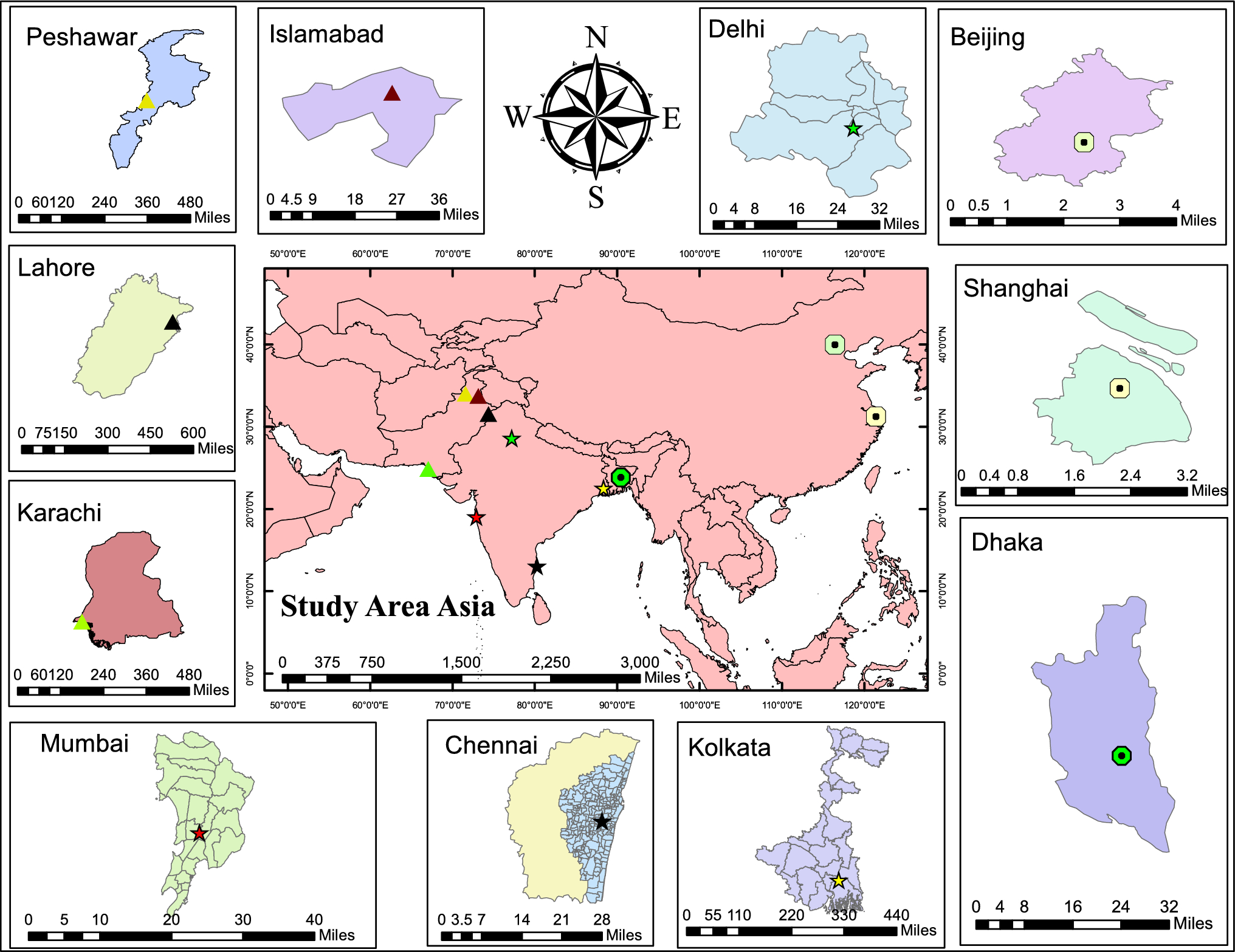

Air pollution is a worldwide crisis that contributes to numerous human problems related to environmental and public health. PM2.5 pollution concentration is one of the major contributors to air pollution. PM2.5 is known to penetrate deep into the respiratory system upon inhalation, leading to a wide range of health problems, such as respiratory infections, cardiovascular diseases, and even premature death.
This study used the AirNow platform to obtain various US Embassies and consolates PM2.5 data in the Indian subcontinent and China. The article proposed two hybrid models to enhance the performance of the model’s accuracy. The prop-1 hybrid model is a one-dimensional convolutional neural network and a bidirectional gated recurrent unit (1DCNN-BiGRU), using their abilities to capture spatial and temporal dependencies in PM2.5 data. The prop-2 (1DCNN-BiGRU-DR) model further enhances the accuracy with the Decomposed-Recomposed (DR) techniques. The DR technique also enhances the model’s capacity to capture complex spatiotemporal patterns inherent in the data. The comparison of the suggested model with conventional deep learning models is conducted to assess a variety of parameter measures, including statistical and non-statistical parameters and graphical analysis. The assessment metrics, which include mean absolute error (MAE), root mean square error (RMSE), mean absolute percentage error (MAPE), and mean square logarithmic error (MSLE), illustrate the efficacy of the proposed models.
Three distinct analysis patterns were pursued: Prop-1 vs. DL, Prop-2 vs. DL, and Prop-2 vs. DL-DR. The performance accuracy of Prop-1 is reflected in RMSE: 4.26 ± 0.12, and MAE: 2.27 ± 0.08. Similarly, the performance accuracy of Prop-2 is demonstrated by RMSE: 4.18 ± 0.10, and MAE: 2.44 ± 0.09. RMSE ranking across all three proposed model analyses secured the first rank, demonstrating superior predictive performance. The proposed models got superior results compared to the AIC-BIC test, Friedman ranking, Diebold Mariano test, and Taylor diagram evaluation. Results indicate that the prop-1 model integrated with the decompose-recompose methodology outperforms traditional deep learning methods, exhibiting superior prediction accuracy across multiple embassy locations. This study significantly contributes to the progression of forecasting methods for air quality on Earth. It has tangible implications for creating comprehensive and practical strategies that promote the well-being of individuals and the environment.
Compares traditional and proposed-1 model configurations. Each model’s distinctive layer setup and parameters are outlined, offering insights into its architecture and optimization choices. For all models, a window length of 8, a batch size ranging from 8 to 200, and 11 features are used, with training epochs set to 200. Additionally, strategies such as ReduceLROnPlateau, with parameters monitoring validation loss, patience of 3 epochs, and a reduction factor of 0.5, coupled with a cooldown of 1 epoch, as well as EarlyStopping monitoring validation loss with a patience of 15 epochs and restoring the best weights are employed.
The comprehensive overview of the computing environment. The components listed in the table include the operating system, CPU, RAM, GPU, storage, Python version, deep learning frameworks, integrated development environment, and other libraries used, along with their respective descriptions. The operating system is specified as Windows 10 Professional 64-bit, and the CPU is identified as an Intel Core i5-9500 CPU running at 3.00GHz with six cores and six logical processors. The system has 16 GB of DDR4 RAM and an Intel UHD Graphics 630 GPU with 8 GB of shared memory. A 1 TB HDD provides storage capacity. The software environment encompasses Python 3.9.12 from the Anaconda Distribution and deep learning frameworks PyTorch 1.10.2 and TensorFlow 2.10.0. Development and coding are facilitated by Visual Studio Code 1.60.2 and Jupyter Notebook 6.4.12. Additionally, the environment incorporates essential libraries such as NumPy 1.24.3, Pandas 1.4.3, Matplotlib 3.7.1, and Scikitlearn 1.1.1.
https://doi.org/10.1007/s41810-025-00372-7

Follow the Topic
-
Aerosol Science and Engineering
Aerosol Science and Engineering is an international journal presenting advanced aerosol knowledge through high-quality papers and discussions.

Related Collections
With Collections, you can get published faster and increase your visibility.
Atmospheric Aerosol: Challenges and Innovations
Atmospheric aerosols are central to many of today's most difficult environmental and engineering challenges. They affect air quality, visibility, weather and climate, public health, ecosystems, and industrial and indoor environments. Their impacts depend not only on mass concentration but also on size distribution, chemical composition, morphology, mixing state, hygroscopicity, optical properties, biological content, toxicity, and atmospheric aging.
This Special Issue is designed as an IAC 2026 companion collection that highlights both scientific challenges and engineering innovations in atmospheric aerosol research. It aims to connect source emissions, formation and transformation mechanisms, measurement technologies, physical and chemical properties, transport and deposition, health and climate impacts, and control strategies within one coherent aerosol-science and aerosol-engineering framework.
We welcome original research articles, reviews, communications, and technical notes that advance fundamental understanding, improve measurement or modeling capability, or translate aerosol science into practical solutions for cleaner air, climate mitigation, exposure reduction, and pollution control. Contributions that integrate field observations, laboratory experiments, advanced instrumentation, source apportionment, remote sensing, numerical modeling, artificial intelligence, or control technology are particularly encouraged.
Scope and Suggested Topics:
- Atmospheric aerosol pollution: Sources, emission characteristics, PM2.5/PM10, ultrafine particles, dust, wildfire and biomass burning particles, urban haze, regional transport, and atmospheric aging.
- Aerosol measurement technology: Online and offline instrumentation, low-cost sensors, remote sensing, mobile platforms, laboratory systems, quality assurance, calibration, and multi-sensor data fusion.
- Aerosol physics and chemistry: New particle formation, secondary aerosol production, gas-particle partitioning, multiphase and heterogeneous chemistry, hygroscopicity, optical properties, and mixing state.
- Aerosol-cloud-climate interactions: Radiative forcing, cloud condensation nuclei, ice-nucleating particles, aerosol-cloud microphysics, climate feedbacks, and model parameterization.
- Aerosols and health: Exposure assessment, oxidative potential, toxicological mechanisms, epidemiological evidence, bioaerosols, indoor-outdoor linkages, and susceptible populations.
- Aerosol control technology: Emission control, filtration, ventilation, air cleaning, industrial applications, smart monitoring networks, and engineering strategies for exposure and risk reduction.
- Modeling, source attribution, and data science: Source apportionment, receptor and chemical transport models, inverse modeling, forecasting, machine learning, explainable AI, and decision-support tools.
- Emerging challenges and applications: Megacity pollution, climate-change-driven aerosol events, wildfire smoke, dust storms, indoor air quality, cultural heritage environments, and policy-relevant mitigation.
Keywords: Atmospheric aerosols, Aerosol science and engineering, Aerosol measurement, Aerosol physics and chemistry, Source apportionment, Aerosol-climate interactions, Exposure and health, Aerosol control technology
Submission URL: https://www.editorialmanager.com/asen
Please refer to the Author Guide (https://www.springer.com/journal/41810/submission-guidelines) for detailed style instructions.
Feel free to contact the Managing Editor, Dr. Li Ai (aili@ieecas.cn) if you have any queries regarding the special issue.
Publishing Model: Hybrid
Deadline: Nov 30, 2026