Enlightening spins help us understand the limits of organic photovoltaics





Sometimes getting thrown into the deep end is the best thing that can happen to a first-year PhD student. When I joined my research group, my advisor, Obadiah, told me that my first task was to become a human sponge and absorb all the information I could from a 6th year grad student who built a “photoinduced absorption-detected magnetic resonance spectroscopy (PADMR)” experiment (whatever that is) and was graduating in one month. Obadiah had a hunch that this technique would be useful for our group’s research into the physical chemistry of organic photovoltaic materials. As a “deer-in-headlights” first-year, I did my best to soak up what I could. Nothing was more exhilarating than showing my advisors the first dataset from this experiment that revealed something they hadn’t seen before, but in an “old” chemical system that they had been studying for years.
The organic photovoltaic “problem”
Organic photovoltaics—carbon-containing molecule-based solar cell devices—(OPVs) have stumped physical chemists for the last 30 years. Yet even though scientists don’t agree on how these devices work at a molecular level, their efficiency continues to climb. One of the main questions that has puzzled the p-chemists is, how do so-called “bound” charge-transfer states become useful or “free” charges that are able to generate a current in a device. This question stems from the central problem with OPV materials—when sunlight hits them and the light energy is converted into a pair of electrical charges, each charge “feels” the other's mutual attraction more than it would in other photovoltaic materials. Many scientists believe that there is a significant energy, and thus efficiency, sacrifice required to separate the charges out of the OPV active material to generate electrical power. Put simply, OPVs seem to be doomed to what we call a low dielectric constant. But how much will this energy sacrifice limit the maximum attainable efficiency of OPVs? And is this sacrifice a real requirement? After all, OPV efficiencies are still going up!
My advisors have been working in the field of “OPV fundamental science” for a long time; one of them since before I was born (sorry to mention it, Garry). Recently, they’ve approached this challenge by investigating model chemical systems of what is normally the active layer of OPV devices: a 50:50 blend film of “electron-donating” and an “electron-accepting” materials. Our model systems instead take one material and lower its concentration to nearly, but not quite, zero. This approach has helped demystify what happens at the donor/acceptor interface without eliminating the interface completely.1–3 My advisors have both employed and developed a gauntlet of techniques to understand and relate these model systems’ behavior to actual OPV chemical physics. However, a piece was always missing.
How can you selectively measure charge-transfer states?
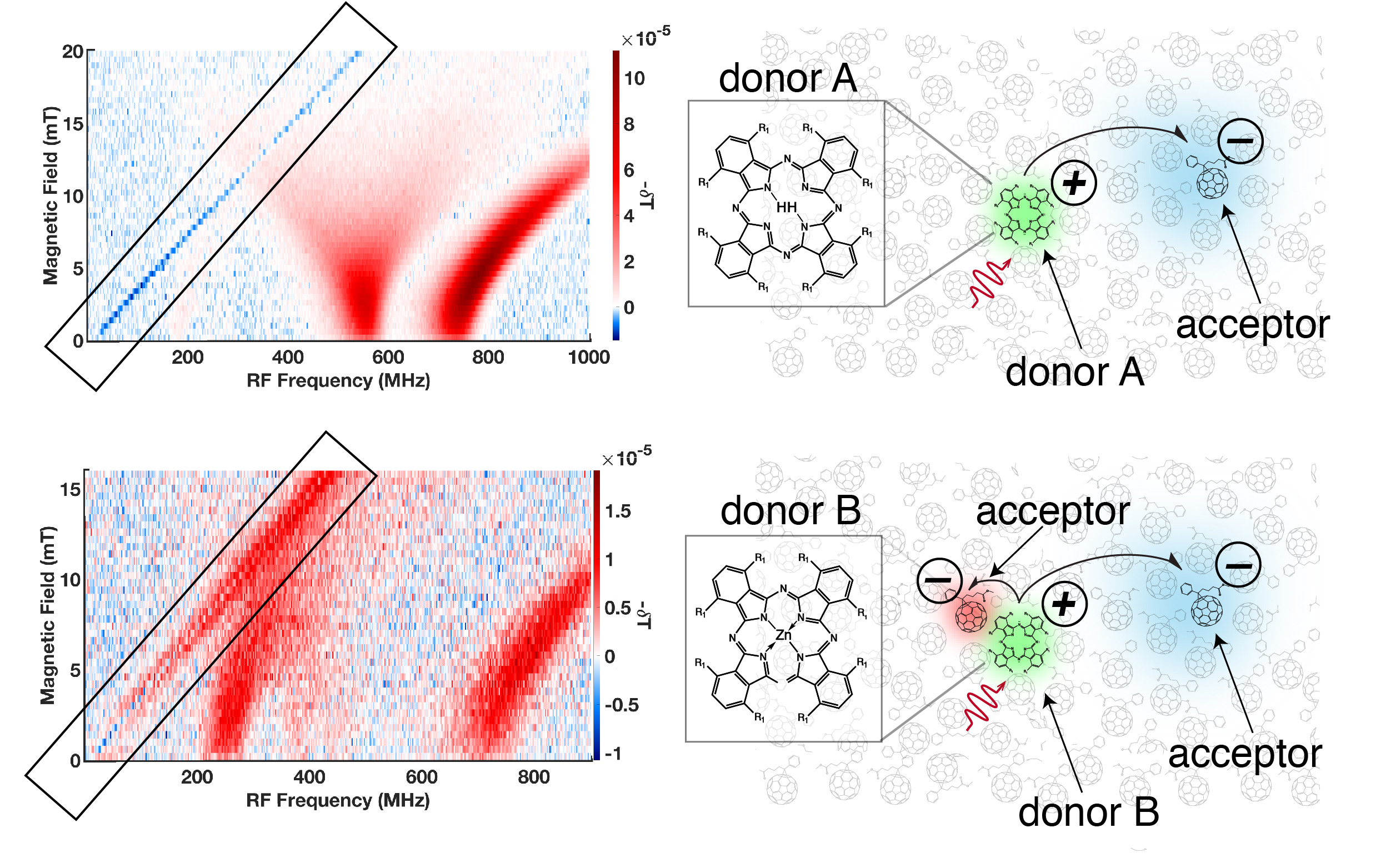
Figure 1: 2D PADMR data for the donor A (top left) and donor B (bottom left) films where I measured signal as a function of two variables: magnetic field and RF frequency. The differences between the top left and bottom left in the highlighted region indicated different spin coupling strengths between separated charges in the material. This was the starting point for the analysis in the study. Diagrams (right) showing the dilute donor/acceptor chemical system with a H2-centered molecule (donor A, top right) and zinc-centered molecule (donor B, bottom right) and how the difference in the PADMR data indicated the presence of shorter-range charge-pair/charge-transfer states in the donor B system
I initially collected PADMR data in a “kitchen sink” fashion. I would take very large data sets that measured signal as a function of two scan variables across relatively wide ranges (see the plots in the figure). These 2D maps would take several days to collect, and they captured much more detail than ended up being necessary to the work's central conclusions. But what my advisors and I were excited about were these highlighted diagonal lines of signal that started at zero on both axes. They indicated the presence of charges separated across the donor/acceptor interface that were interacting through their quantum mechanical spins. A very slight tweak of the donor’s chemistry led to a qualitative difference in this signal. Changing the donor molecule’s central component from H2 to zinc tuned this “charge-separated state” signal to indicate that on average, the charge pairs' spin interactions were stronger in the zinc-centered donor film. The qualitative difference was so significant that we became convinced that we were distinguishing between the elusive charge-transfer state and a more distant charge-separated pair (see right half of the figure). From there, we expanded the study around a series of additional donor molecules, incorporated a more detailed analysis of the PADMR data, and were off to the races.
The old and the new for organic photovoltaics
The nail-in-the-coffin of our study is that the PADMR results are consistent with a model that suggests the “OPV problem” still exists. The energy sacrifice of OPVs is real and unavoidable if you can’t boost the dielectric constant. This is true regardless of what role you consider the charge-transfer state to be playing in an OPV device: either a doomed trap for charges at the donor/acceptor interface, or an intermediate to free charges that has a sufficient amount of low energy pathways to move into. The future of this work lies in convincing the OPV community that these findings hold not only for the, to be harsh, “defunct” chemical systems in this work, but for the “modern” materials as well. We’ll be testing the generality of our findings with the “non-fullerene acceptors” which many believe are the reason OPV power conversion efficiencies have pushed above 20% 4. Who knows, maybe in five years OPVs will be at 25%? Our money is on the dielectric constant spoiling the fun.
- Allen, T. G. et al. Reconciling the Driving Force and the Barrier to Charge Separation in Donor–Nonfullerene Acceptor Films. ACS Energy Lett. 6, 3572–3581 (2021).
- Carr, J. M. et al. Short and long-range electron transfer compete to determine free-charge yield in organic semiconductors. Mater. Horiz. 9, 312–324 (2022).
- Carr, J. M., Gish, M. K., Reid, O. G. & Rumbles, G. Missing Excitons: How Energy Transfer Competes with Free Charge Generation in Dilute-Donor/Acceptor Systems. ACS Energy Lett. 896–907 (2024)
- The role of non-fullerene acceptors continues. Nat. Mater. 24, 323 (2025).

Follow the Topic
-
Nature Chemistry
A monthly journal dedicated to publishing high-quality papers that describe the most significant and cutting-edge research in all areas of chemistry, reflecting the traditional core subjects of analytical, inorganic, organic and physical chemistry.