Estimation and usefulness of measurement uncertainty from sampling at different spatial scales: microns to kilometres
Published in Chemistry, Earth & Environment, and Physics
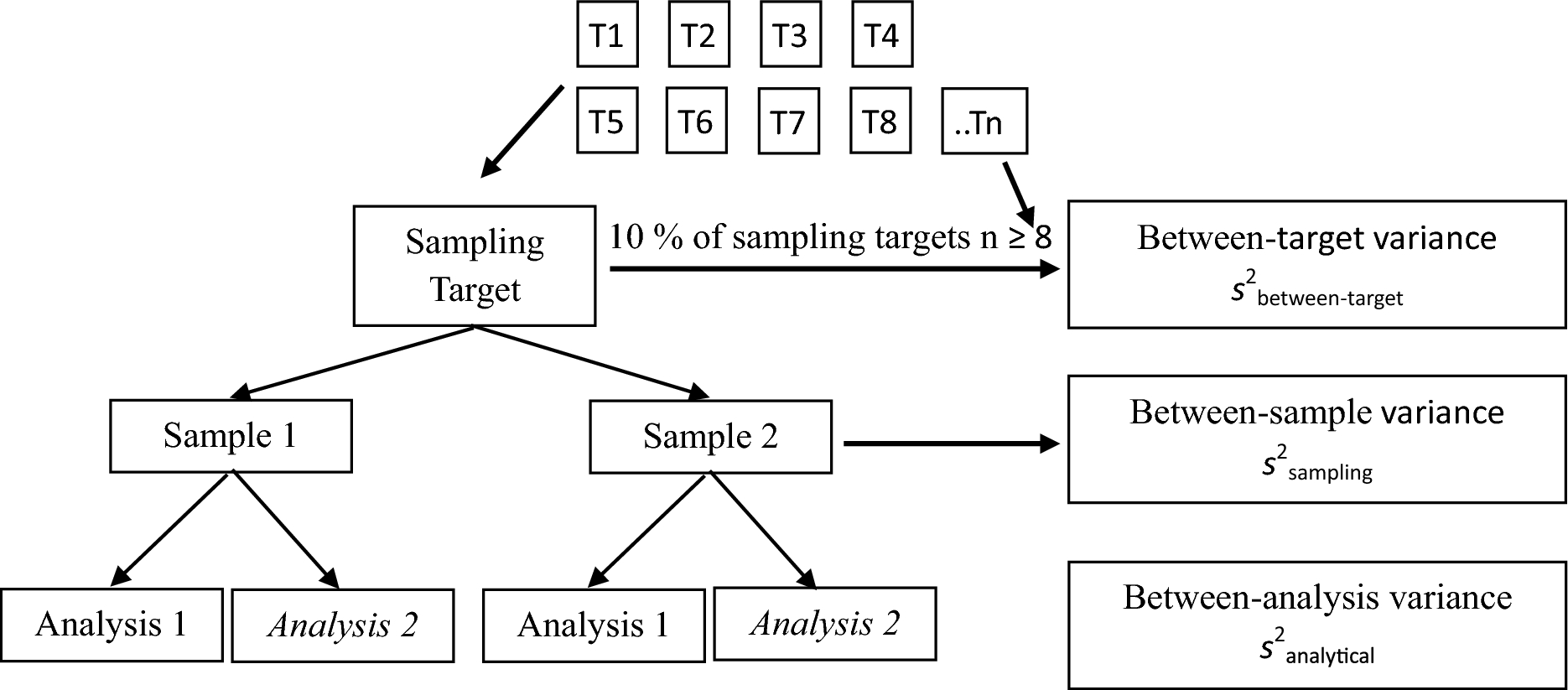

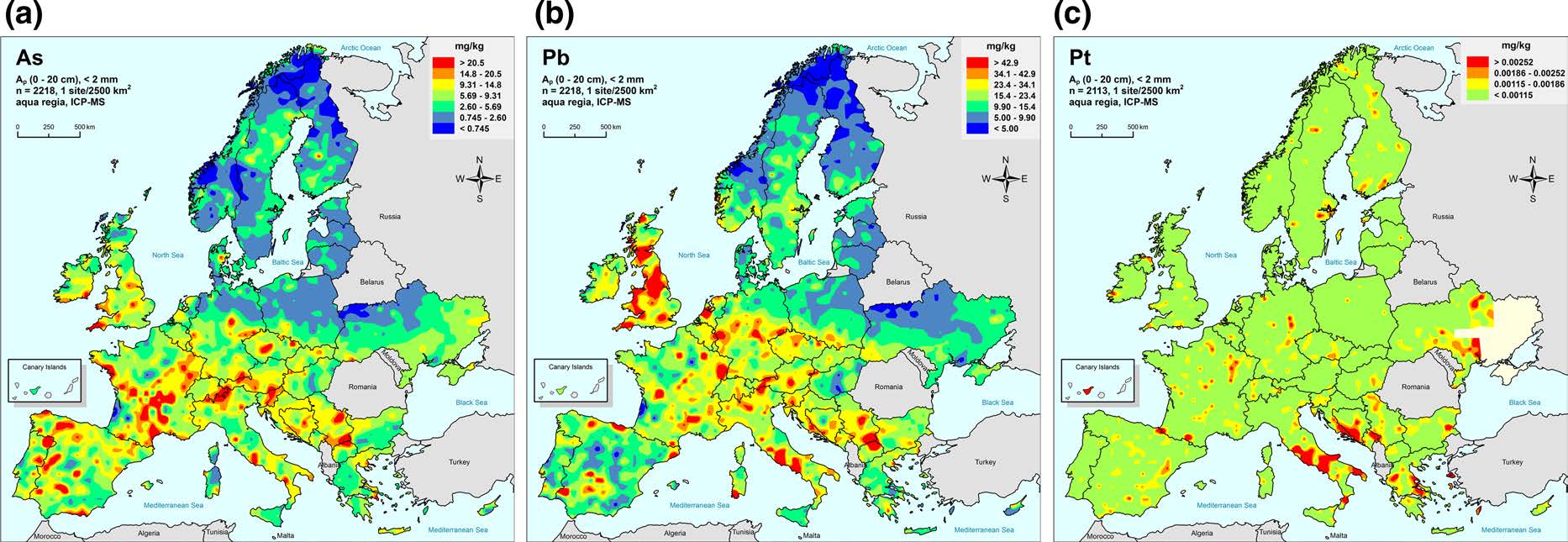
Uncertainty of measurement values (MU) is crucial to their reliable geochemical interpretation. MU can be estimated using the Duplicate Method, which requires the taking of a small proportion of duplicated samples, and can be applied at any spatial scale. The distance between the duplicated samples is selected to reflect the effect of analyte heterogeneity on the measurement result (i.e. estimated concentration) within each sampling target, at the particular scale of investigation. Three published case studies, at different spatial scales, are used to explain how the Duplicate Method can be applied to estimate MU. They also illustrate how MU can be used to improve geochemical interpretation and validate measurement procedures (that include sampling) by judging their fitness for purpose. At the kilometre scale, measurements from the GEMAS survey of agricultural soils across Europe are used to estimate their MU for the first time. The MU for 53 elements range from an uncertainty factor of 1.01 to over 10. The MU contributes more that 20% to the total variance for 8 of the 53 elements, showing that the measurement procedure was not fit for purpose in those cases.
At the micron scale, measurements of oxygen isotopes in candidate quartz reference materials had MU that was dominated by its sampling component, caused by sometimes unacceptable heterogeneity. A third case study of Pb in soils at 12 UK sites showed that the Duplicate Method can also be used to quantify the heterogeneity (as factor 1.03 to 2.4), and that it can indicate different possible sources of an element.

Follow the Topic
-
Environmental Geochemistry and Health
This journal publishes original research papers and review papers across the broad field of environmental geochemistry. It aims to establish and explain links between the natural or disturbed chemical composition of the earth’s surface and the health of the ecosystem, animals and people.

Related Collections
With Collections, you can get published faster and increase your visibility.
Environmental Radiochemistry and Health: Advances in Monitoring, Risk Assessment, and Remediation Strategies
This Special Issue focuses on environmental applications and implications of radiochemistry and nuclear chemistry, emphasizing research that advances our understanding of radioactivity in the environment and provides practical solutions for environmental protection and human health. We welcome original research articles, comprehensive reviews, and case studies that contribute novel insights or practical applications to the field.
The scope encompasses six interconnected research areas that collectively address the full spectrum of environmental radiochemistry challenges, from detection and monitoring through risk assessment to remediation and long-term management. Monitoring and analytical innovation forms the foundation of environmental radiochemistry. We seek contributions on advanced analytical techniques for radionuclide detection, quantification, and speciation, as well as developments in environmental radioactivity monitoring systems and networks. Research on biomonitoring approaches, radionuclide uptake in ecosystems, and novel sensor technologies including real-time radiation detection methods will be particularly valuable for improving our capacity to track and understand radioactivity in the environment.
Understanding environmental behavior and assessing risks requires comprehensive knowledge of how radionuclides move through and interact with environmental systems. Contributions addressing the fate, transport, and transformation of radionuclides in soil, water, and air are welcome, as are studies on radioecology and radionuclide cycling in terrestrial and aquatic ecosystems. Research on risk assessment methodologies, long-term environmental impact studies of nuclear facilities and legacy sites, and investigations of radionuclide bioavailability and transfer in food chains will strengthen our ability to predict and manage environmental risks. Remediation and waste management represent critical practical challenges requiring innovative solutions. We encourage submissions on innovative remediation technologies for radioactively contaminated sites, radioactive waste treatment, conditioning, and disposal strategies, and decommissioning technologies with environmental restoration approaches. Studies on advanced materials—including nanomaterials, biosorbents, and polymers—for radionuclide removal, as well as both in-situ and ex-situ treatment methods, will contribute to more effective and sustainable management practices.
Nuclear safety and emergency preparedness ensure rapid and effective response to radiological events. Research on environmental monitoring protocols during radiological emergencies, predictive modeling of radionuclide dispersion and environmental fate, and post-accident environmental assessment and recovery strategies is essential. Contributions on rapid screening and early warning systems will enhance our capacity to protect public health and the environment during nuclear emergencies. Sustainable nuclear technologies address the environmental dimensions of current and future nuclear energy systems. We welcome studies on environmental aspects of advanced nuclear reactor designs and fuel cycles, life cycle assessment of nuclear energy systems, and strategies for minimizing the environmental footprint of nuclear operations. Research examining environmental considerations in nuclear facility design and operation will support the development of more sustainable nuclear technologies. Natural radioactivity presents ongoing challenges distinct from anthropogenic sources. Contributions on natural radionuclides in the environment and their health implications, technologically enhanced naturally occurring radioactive materials (TENORM), and radon and its progeny in indoor and outdoor environments will provide valuable insights into these widespread but often overlooked exposure sources.
This Special Issue particularly values interdisciplinary research that integrates radiochemistry with related fields such as geochemistry, environmental microbiology, ecology, and environmental engineering. Studies combining multiple approaches—analytical, modeling, experimental, and field-based—will provide the most comprehensive insights. We accept original research articles presenting novel findings, comprehensive reviews synthesizing current knowledge and identifying future directions, critical perspectives challenging existing paradigms, and case studies demonstrating practical applications of radiochemistry to real-world environmental problems.
Authors are encouraged to emphasize the practical implications of their work for environmental protection, human health, and sustainable nuclear technology development.
Publishing Model: Hybrid
Deadline: Nov 30, 2026
Advanced Nanointerfaces for Monitoring and Mitigation of Emerging Organic Pollutants
This Special Issue focuses on recent advances in monitoring and mitigation of EOCs and EDCs in environmental systems. It highlights nano-enabled sensors, advanced functional materials such as MOFs, and sustainable remediation strategies. Importance is focused on interdisciplinary approaches that enhance detection sensitivity, degradation efficiency, and the translation of laboratory innovations into real-world environmental applications.
- Emerging Contaminants and Transformation Products: Studies addressing the detection, fate, and toxicity of emerging contaminants and their transformation byproducts, including intermediate species formed during degradation of EDCs and pharmaceuticals.
- Hybrid and Composite Materials for Remediation: Research on multifunctional hybrid systems (e.g., MOF-derived materials, nanocomposites, biohybrids) that integrate adsorption, catalysis, and separation for enhanced remediation performance.
- Photocatalytic and Electrocatalytic Processes: Advances in light-driven and electrochemical technologies for efficient degradation of emerging EOCs and EDCs under environmentally relevant conditions.
- Artificial Intelligence and Data-Driven Environmental Monitoring: Application of machine learning, big data analytics, and predictive modeling for contaminant detection, source tracking, and optimization of remediation strategies.
- Sustainable Remediation Approaches: Development of eco-friendly, low-energy, and resource-efficient technologies, including biodegradable materials, solar-driven systems, and nature-based solutions.
By addressing these themes, the Special Issue will provide a comprehensive overview of the recent advances in monitoring and mitigating EOCs and EDCs, fostering interdisciplinary collaboration and enabling the development of sustainable and effective solutions to critical environmental challenges.
Publishing Model: Hybrid
Deadline: Dec 31, 2026