Ethical AI: A Double Misnomer
Published in Social Sciences and Philosophy & Religion



Lets start with "intelligence." Natural intelligence carries billions of years of evolutionary refinement behind it. A child recognizes her mother's face from a handful of exposures, infers intention from a half-smile, balances grief against hope while deciding whether to forgive. Octopuses solve novel puzzles with neurons distributed through their arms. Forests coordinate nutrient exchange through fungal networks that some biologists now describe as intelligent in their own register. Natural intelligence is embodied, contextual, relational, and stitched through with consequence: the organism that misjudges a predator does not get a second training run.
Artificial intelligence performs something narrower and, within its narrowness, genuinely remarkable: statistical pattern extraction across enormous datasets, optimization toward an objective function specified by engineers, prediction calibrated through gradient descent. The achievement deserves recognition on its own terms. Borrowing the word "intelligence" to describe it does the achievement no favors. The borrowed word implies awareness, intention, the felt weight of a decision. None of these accompany a transformer model predicting the next token. Each time a chatbot earns the label "intelligent," the word stretches a little further from what gave it meaning in the first place, and grows a little thinner in the stretching.
The Second Misnomer: Ethics
Then comes "ethical," the half of the phrase doing the heavier lifting.
Ethics names a capacity: the capacity to weigh competing goods, to anticipate harm, to choose against self-interest when conscience demands it, and to answer for the choice afterward. A scalpel carries no capacity for ethical judgment of its own. A loan-approval algorithm weighs nothing resembling a family's circumstances against institutional risk tolerance; it returns a number shaped entirely by the data fed into it and the threshold someone set for approval. The algorithm holds no stake in the outcome, no capacity for remorse, no tomorrow in which the consequence of today's decision will visit it.
Where Responsibility Smoothly Relocates
Attaching "ethical" to the tool performs a quiet relocation. Responsibility that belongs with the data scientist who selected training examples, the product manager who chose deployment context, the executive who signed off on release timelines, and the regulator who wrote — or failed to write — the governing rule migrates instead into the artifact. The artifact becomes the locus of moral evaluation. The humans who built, trained, and shipped it recede into the background, shielded by a phrase that suggests the hard ethical work has already been done, certified, boxed, and shipped alongside the product.
This relocation carries practical consequences well beyond semantics. Institutions adopt "Ethical AI principles" as a governance milestone, publish the document, hold the launch event, and treat the underlying accountability question as settled. Procurement teams ask vendors whether their AI is "ethical" rather than asking who audited the training data, who can be held liable for a discriminatory outcome, and what recourse exists for the person harmed by a system's error. The phrase functions as an institutional alibi, pointing a finger at the tool so that no finger need point at a person.
Asking Better Questions
The corrective requires precision rather than complexity. Algorithmic systems deserve evaluation on engineering terms: accuracy, robustness, the demographic composition of training data, failure modes under distribution shift. Human conduct surrounding those systems deserves a separate evaluation on ethical terms: whether the people designing, deploying, and governing the system act with diligence, transparency, and genuine accountability toward those affected by its outputs. Collapsing both evaluations into a single adjective buries the second one inside the first, precisely where institutions might prefer it to stay buried.
A more exacting vocabulary asks different questions. Who selected this training data, and what populations does it underrepresent? Who defined the objective function, and what tradeoffs did that definition encode? Who decided this system was ready for deployment, and on what evidence? Who bears liability when the system causes harm, and through what mechanism can the harmed party seek remedy? Each question points toward a person with a name, a title, and an institutional address. None can be answered by interrogating the algorithm.
Toward Double Literacy
Navigating this terrain well requires fluency in two registers at once: enough grounding in how natural intelligence actually works to resist over-attributing mind to machines, paired with enough grounding in how algorithmic systems actually work to pose the engineering questions with precision. Call this pairing Double Literacy — Human Literacy and Algorithmic Literacy, developed together, each sharpening the other. A research community, a ministry, or a workforce fluent in both registers redirects its scrutiny toward the humans behind a given system, examining whether they act with diligence, transparency, and accountability.
Language shapes governance more than committees tend to admit. A phrase that misnames its subject and misplaces its verdict will, given enough repetition, misdirect the remedy too. "Ethical AI" deserves retirement, not as a rhetorical flourish but as a matter of institutional hygiene. What should replace it carries less comfort and considerably more accuracy: ethical governance of algorithmic systems, designed, trained, tested, and deployed by people who remain answerable for every one of those verbs.
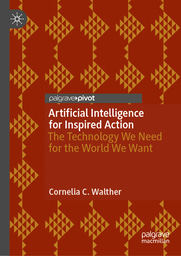
The new book looks at these questions in more detail. https://link.springer.com/book/9783032062772

Dr. Cornelia C. Walther is a humanitarian leader with 20+ years at the UN, driving social change. She pioneers research on hybrid intelligence and ProSocial AI through the global POZE alliance to build ‘Agency amid AI for All.’ Cornelia is a professor at Sunway University in Malaysia and works with the United Nations in Morocco on national blueprints for ProSocial AI. She is a contributor on Forbes, Psychology Today and CIGI online; as well as a senior fellow at the Wharton School, the Harvard Learning and Innovation Lab, the Center for International Governance Innovation and an advisor at the European Policy Center. Her new book is looking at AI4IA - Artificial Intelligence for Inspired Action.