European Public Health Week 2026: Why defining advocacy matters (and why we almost took it for granted)
Published in Social Sciences


In health and public health, advocacy is one of those words that feels immediately familiar.
It appears everywhere: in conversations about health equity, patient engagement, professional responsibility, policy change, and community action. It is present in institutional strategies, training frameworks, and everyday professional language. It is widely treated as something essential, almost self-evident.
And yet, as European Public Health Week 2026 invites us to reflect on how health systems can become more equitable, participatory, and responsive, a fundamental question becomes harder to ignore: do we really share a clear understanding of what advocacy means?
When we began working on this paper, we thought we did. But the more we explored the literature, the less certain we became.
That realization was not immediate. At first, advocacy seemed like a stable concept - widely used, broadly understood. But as we started examining the literature more systematically, a different picture emerged. Advocacy was not only central to many discussions in healthcare and public health; it was also surprisingly underdefined.
This tension - between importance and ambiguity - became the starting point of our study.
A simple question that turned out to be complex
We began with what seemed like a straightforward question:
What do we actually mean when we talk about advocacy in public health and healthcare?
This was not just a conceptual curiosity. It had very practical implications. Across many contexts, advocacy is increasingly expected - from health professionals, patient representatives, community leaders, and civil society actors. It is often described as a core competence, a professional duty, or even an ethical imperative.
But if something is expected, it should also be clear enough to be supported, taught, and evaluated.
Otherwise, it risks remaining a powerful but vague idea - something we all agree is important, but struggle to translate into practice.
Looking across disciplines and practices
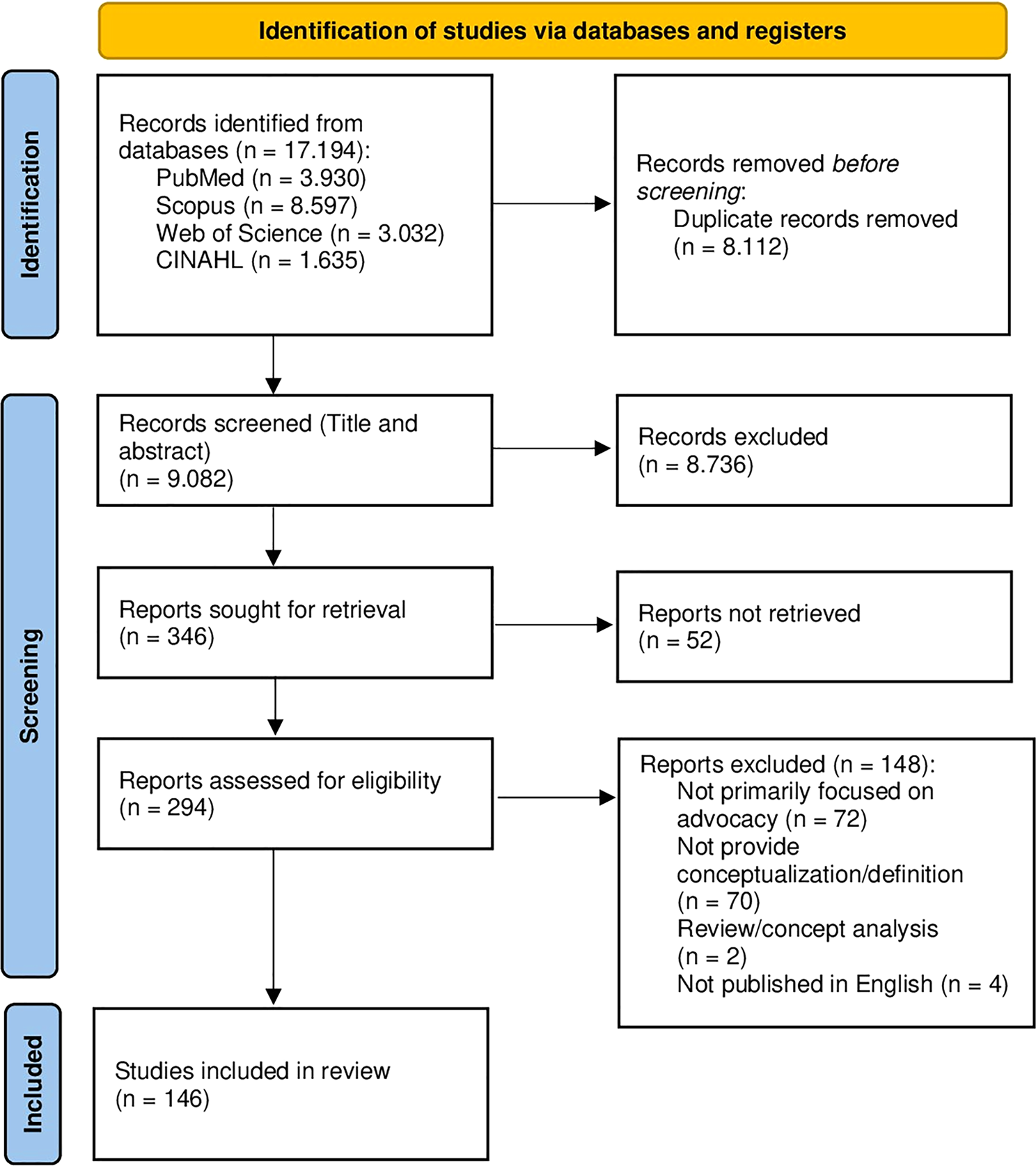
To explore this issue, we conducted a scoping review across multiple domains, including healthcare, public health, education, and social and policy research.
Rather than focusing on a single profession or type of action, we deliberately took a broad perspective. Advocacy is not confined to one role or setting, and we wanted to reflect that diversity. In total, we included 146 documents.
What we found was both reassuring and challenging.
A shared vision - at least in principle
On one level, the literature was remarkably consistent.
Across different contexts, advocacy was closely associated with values such as equity, social justice, participation, and systemic change. It was rarely described as simply helping individuals navigate services. More often, it was framed as something broader: a way to address structural barriers, amplify marginalized voices, influence institutions, and connect lived experiences with decision-making processes.
In that sense, there was a strong shared vision. Advocacy was presented as a necessary component of more inclusive and responsive health systems.
But many meanings, many roles, many practices
At the same time, however, this coherence did not extend to definitions or operational models.
Advocacy could mean many different things: supporting individual patients, mobilizing communities, engaging in policy processes, initiating legal action, working with the media, or contributing to education and awareness.
It could be carried out by healthcare professionals, patient groups, community actors, or organizations. It could take place at the bedside, in local communities, or at national and international policy levels.
This diversity is not a problem in itself. On the contrary, it reflects the richness and adaptability of advocacy.
But it also creates a challenge.
When a single term is used to describe such a wide range of activities, without sufficient conceptual clarity, it becomes difficult to build shared expectations. What does advocacy actually require? What are its boundaries? What should it achieve?
These questions are not always explicitly addressed.
The missing piece: how do we evaluate advocacy?
This lack of clarity became even more evident when we looked at evaluation.
Although advocacy is widely recognized as important, very few studies reported concrete ways to assess it. Only a small minority of the papers we included referred to specific measurement tools - and none of these was standardized.
In many cases, advocacy seemed to function as a normative concept: something that should matter, rather than something that is systematically examined.
For us, this was one of the most striking findings.
It suggests that while advocacy has gained visibility and legitimacy, the methodological tools needed to support it have not developed at the same pace.
Growing expectations, uneven foundations
This gap becomes particularly relevant in the current context.
Health systems are increasingly called to be more participatory, more inclusive, and more responsive. There is growing emphasis on patient involvement, community engagement, and equity-oriented approaches.
Advocacy is often positioned at the heart of these transformations.
And yet, the infrastructures that would allow advocacy to be practiced, supported, and evaluated in a consistent way remain uneven. Expectations are rising, but the conceptual and methodological foundations are still fragmented.
From mapping to proposing a way forward
Our goal, therefore, was not only to map how advocacy is described in the literature, but also to contribute to a more structured conversation about its future.
Based on our findings, we developed a preliminary framework for equity-oriented public health advocacy. This framework brings together several interconnected dimensions:
- a clear normative grounding in values such as equity and justice
- a multilevel perspective that connects individual, community, and systemic action
- attention to relational and communicative practices
- the development of critical and systemic literacy
- a form of professionalism that includes reflexivity and civic agency
- and, importantly, mechanisms for evaluation and accountability
We do not present this as a definitive model. Rather, it is a starting point—a way to make the concept of advocacy more explicit, more discussable, and more operational.
Beyond “speaking up”
One of the risks we identified is reducing advocacy to a generic idea of “speaking up.”
While voice is certainly important, advocacy is more complex than that.
It involves navigating relationships, understanding systems, interpreting contexts, and connecting individual or collective experiences with broader institutional change. It requires not only motivation, but also knowledge, skills, and supportive environments.
If these dimensions remain implicit, advocacy may continue to be celebrated in principle while under-supported in practice.
A shared space between professions and society
Another important insight from our review is that advocacy does not belong to a single group.
It is not only the responsibility of individual professionals, nor is it confined to formal institutions. It exists at the intersection of professional roles, civic action, and public accountability.
This is precisely why defining it more clearly matters.
Clarification is not about limiting advocacy, but about making it more visible, more teachable, and more sustainable.
A final reflection
As a scoping review, our study does not resolve all the ambiguities surrounding advocacy. Nor should it. Different contexts will always call for different forms of action.
But if there is one message we hope readers will take away, it is this:
Advocacy has become too important to remain conceptually vague.
Defining it more carefully is not just an academic exercise. It is part of building health systems that are more equitable, more accountable, and more connected to the realities of the people they serve.
And perhaps, in the end, that is what advocacy is really about.
Follow the Topic
Introducing: Social Science Matters
Social Science Matters is a campaign from the team at Palgrave Macmillan that aims to increase the visibility and impact of the social sciences
Continue reading announcement



Please sign in or register for FREE
If you are a registered user on Research Communities by Springer Nature, please sign in