Every Body, But Not Every System: Where Sexual Health Infrastructure Is Failing
Published in Microbiology, General & Internal Medicine, and Public Health
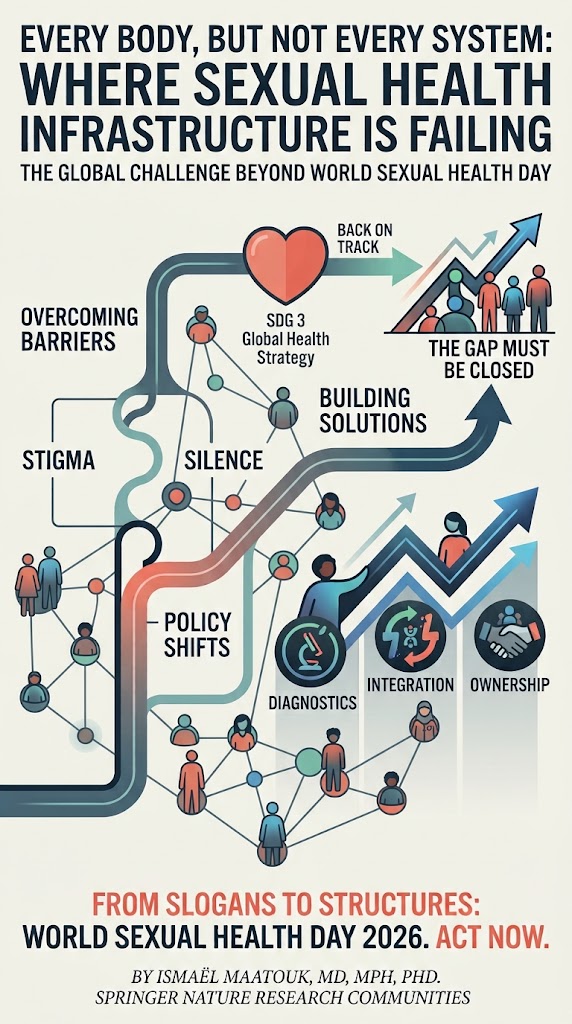


World Sexual Health Day 2026 carries a theme that sounds inclusive: "Every Body." Five dimensions follow from it: the personal, the relational, the institutional, the cultural, and the political. The first two depend on the last three. And it is the last three that are now under direct threat.
When I was at WHO headquarters, I coordinated the development of the WHO Consolidated Operational Handbook on Sexually Transmitted Infections, released in February 2026. The handbook brings together, for the first time, all WHO normative and operational guidance on STI prevention, diagnosis, treatment, surveillance, and service delivery published between 2016 and 2025. It exists because the global STI response has never matched the scale of the problem. More than one million new curable STIs are acquired every day. Syphilis infections rose to an estimated eight million globally in 2022, with about 700,000 cases of congenital syphilis. These numbers are not new. The failure to act on them is not new either.
The systems we built are not enough
The WHO Global Health Sector Strategy on STIs sets a target: reduce gonorrhoea and syphilis infections by 90% by 2030 (SDG 3). Most countries are not on track. Many have no national STI strategy at all. Those that do often lack the budget, the workforce, or the political will to put it into operation.
Start with diagnostics. Most low- and middle-income countries still use syndromic management. Clinicians treat symptoms without a confirmed pathogen. Point-of-care tests for syphilis exist but reach only a fraction of the population that needs them. For Mycoplasma genitalium, a pathogen with macrolide resistance above 60% in parts of Europe, most clinics cannot test at all. The operational handbook introduces the STI prevention and care cascade as a framework to map where people fall out of the system. In most settings, they fall out early.
Then look at services. STI care, HIV treatment, and sexual and reproductive health remain separate in most countries. Patients move between departments that do not share records, referrals, or accountability. The handbook provides package-based guidance to integrate these services within primary health care. But integration needs a national decision, national financing, and national ownership. External donors cannot build it. Countries must.
Stigma and silence are structural failures, not cultural inevitabilities
STIs remain taboo in nearly every setting, including the most advanced. Patients delay care because of shame. Clinicians avoid sexual history-taking because they lack training or comfort. Public health campaigns on STIs are rare compared to those on diabetes, cancer, or even HIV. Advocacy is weak because few political leaders will attach their name to a sexually transmitted infection.
This silence has a cost. Without public pressure, STI programmes stay underfunded. Without advocacy, national STI responses stay low on the political agenda. Without open conversation, the populations most affected (sex workers, men who have sex with men, adolescents, people in conflict settings) remain invisible to the systems that are supposed to serve them.
"Every Body" cannot be a theme for one day in September if the rest of the year these bodies do not appear in national health budgets, training curricula, or parliamentary debates.
When policy environments shift, health systems pay the price
Sexual health infrastructure is shaped by policy decisions that often happen far from clinics. When foreign assistance decreases, HIV and STI service sites close. A Lancet analysis of 133 countries found that two decades of global health programming prevented 91.8 million deaths. The same analysis projects 14 million additional deaths by 2030 if current funding reductions continue. In Pakistan, 331 children were infected with HIV at a single hospital through reused needles. These are failures of financing, governance, and oversight.
Vaccine programmes face similar pressures. When immunization policy follows political debate rather than scientific evidence, coverage drops. The history of vaccine programme disruptions across multiple countries shows how quickly public trust, once lost, takes a generation to rebuild.
The populations that carry the cost are always the same: women, children, sex workers, men who have sex with men, people in conflict zones, people in poverty. Sexual health does not exist in isolation from these broader policy shifts. Every disruption in global health financing or evidence-based decision-making reaches STI services, often first.
What "Every Body" demands
If the WSHD 2026 theme is more than a slogan, it must translate into structural demands. Countries must own their national STI responses with domestic financing, not depend on external donors whose priorities shift. Surveillance systems must detect resistance before it becomes untreatable. Diagnostic capacity must reach beyond referral hospitals. Vaccine programmes must follow scientific evidence. Service models must integrate STI, HIV, and reproductive health care so that patients do not fall between them. Training pipelines must produce providers who can meet patients without judgment.
The SDG 3 targets on STIs are five years away. Most countries will not meet them. The question is whether we will name the reasons (underfunding, stigma, weak advocacy, fragile national ownership) or continue to write declarations that no system is built to deliver.
On September 4, World Sexual Health Day asks us to close that gap. The operational handbook exists. The evidence exists. What remains is the institutional will to act on them.
Ismaël Maatouk, MD, MPH, PhD, is a Professor of Dermatology and STIs at the University of Balamand (Lebanon), and a global sexual health physician. He is an Editorial Board member of BMC Global and Public Health.
Follow the Topic
-
BMC Global and Public Health
An open access, transparent peer review journal publishing outstanding and influential research and opinion of broad interest to all professional communities involved in global and public health research, policy-making, implementation and delivery worldwide.

Related Collections
With Collections, you can get published faster and increase your visibility.
Environmental exposure, maternal health and child health
BMC Global and Public Health is pleased to announce a call for papers for our upcoming collection entitled Environmental exposure, maternal health and child health, guest edited by Dr. Nuria Güil from the Barcelona Institute for Global Health, Spain, Dr. Pengfei Guo from University of South Carolina, USA and Dr. Wei Li from Yale University, USA. The aim of the collection is to capture global efforts and novel approaches in this multi-disciplinary area. Maternal and child health is a substantial domain of global public health, with outcomes that shape individual well-being and societal development. Pregnancy and early life are periods of heightened biological sensitivity, during which exposures exert lasting effects. Complications such as hypertensive disorders, gestational diabetes, and perinatal mental health challenges, as well as birth and child outcomes including preterm birth, growth restriction, and neurodevelopmental impairment, highlight the need for continued research and intervention to reduce risks and promote health equity.
Environmental exposures are increasingly recognized as critical and modifiable determinants of maternal and child health. Adverse exposures such as ambient air pollution, environmental tobacco or cannabis smoke, contaminated water, pesticides, endocrine disruptors, heavy metals, noise, light pollution, natural disasters, and other emerging pollutants contribute to reproductive and developmental risks, often acting in mixtures and interacting with social or neighborhood determinants. At the same time, positive environmental influences such as access to clean air and water, green space, safe housing, and supportive community environments, have been shown to promote healthier pregnancies, enhance child neurodevelopment, and reduce stress for families. Advancing knowledge of both harmful and protective pathways is essential for developing effective interventions, guiding policy, and addressing environmental challenges that threaten maternal and child health.
We are now inviting the submission of manuscripts of outstanding interest covering the breadth of multi-disciplinary studies, ranging from observational to interventional that are focused on the effect of environmental exposure on maternal and child health. We envision this work to inform future research, conceptual frameworks, intervention development, and policy advancement.
Sample foci of papers include:
- Epidemiological studies on environmental exposures (e.g., air pollutants, per- and polyfluoroalkyl substances, pesticides, heavy metals, plastics, greenspace, noise, climate-related hazards) and maternal, fetal, and child health outcomes
- Environmental tobacco or cannabis secondhand smoke exposure and postpartum physical and mental health on maternal and child health (e.g., postpartum depression and anxiety, maternal sleep and recovery, breastfeeding outcomes, infant respiratory illness and neurodevelopment)
- Population-level insights into contextual pathways and disparities (e.g., social determinants, neighborhood environment, climate vulnerability) that influence reproductive, perinatal, and developmental health outcomes
- Policy, intervention, and prevention strategies to reduce environmental risks and improve maternal and child health globally
- Interactions between environmental exposures and social determinants of health
- Novel data collection/assessment tools (e.g., mixture, exposome, or omics approaches)
This Collection supports and amplifies research related to SDG 3: Good Health and Well-being.
We encourage work from local, regional and global partnerships and collaboration among scientists from multi-disciplinary fields and using multiple methodologies. We ask that authors be attentive to the use of non-stigmatizing/preferred language in their manuscripts as outlined in relevant language guidelines for their respective fields.
All manuscripts submitted to this journal, including those submitted to collections and special issues, are assessed in line with our editorial policies and the journal’s peer-review process. Reviewers and editors are required to declare competing interests and can be excluded from the peer review process if a competing interest exists.
Publishing Model: Open Access
Deadline: Oct 30, 2026
Strategies for reducing cross-border health challenges
BMC Global and Public Health is calling for submissions to our Collection on strategies for reducing cross-border health challenges. This Collection aims to address the pressing need for innovative, collaborative solutions to health issues that transcend national boundaries, such as infectious disease outbreaks, migration-related health disparities, and the global impact of climate change on health systems.
The aim of this Collection is to explore the multifaceted nature of cross-border health challenges and to identify actionable strategies that promote health equity and resilience. Potential topics include the role of international partnerships, data sharing, and policy harmonization in managing health crises. Submissions addressing technological innovations, public health interventions, or socio-political frameworks to tackle these global issues are highly encouraged.
Our goal is to foster a deeper understanding of how interconnected health systems and collaborative actions can reduce the burden of cross-border health challenges. We invite submissions on the following subtopics:
Strengthening health system resilience in response to transnational disease outbreaks.
Addressing health disparities among migrant and refugee populations.
The impact of climate change on cross-border health challenges.
Leveraging technology and big data to enhance global health surveillance and response.
Policy frameworks for improving international health collaboration.
Case studies of successful cross-border public health initiatives.
By focusing on scalable and sustainable solutions, this Collection seeks to advance knowledge and inform practice in tackling health challenges that require coordinated global action.
We encourage work from local, regional, national, and global partnerships and collaboration among multidisciplinary scientists using multiple methodologies. We ask that authors be careful to use non-stigmatizing/preferred language in their manuscripts as outlined in relevant language guidelines for their respective fields.
This Collection supports and amplifies research related to SDG 3: Good Health and Well-being, SDG 5: Gender Equality, and SDG 10: Reduced Inequalities.
All manuscripts submitted to this journal, including those submitted to collections and special issues, are assessed in line with our editorial policies and the journal’s peer-review process. Reviewers and editors are required to declare competing interests and can be excluded from the peer review process if a competing interest exists.
Publishing Model: Open Access
Deadline: Sep 29, 2026



Please sign in or register for FREE
If you are a registered user on Research Communities by Springer Nature, please sign in