Experimental and numerical analysis of outdoor PM2.5 in indoor microenvironments using the indoor air quality and inhalation exposure (IAQX) model
Published in Social Sciences, Earth & Environment, and Sustainability

1. Title and Objectives
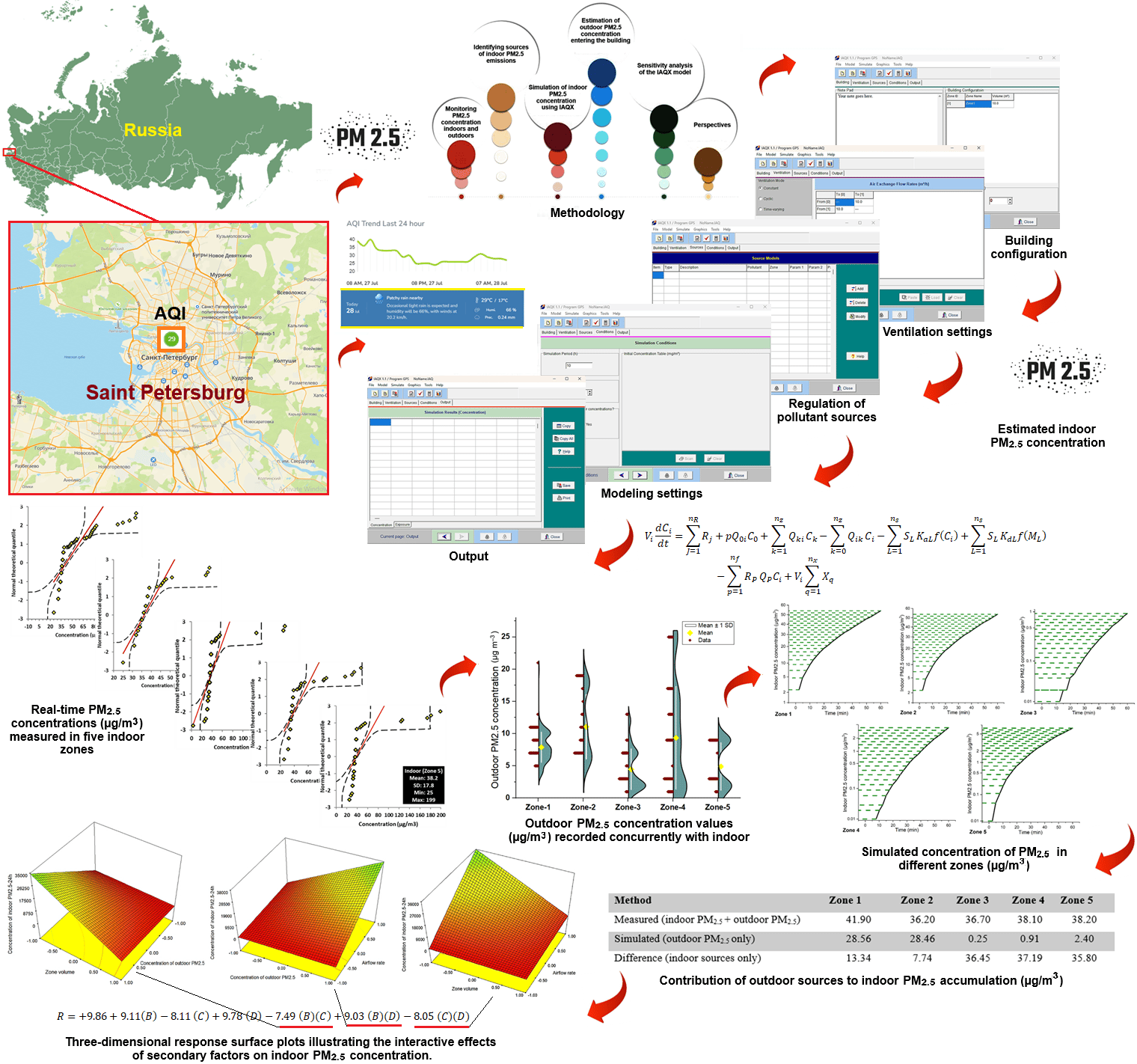
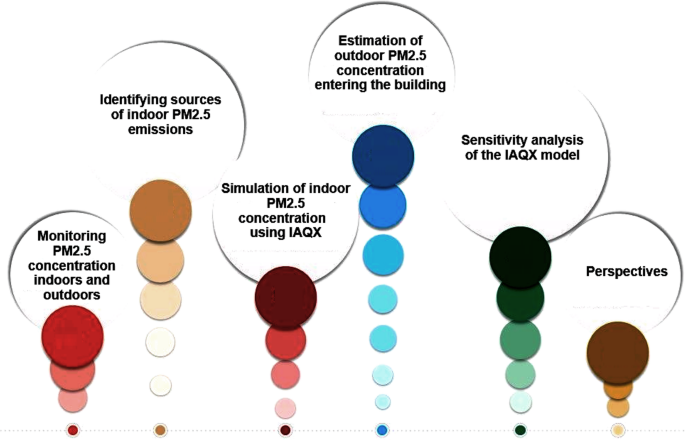
The study investigates the infiltration of outdoor fine particulate matter (PM2.5) into indoor environments using the IAQX (Indoor Air Quality and Inhalation Exposure) model. The case study is a naturally ventilated student dormitory in Saint Petersburg, Russia, housing approximately 1,500 students. The research has four primary goals:
To measure real-time indoor PM2.5 concentrations across five distinct zones (rooms, kitchen, bathroom, WC).
To obtain outdoor PM2.5 data from the SILAM atmospheric chemistry model and use it as input for the IAQX model.
To simulate the contribution of outdoor PM2.5 to indoor levels and estimate the outdoor-to-indoor infiltration factor.
To conduct a comprehensive sensitivity analysis using polynomial regression to determine which parameters (airflow rate, zone volume, outdoor concentration, sink area, and infiltration factor) most significantly influence indoor PM2.5 levels.
2. Literature Review
The review traces the evolution of Indoor Air Quality (IAQ) models over the past decades, highlighting a transition from simple analytical and semi-empirical approaches to highly sophisticated numerical frameworks.
Early Semi-Empirical Models: Foundational studies (e.g., Dunn, 1987; Clausen, 1993) focused on mass transfer theory to predict emissions of volatile organic compounds (VOCs) and formaldehyde from building materials like caulk, paint, and particleboard. For instance, Hoetjer and Koerts developed a model linking formaldehyde concentration to ventilation rate and load factor, showing the importance of material properties and air exchange.
Sink and Source Interactions: The review emphasizes that estimating emissions alone is insufficient because indoor surfaces (walls, floors, furniture) act as sinks that absorb and later re-emit pollutants. Therefore, models must account for adsorption and desorption dynamics.
Modern IAQ Tools: The USEPA developed a suite of models, including the Well-Mixed Box Model (WMBM), i-SVOC, IAQX, and IECCU. For multi-zone simulation, CONTAM and Computational Fluid Dynamics (CFD) are used. While CFD offers high spatial resolution, it demands enormous computational resources, limiting real-time applications. The IAQX model strikes a balance by providing time-dependent, multi-zone predictions with low computational cost, making it suitable for practical assessments.
Research Gap: The review identifies a critical gap: most prior IAQX applications (e.g., McCready et al., 2012, assessing formaldehyde exposure from washing machines) have focused almost exclusively on indoor emission sources. The contribution of outdoor pollution and the interaction of outdoor PM2.5 with building ventilation have not been systematically quantified. Additionally, comprehensive sensitivity analyses of IAQX input parameters have been largely overlooked, leaving model uncertainty inadequately addressed.
3. Methodology
The study employs a hybrid experimental-numerical approach, structured as follows:
Study Site and Climate: The dormitory is located in Saint Petersburg, which has a humid continental climate. The study was conducted in summer 2023, when residents rely heavily on natural ventilation (opening windows) due to warm temperatures (indoor average ~29∘ C, outdoor ~18∘ C).
Building Characteristics: The building lacks mechanical ventilation. Air exchange occurs solely through infiltration via window gaps, door cracks, and wall pores. Five zones were defined: Zone 1 (Room 1), Zone 2 (Room 2), Zone 3 (Bathroom), Zone 4 (Toilet/WC), and Zone 5 (Kitchen).
Indoor Measurements: A portable laser-scattering sensor (Plantower PMS5003) was used to measure PM2.5 at 1.5 m height, logging data at 5-second intervals. The average measured indoor concentration across all zones was 38.20 μg/m3.
Outdoor Data: Outdoor PM2.5 concentrations were not measured on-site but were retrieved from the Ventusky platform, which integrates data from the SILAM (System for Integrated modelling of Atmospheric coMposition) Eulerian chemical transport model. SILAM incorporates emission inventories, aerosol chemistry, and data assimilation (e.g., 3D/4D-Var) to provide regional background concentrations. The average outdoor level during the study was 7.08" " μg/m3.
IAQX Configuration: The model was configured with the GPS (General-Purpose Simulation) module. It used the RKF45 numerical integration method to solve mass balance equations. Airflow rates between zones were calculated using the Gross and Haberman gap flow method, based on pressure differences and gap dimensions (e.g., window gap: 1.33×0.10 m; door gap: 0.80×0.02 m).
Sensitivity Analysis Design: A Central Composite Design (CCD) was implemented, generating 32 hypothetical scenarios. Five independent variables were varied at two coded levels (-1 and +1):
(A) Infiltration factor (0.56 to 0.99)
(B) Outdoor PM2.5 concentration (1 to 25 μg/m3)
(C) Zone volume (3.88 to 39.84 m3)
(D) Airflow rate (2.39 to 580.53 m3/h)
(E) Sink area (0 to 3.66 m2)
Polynomial regression models (Linear, 2FI, Cubic) were fitted to the data, and ANOVA was used to identify significant main and interaction effects
4. Results
Measured vs. Simulated Concentrations: The average measured indoor concentration was 38.20 μg/m3, significantly exceeding the WHO daily guideline (15μg/m3) and annual guideline (5 μg/m3). The outdoor average was 7.08 μg/m3, resulting in an Indoor-to-Outdoor (I/O) ratio of 5.39, indicating that indoor sources were the dominant contributors overall.
Outdoor Contribution by Zone: The IAQX simulation estimated the contribution of outdoor PM2.5 alone. Zones 1 and 2 (rooms with direct window exposure) had the highest outdoor contributions (28.56 and 28.46 μg/m3, respectively). In contrast, Zones 3, 4, and 5 had much lower outdoor contributions (0.25 to 2.40 μg/m3). The difference between measured total and simulated outdoor contribution was attributed to indoor sources (e.g., cooking in the kitchen, bathing in the bathroom, and unauthorized smoking in the WC).
Sensitivity Analysis Findings: The ANOVA for the selected 2FI (Two-Factor Interaction) model revealed that the overall model was highly significant (p<0.0001). The most influential single factor was Airflow rate (D) with a coefficient of +9.78 (p<0.0001), followed by Outdoor concentration (B) (+9.11) and Zone volume (C) (-8.11). Sink area (E) and infiltration factor (A) were not statistically significant in the final model.
Significant Interactions: Three interaction effects were statistically significant:
Outdoor concentration × Zone volume (p=0.0010)
Outdoor concentration × Airflow rate (p=0.0001)
Zone volume × Airflow rate (p=0.0005)
Boundary-case scenarios (e.g., small volume, high outdoor PM2.5, high airflow) produced extremely high simulated concentrations (e.g., 87,970 μg/m3), illustrating the amplifying effect of these combined factors.
5. Discussion
Dominance of Indoor Sources: The high I/O ratio (5.39) confirms that indoor activities are the primary drivers of PM2.5 exposure in this dormitory. However, the IAQX model revealed that zones with direct outdoor connectivity (Zones 1 & 2) are highly susceptible to ambient pollution infiltration. This aligns with previous studies (e.g., Lu et al., 2020; Han et al., 2015) showing that I/O ratios vary widely depending on building design, ventilation type, and occupant behavior.
Role of Airflow Rate: The sensitivity analysis highlights that airflow rate is the double-edged sword of IAQ. In clean outdoor conditions, higher airflow dilutes indoor pollutants. However, when outdoor air is polluted (as in Scenarios 25 and 30), increased ventilation acts as a conveyor of outdoor particles into the indoor environment, dramatically raising indoor concentrations. This underscores the critical need for filtration in naturally ventilated buildings located in urban areas.
Negligible Role of Sink Area: The sink area (deposition surfaces) showed no significant effect on indoor PM2.5 concentrations across the scenarios. This suggests that, given the high ventilation rates and continuous source activities, the deposition of particles onto surfaces is a secondary mechanism compared to advection (airflow) and direct emission.
Comparison with Literature: The findings are consistent with Chen and Zhao (2011), who emphasized that ventilation rate is the primary determinant of indoor particle concentrations. Morawska et al. (2017) similarly identified air exchange rate as a critical factor in naturally ventilated buildings. The study also contextualizes the results within broader urban climate studies (Wang et al., 2025; Zhang et al., 2024), noting that large-scale factors like urban heat islands and ventilation corridors can indirectly influence indoor pollutant dynamics.
Discrepancy between Measured and Modeled Data: A notable difference exists between the measured total indoor PM2.5 and the modeled outdoor-only contribution. This discrepancy arises because the IAQX simulation did not explicitly include occupant-related indoor emission sources (e.g., cooking, resuspension, smoking) as input parameters. Therefore, the modeled results represent the minimum baseline contribution from outdoor air, not the absolute indoor concentration.
6. Conclusion
Key Findings
The average indoor PM2.5 concentration exceeded WHO guidelines by a substantial margin. While indoor sources were the dominant overall contributors, outdoor infiltration significantly affected specific zones with direct window access. The IAQX model successfully quantified outdoor contributions, but its outputs must be interpreted with caution as they exclude indoor emission sources.
Most Influential Parameter: Airflow rate was identified as the most critical parameter governing indoor PM2.5 levels. This variable interacts strongly with outdoor concentrations and zone volume, meaning ventilation strategies must be adapted to ambient air quality.
Practical Recommendations: In naturally ventilated, high-occupancy urban residences, controlling airflow is essential. Strategies should include:
Managing window-opening behavior based on real-time outdoor pollution levels.
Installing supplementary filtration (e.g., portable HEPA air cleaners) to treat incoming air.
Considering hybrid ventilation systems that switch to mechanical filtration during high-pollution episodes.
Limitations: The study is limited to a single building type and summer season. Outdoor data were model-derived rather than co-located ground measurements, introducing some uncertainty.
Future Research Directions: The authors suggest extending this framework across different seasons, deploying real-time sensor networks, evaluating specific intervention strategies (e.g., air purifiers), and applying the methodology to various building typologies and climatic regions to enhance generalizability. The broader implication is that integrated, evidence-based IAQ management is vital for protecting public health, especially in vulnerable populations like students.

Follow the Topic
-
Air Quality, Atmosphere & Health
This is a multidisciplinary journal focusing on atmospheric consequences of human activities and their implications for human and ecological health.

What are SDG Topics?
An introduction to Sustainable Development Goals (SDGs) Topics and their role in highlighting sustainable development research.
Continue reading announcement