Extreme heatwaves and ocean biology
Published in Earth & Environment


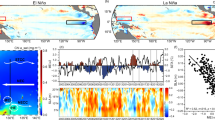

Does phytoplankton care about marine heatwaves?
This paper is part II in a series of studies motivated by understanding how phytoplankton ecology is changing in response to marine heatwaves.
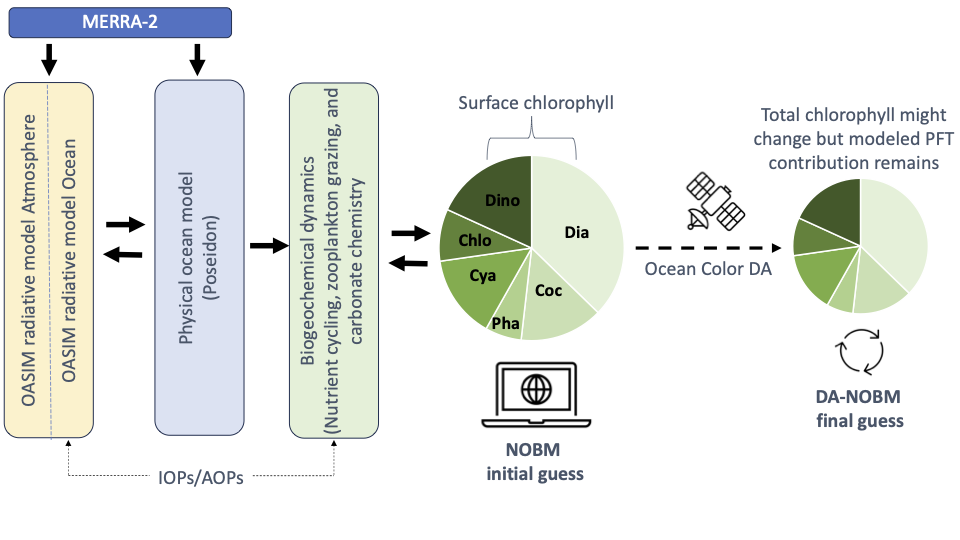
In part I, we investigated changes in total phytoplankton (chlorophyll) biomass and across different phytoplankton groups under severe heatwaves that affected the Pacific Ocean in the last decade (2010s). We used ocean satellite data to inform a biogeochemical ocean model that describes how changes in environmental conditions alter the chemistry and biology of the ocean. By combining ("assimilating") satellite data with the model, we improve the accuracy of the model and make sure that our numerical simulations are consistent with observations obtained from satellite remote sensing. This helps the model to "behave" closer to reality (Figure 1).
What did we find in Part I?
Our biogeochemical model includes six different phytoplankton groups. Each of these groups can be thought of as different "species", with varying sizes, division rates, nutritional requirements, etc. We analyzed how these groups changed in four different regions of the Pacific Ocean affected by marine heatwaves between 2013 and 2020. While changes in bulk chlorophyll were observed in all regions, only the central equatorial Pacific (Niño 3.4 region) showed drastic changes in phytoplankton community composition (Figure 2). Here, we saw a near total decline in diatoms during the extreme 2016 El Niño heatwave. Diatoms are a highly productive phytoplankton group, fixing and driving large amounts of organic carbon from the surface to deep ocean. A major decline in the concentration of diatoms would also represent and strong weakening in the vertical export of oceanic carbon. Investigating and verifying this alteration in carbon export flux in the central equatorial Pacific is what drove our study in part II.
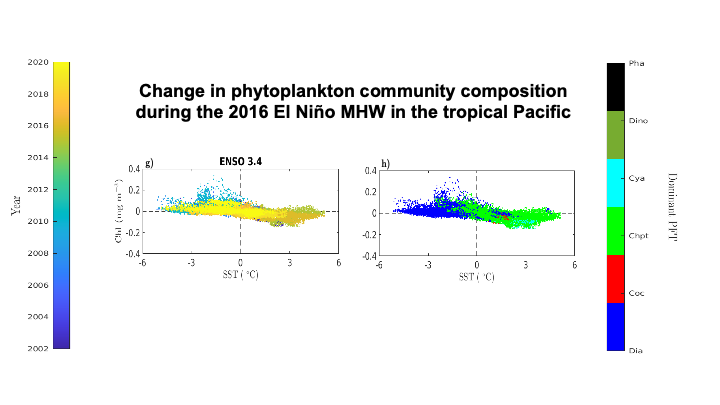
Figure 2. Change in phytoplankton community composition in relation to temperature and chlorophyll anomalies in the central equatorial Pacific (El Niño 3.4 region) between 2002-2020. Diatoms dominate in high chlorophyll-cold temperature conditions, while chlorophytes dominate in low chlorophyll-warm temperature waters. Results are obtained from the NASA Ocean Biogeochemical Model (NOBM), which assimilates satellite ocean color data. Figure adapted from Arteaga and Rousseaux (Commun. Biol. 6, 2023).
Part II - Verifying the weakening in carbon export and respiration
In part II, we combined satellite and model-based output on carbon biomass and fluxes, with reconstructions of particle backscatter (a proxy for particle concentration) and dissolved oxygen in the interior of the ocean obtained from the application machine-learning algorithms to BGC-Argo float and ship data. We found that in the central equatorial Pacific region, carbon export and ecosystem respiration were strongly diminished during the 2016 El Niño heatwave. This is the same region (Niño 3.4) where we saw a strong decline in diatoms during the same period in our ecological simulation in part I.
Overall, there is a strong connection between anomalies in vertical export carbon flux, net ecosystem respiration, and sea surface temperature driven by El Niño Southern Oscillation (ENSO) cycles. The extreme 2016 El Niño accentuates the decline in biogenic carbon flux, with a reduction of - 50 % in export and - 30 % in inferred respiration (Figure 3).
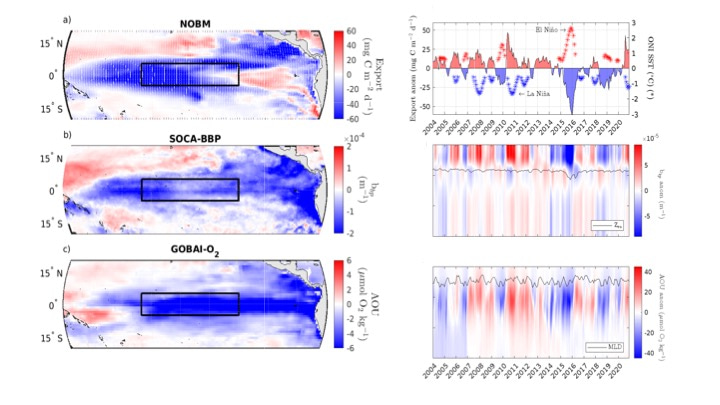
Figure 3. Left panels show anomalies in modeled export flux (NOBM, a), particle backscatter (bbp) (SOCA-BBP, b), and apparent oxygen utilization (AOU) (GOBAI-O2, c) averaged between November 2015 – March 2016. Right panels show corresponding anomalies in export, bbp, and AOU in relation to ENSO cycles (top panel)
The impact of phytoplankton community composition on carbon export
Living phytoplankton may sink to depth, but the estimated primary sinking pathway is the settling of detritus particles, which includes dead and fecal material from phytoplankton and zooplankton . The grazing diet of zooplankton is a major determinant of the detritus composition in the ecosystem model.
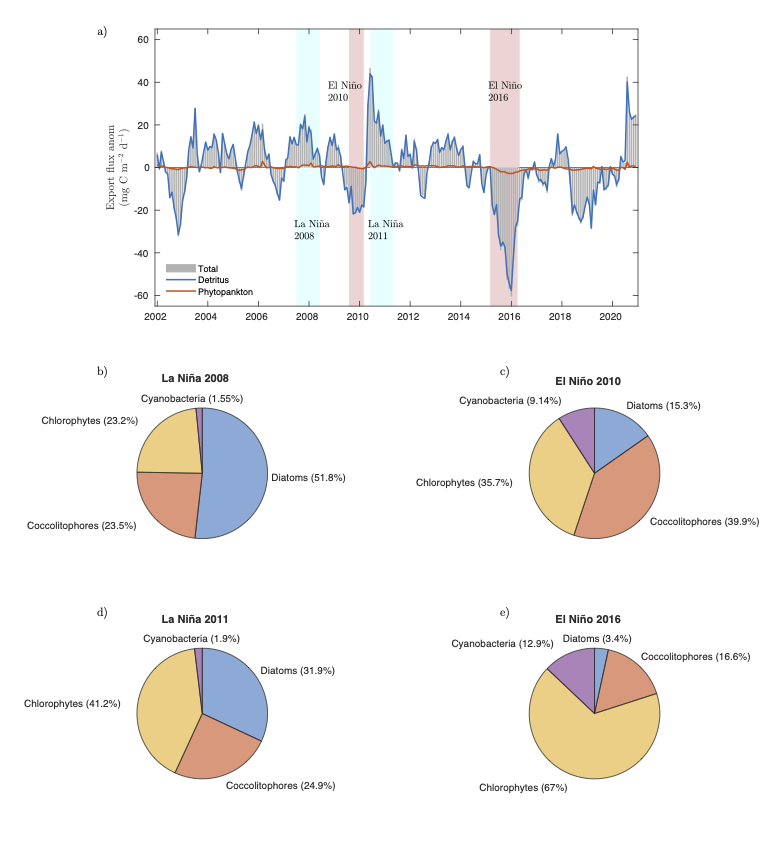
During the two strongest La Niña events of the 21st century to date, 2008 and 2011, the anomaly in export production was positive and had a maximum interannual deviation of > (+) 40 mg C m−2 d−1 in 2011. For these two events, diatoms had a relatively high carbon contribution to the total phytoplankton biomass grazed of 52 % in 2008 , and 32 % in 2011 , while cyanobacteria represented a very small fraction of 1.6 % (2008) and 2 % (2011).
In contrast, the two strongest El Niño to date, 2010 and 2016, triggered low export anomalies, with the largest interannual decline being lower than (-) 50 mg C m−2 d−1 in 2016 . In 2010, the grazed diatom fraction was 15 %, considerably lower than during La Niña phase and closer to the grazed cyanobacteria fraction of 9 %. During the 2016 MHW, grazing of diatoms declined drastically to only 3 % of the total phytoplankton consumed by zooplankton, while cyanobacteria (and chlorophytes) showed a contribution of 13 % (67 %), relatively high with respect to the other acute ENSO events (Figure 4).
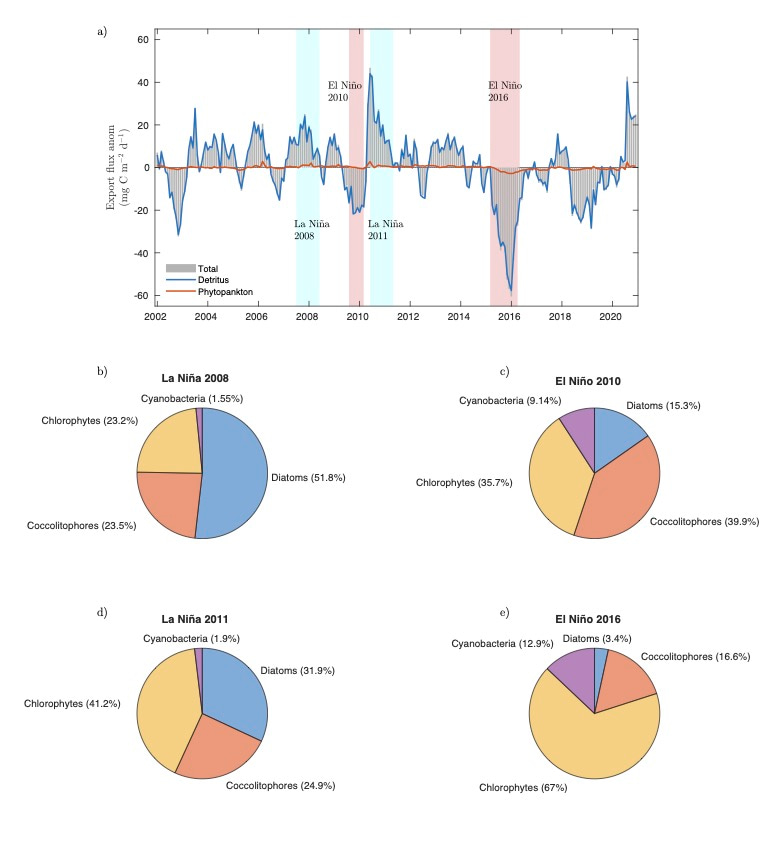
Figure 4: (a) Time series of monthly anomalies in modeled carbon export decomposed for detritus (blue line) and living phytoplankton (orange line). Total export flux is indicated by the grey bars. (b-e) Modeled grazing allocation of phytoplankton exported via detritus for (b) La Niña 2008, (c) El Niño 2010, (d) La Niña 2011, and (e) El Niño 2016. Marked changes in modeled phytoplankton functional types (PFTs) are reflected in the particulate organic matter sinking via the downward detritus flux. In strong La Niña episodes, diatoms represent a large fraction (30 to 50 %) of the total sinking detritus (Fig. 4b and d). This contribution collapsed during the 2016 El Niño heatwave to only 3 % (Fig 4e).
Preparing for the next mega El Niño
Our results highlight major biogeochemical changes affecting the Pacific Ocean during the strongest El Niño recorded in this century (2016). Ten years later, seasonal prediction systems are forecasting another massive El Niño event for 2026. Close attention should be payed to what the ecological consequences of this potential mega El Niño on the equatorial Pacific. Furthermore, our results highlight the need to include ocean biogeochemistry in seasonal prediction systems.

Follow the Topic
-
Communications Earth & Environment

An open access journal from Nature Portfolio that publishes high-quality research, reviews and commentary in the Earth, environmental and planetary sciences.
Related Collections
With Collections, you can get published faster and increase your visibility.
Climate extremes and water-food systems
Publishing Model: Open Access
Deadline: May 31, 2026
Drought
Publishing Model: Hybrid
Deadline: Jun 30, 2026
Please sign in or register for FREE
If you are a registered user on Research Communities by Springer Nature, please sign in