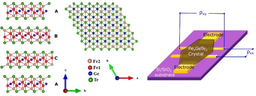
Ferromagnetic Resonance Spectroscopy on the Kagome Magnet MgMn6Sn6

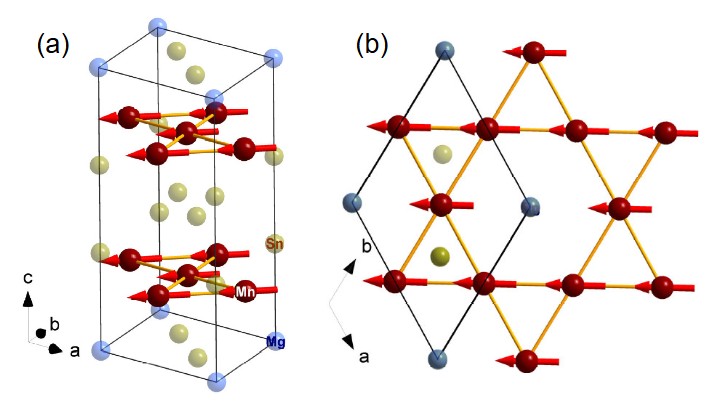
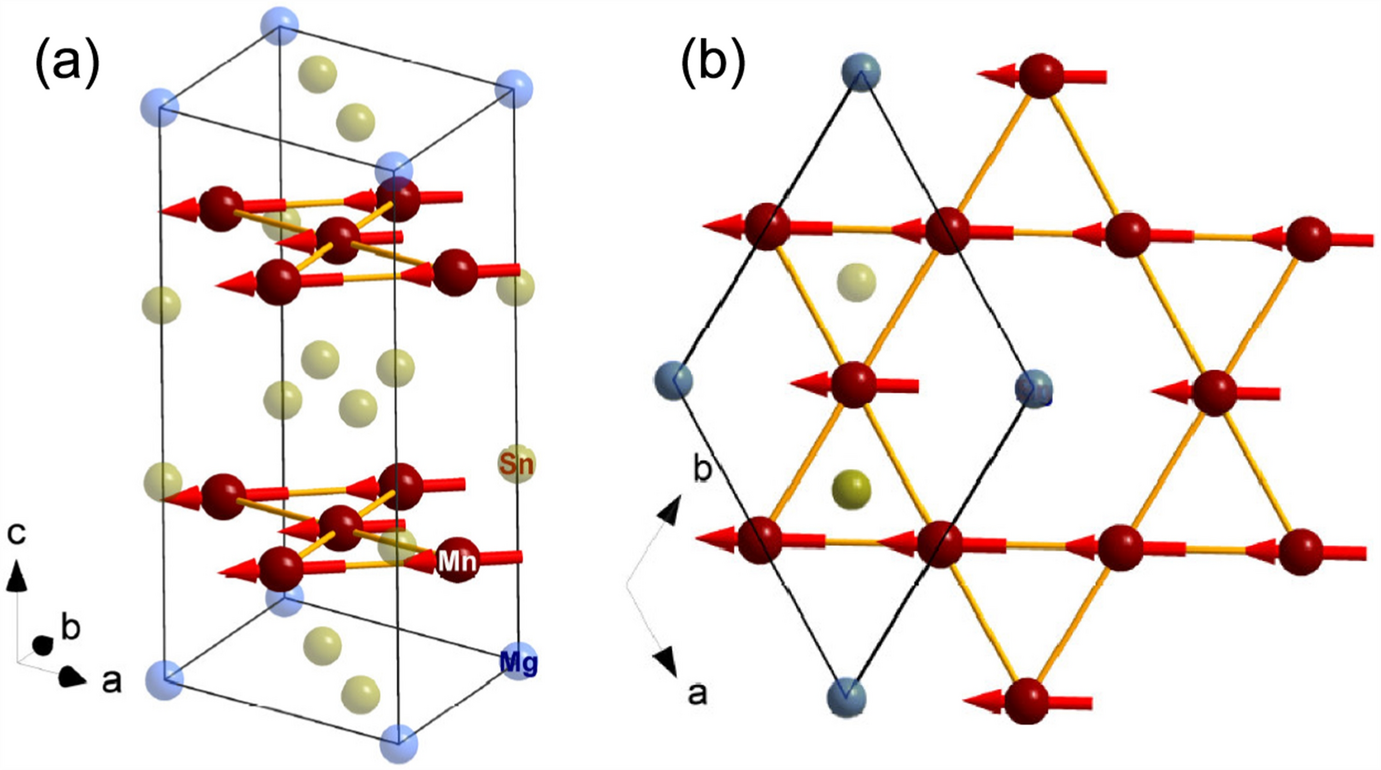

MgMn6Sn6 is the itinerant ferromagnet on the kagome lattice with high ordering temperature featuring complex electronic properties due to the nontrivial topological electronic band structure, where the spin-orbit coupling (SOC) plays a crucial role.
Here, we report a detailed ferromagnetic resonance (FMR) spectroscopic study of MgMn6Sn6 aimed to elucidate and quantify the intrinsic magnetocrystalline anisotropy that is responsible for the alignment of the Mn magnetic moments in the kagome plane. By analyzing the frequency, magnetic field, and temperature dependences of the FMR modes, we have quantified the magnetocrystalline anisotropy energy density that reaches the value of approximately 3.5×10⁶ erg/cm3 at T = 3 K and reduces to about 1×10⁶ erg/cm3 at T = 300 K.
The revealed significantly strong magnetic anisotropy suggests a sizable contribution of the orbital magnetic moment to the spin magnetic moment of Mn, supporting the scenario of the essential role of SOC for the nontrivial electronic properties of MgMn6Sn6.
Paper details: R. Pal et al., Ferromagnetic Resonance Spectroscopy on the Kagome Magnet MgMn6Sn6. Appl Magn Reson (2025).
Paper link: https://doi.org/10.1007/s00723-025-01806-8
arXiv link: https://doi.org/10.48550/arXiv.2510.10356
Follow the Topic
-
Applied Magnetic Resonance
A peer-reviewed journal focusing on the application of magnetic resonance methodology across multiple fields

Related Collections
With Collections, you can get published faster and increase your visibility.
MDMR2026: Advances in Magnetic Resonance and Its New Applications
More than 80 years have passed since the discovery of paramagnetic resonance by E.K. Zavoisky in 1944, but EPR-based methods continue to develop and are widely used in various fields of science and industrial research. Later, in 1946, American scientists E.M. Purcell and F. Bloch discovered the phenomenon of nuclear magnetic resonance, which also became a powerful tool for studying the properties of compounds. This special issue welcomes articles that demonstrate both achievements and new examples of the successful applications of these methods in chemistry and biology, studies of strongly correlated electron structures, low-dimensional and nano-systems, defects and spin qubits and other systems.
Publishing Model: Hybrid
Deadline: Dec 31, 2026
Brian Hoffman - on the occasion of his 85th birthday
This special issue is devoted to Professor Brian M. Hoffman, Northwestern University, on the occasion of his 85th birthday. It aims to recognize the many contributions of Prof. Hoffman to EPR spectroscopy in bioinorganic chemistry and inorganic chemistry in general. Topics covered include, but are not limited to: advanced experimental or theoretical techniques in EPR, applications of EPR and related techniques to biochemistry, metallo- and radical enzymes, and structural biology applications in materials science, as well as spin chemistry and relevant applications, for example in molecular magnetism, high-spin organic, or stable radical chemistry.
Publishing Model: Hybrid
Deadline: Nov 25, 2026